




Dedicated to the 45th anniversary of the world premiere of the musical “Cats”
The concept of the “mega-musical” is associated with the name of Andrew Lloyd Webber—the world’s most famous contemporary composer in musical theatre.
His spectacular musicals —such as Cats, The Phantom of the Opera, Starlight Express, Evita, and others—impress audiences like no other and rank among the most popular works of musical theatre from the late 20th and early 21st centuries.
The essence of the innovations introduced in Lloyd Webber’s musicals lay in putting set design, costumes, choreography, and special effects on the same level as the music. Special emphasis was placed on special effects; indeed, spectators will never forget the chandelier and the underground lake from The Phantom of the Opera, the grand staircase in Sunset Boulevard, or the tracks for locomotives and train cars in Starlight Express. Mega-musicals prioritize spectacular scenography, incorporating elements that range from simple details to truly breathtaking visual spectacles.
If one had to name the single driving creative force behind the emergence of this genre in the late twentieth century, it would be producer Cameron Mackintosh. His collaboration with Andrew Lloyd Webber on Cats in 1981 effectively expanded the boundaries of musical theatre, initiating a transformation toward the contemporary musical theatre style.
Thanks to the talent of Cameron Mackintosh—who possesses a rare theatrical vision that enables the fusion of auditory and visual elements—mega-musicals are now a vital part of musical theatre culture. Their narratives are characterized by romanticism and a socio-political message, combining themes of human suffering and redemption with issues of social significance.
When music, drama, dance, lavish costumes, set designs, and special effects combine, the message conveyed becomes particularly powerful.
Grizabella, the aging cat from the musical “Cats”—much like the Phantom, Norma, Jesus, Evita, and Rusty the Steam Engine—has earned a place among the most renowned characters in musical theatre. They are superstars “created and elevated to that status by Webber’s music and his colorful imagination,” as Andy Warhol once described them.
The libretto is based on the poems by the Nobel Prize laureate T.S. Eliot—”Old Possum’s Book of Practical Cats”. Trevor Nunn and Richard Stilgoe crafted a story from them in which the worthiest Jellicle Cat must undergo the “Jellicle Choice” to ascend to the Heaviside Layer (a feline paradise) and be reborn into a new life.
Grizabella—an elderly, frail cat and a clear outsider—ultimately wins the competition and ascends to the Heaviside Layer. The plot unfolds as a parade of diverse feline characters, whose distinct traits are highlighted through musical numbers spanning contrasting styles; each character possesses a signature musical theme tailored to their specific type.
“Memory,” one of the show’s signature songs, is a sentimental ballad brilliantly performed by singers including Elaine Paige, Sarah Brightman, and Barbra Streisand. A diverse blend of musical styles, a quest for new life symbolized by a spotlight, the transformation of the stage and auditorium into a junkyard, and a dancing chorus of cats—forming a fully realized, distinct community—come together to create a unique, unparalleled new world on stage. This is yet another hallmark of Webber’s musicals: whether depicting the world of the Paris Opera (The Phantom of the Opera), the railway (Starlight Express), or a feline clan, the setting always feels authentic.

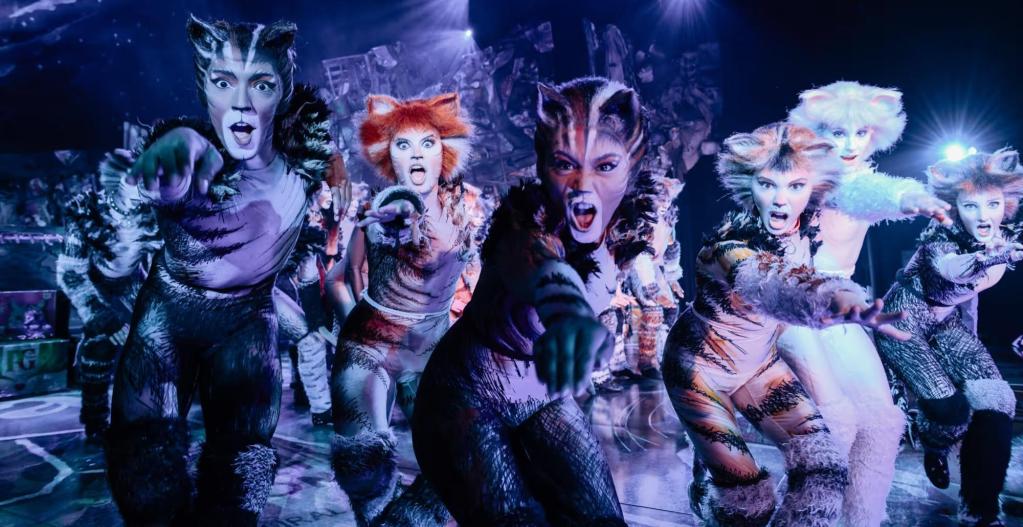
Cats the Musical, Ensemble/ Capitol Theatre in Düsseldorf, Germany/ Photo Credit by Alessandro Pinna
The original version of the musical was directed by Trevor Nunn, together with Gillian Lynne, who also choreographed the show. In the musical “Cats,” dance has become the primary artistic means of conveying the plot. Every scene and every number of the musical is accompanied by a dance. Every character has their own nature and style. In addition to representing many genres and expressive means inherent in opera and operetta, classical ballet and modern dance, rock, pop, jazz, etc., dance in general and ensemble scenes in particular, as well as unique dramatic physicality, are given a significant role in this musical. The whimsical but organic feline physicality goes well with the overall very specific choreography, outlining the creators’ dialogue with classical ballet. The viewer can determine a character’s traits from the costume, physicality, and musical style.
This flamboyant, beautiful variety, which functions like a magic kaleidoscope, creates a unified image of the Jellicle Cats— who lure us into their own world. The choreographer’s innovative work was duly recognized; the musical was awarded the highest honor – three Tony Awards (Best Musical, Best Book of a Musical, Best Original Score). But the biggest prize it won was the inexhaustible and undying love and recognition of the audience.
Grizabella is the main protagonist of the musical “Cats.” We had the wonderful opportunity to speak with the actress who originated the role on Broadway—American actress and singer Betty Buckley.

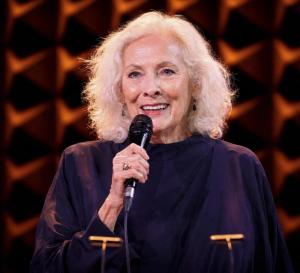
Betty Buckley / Photo Credit by Nicole Wilson
Lisa Monde: Your creative path led you to Cats the Musical! Back in 1982, you originated the role of Grizabella the glamour cat.
Betty Buckley: Cats was a life-changing experience. I had a goal of becoming a better actress and bringing a level of truth-telling to musical theatre. It wasn’t the standard back then. Musical theatre used to be called musical comedy, and it has evolved a lot since then…
LM: Do you remember your audition? Did you believe you would get the part?
ВВ: I auditioned for Cats, and the casting director told my agent, “No, she’s not right for the part – she radiates health and well-being. We’re looking for someone petite. The great Elaine Paige, who originated the role in London, was petite…” They said they needed someone who radiated death and dying. I had a very strong feeling about the role. I said to my agent, “They’ll be back.” Six months later, my agent called and said they wanted to see me again for Cats. I went in for my callback and sang Memory three times, and each time Trevor Nunn, the brilliant director, would tell me: “More suicidal, more suicidal…”
The last time I sang it, I felt I had turned myself inside out. He still seemed to be hesitant, so I said, “Mr. Nunn, could I talk to you?” and he came down to the edge of the stage, and I said, “You’ve been auditioning for this role for a while…”
LM: Many celebrities wanted the chance to play Grizabella, isn’t that right?
ВВ: Yes, Cher, for example… They’d auditioned for six months. They saw everybody in New York and Los Angeles. Then we were down to these last callbacks, and I said: “Surely, you’ve seen everyone who is conceivably right for this role, and there are several women out there who can do this job as well as I can. But the truth is, nobody can do it better, and it’s my turn!” I felt like such an idiot. The audition pianist and the stage manager both gave me a thumbs up, and the stage manager said, “Betty, sometimes we have to represent ourselves.” A couple of hours later, my agent called and said I got the part.
LM: What was the rehearsal process like?
ВВ: That rehearsal process was singular. The creative team was amazing! The director, Trevor Nunn, is a genius. We did a lot of ensemble work, during which Trevor led us through a month of improvisational theatre games based on the Grotowski acting improvisations. It was extraordinary.
My job assignment was to “stop the show.” But it wasn’t quite working just yet…. Memory was the key song. They started calling special rehearsals for me. In one rehearsal, Trevor Nunn told me the entire story of Shakespeare’s The Winter’s Tale. I was clinging to every word, trying to figure out how it all applied to me as Grizabella. During another rehearsal, the composer, Andrew Lloyd Webber, played “Memory” for me and had me sing it over and over again. Andrew told me Placido Domingo saw the show and said to him: “Tell the girl to just sing the song!” I thought – “I am just singing the song!” I was so confused, so I called my brilliant voice teacher, Paul Gavert.
LM: Was Paul able to help you? How did you discover Grizabella’s voice and her as the character?
ВВ: We were rehearsing the show at the Winter Garden Theatre during previews and performing at night. So I went to Paul’s place during a lunch break; he threw a pillow on the floor and said, “Hit this pillow.” I had my doubts that the kinetic exercises would work at that point, but he insisted. So, I hit the pillow and started sobbing; suddenly, this little girl’s voice came out of me: “I’m here too! I’m here too!” And I realized that the only person I had neglected to consult about how she wanted to play Grizabella was the little kid inside me. So, I started listening to my inner self, and that consciousness took me out to the streets of New York and had me follow homeless women. I started seeing this connection: the women’s eyes were the same as mine; I was the same age as many of them; it was quite transforming. Then one morning, I was coming out of my apartment building, on my way to rehearsal, and this beautiful, unhoused woman crossed my path… We were just starting to become aware of the problem of homelessness in 1982. And Trevor Nunn was very political. He was concerned about the phenomenon of homelessness, and Grizabella was a representative of this. Every character in the musical Cats represented a cultural metaphor of our society. So, I knew that was my job, but I didn’t have the rest of the information about who these people really were.
LM: So, this unhoused woman became the inspiration for Grizabella? And thus, the intended metaphor became embodied in the show?


Betty Buckley as Grizabella from Cats the Musical/ Broadway, 1982/ Photo Credit by John Napier
ВВ: There was this beautiful woman; she was dressed quite like Grizabella’s costume, with this moonlit wild hair and this pasty makeup, red smeared lipstick… She walked with such grace and dignity. And we had this connection; I was really startled by it. I felt like her communication to me was: “I see you; I know you see me… I’d like to stay and talk, but I don’t have time, and neither do you. So maybe some other time…” And she just floated off down the street. I was so moved by this encounter. I felt like I met Grizabella in real life.
LM: This is an amazing story and one of the best examples of how a musical theatre artist can work on a role!
ВВ: Then, exactly two nights later, outside the stage door of the Winter Garden Theatre, I was coming out after the performance, and another woman quite like the first was floating down the street with all this same beauty, grace, and dignity. She looked me in the eye, and that was the moment when I realized I knew what to do. I had been meditating intensely for guidance, and it became clear that I was receiving it. It took me about two weeks before we opened to figure out how to apply all these details to my journey, which was tightly choreographed and very specific. I felt like I was in transition and needed time. I walked out on the stage one night, and the whole thing just came together. When I finished the song, there was a breathless silence from the audience, and then people went crazy. When I came off stage, Trevor Nunn said: “That’s it, that’s what I was talking about!” It was very interesting to me because ultimately what I ended up playing was almost the exact opposite of everything I’ve been directed to do. I learned that Trevor had been describing the result of what needed to happen and what I had to do to feel the emotional condition to facilitate that result, but it doesn’t work to play a result. It was a big lesson for me.
I was extremely grateful to be able to play that role and to be part of the whole journey. I think of Cats as my master’s thesis. It was a big year for me. The film “Tender Mercies” came out the same year. It was like stepping through the door of my potential as an actress and singer.
LM: Have you seen the new revival of Cats? Cats: The Jellicle Ball?
BB: I was there on opening night, and I absolutely loved it. Then I went back recently, and I was one of the judges.
LM: The new version of the musical delicately and appropriately incorporates both immersiveness and interactivity. A guest for the evening, seated at a table right next to the action unfolding on stage, and a guest judge evaluating the ball participants’ performances are undoubtedly directorial touches that enhance the show. How did you enjoy being one of the judges?


Betty Buckley (L) as one of the Judges at Cats: The Jellicle Ball, Broadway, 2026/ From Betty Buckley’s Personal Archive
BB: This last time I saw Cats: The Jellicle Ball, I sat in the front row before they brought me up as a judge. Аnd it was really fun!
LM: There’s an interview with you and “Tempress” Chasity Moore, who currently plays Grizabella in Cats: The Jellicle Ball on Broadway. What do you think of her performance as Grizabella?
BB: Yes, I did an interview with Chasity, and what a beautiful person she is! We were both interviewed by Town and Country Magazine. Chasity is an amazing woman; what she’s been through, her heart and generosity to me – I was so happy for her and her success in the show! I saw the first preview of the show at the PAC NYC, and since then it has evolved a lot. It’s a genius interpretation, and Chasity is wonderful in the role of Grizabella.
LM: What did you think of the whole transformation of the show? Now that it has even more facets.
BB: I think the show lends itself beautifully to the Ballroom scene. I’m a total fan of the new interpretation of the show and delighted for its presence on Broadway. I wrote an op-ed for The New York Times to help the general theatre public understand what they are seeing. It is extremely relevant, timely, and important politically.
LM: What did you think of the immersive element of it? Now that people can be on the stage, surrounded by the cats…
BB: We had that too. In the original Broadway production, we had people sitting on stage. As cats, we were in the audience playing with the spectators at the beginning. For example, in the overture, we had these little green light masks. Our assignment was to be in different places in the audience, to sneak up on people in the dark, get as close as we could, and turn our lights on. People would scream. It was a blast!
LM: That’s interesting; I didn’t know. You were eventually able to see the show as an audience member; what were your impressions?
BB: I saw the 8th anniversary of Cats in London; they flew me over to sing Memory at the curtain call. It was a huge honor. This was my first time actually seeing the full show except in bits and pieces during our previews. It was so fun! The costumes were out of this world, and I enjoyed it so much! The cast all knew I was there, so they were all playing with me.
LМ: That’s an amazing experience being on the other side. When you’ve done the show, and then you can experience it as an audience member!

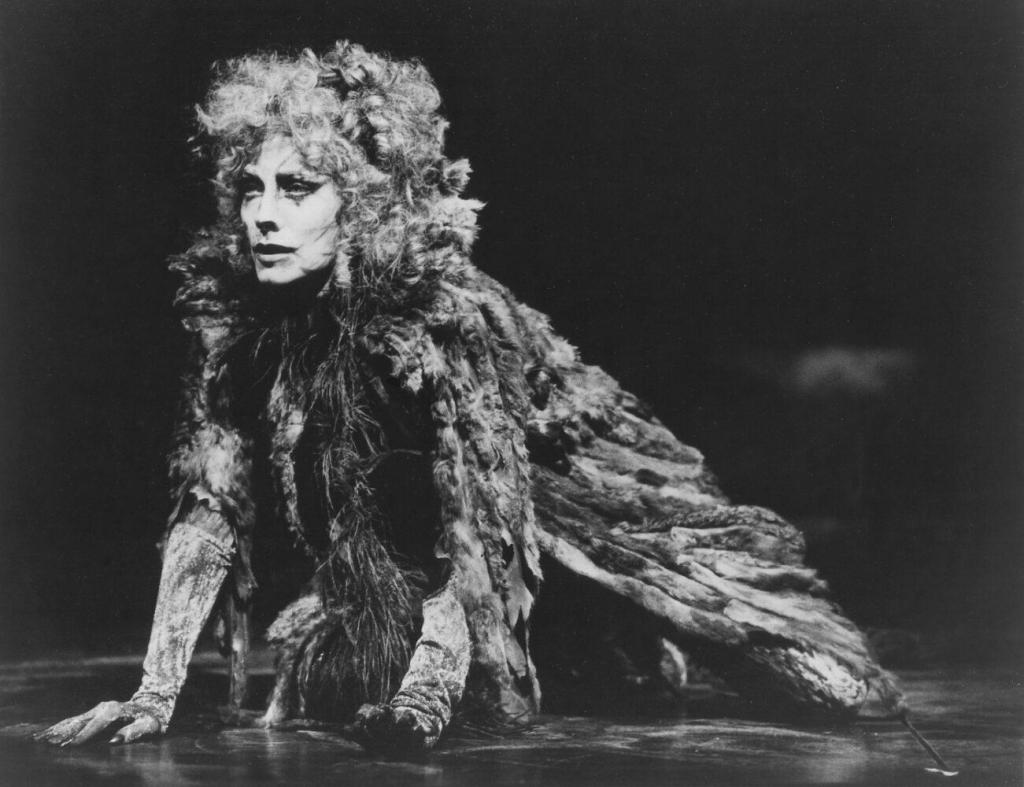
Betty Buckley as Grizabella, Cats the Musical/ Broadway, 1982/ Photo Credit by Martha Swope
LM: We are about to talk about your career as a solo performer, as a singer. I know that you are releasing your new album soon. Please tell us, is it related to musical theatre or is this your solo work?
BB: This is my 20th album. About 19 years ago, I started working with Christian Jacob, who is my musical director for this album. He is a multi-Grammy-nominated brilliant jazz pianist, arranger, and film composer.
LМ: What is the title song?
BB: The title song, Enough, is a song by Sara Bareilles from her new musical, “The Interestings,” that is coming out in 2027. She kindly gave us her blessing to do the song. We also do her song You Matter to Me, as well as songs by great poet/singer-songwriters Bob Dylan, James Taylor, and Paul Simon. Everything Must Change by Bernard Ighner – that was the song that I heard Sarah Vaughan sing at the Philharmonic when I was 22 years old, and the moment inspired me to become a concert artist.
LM: Is Memory on the album?
BB: Yes. We are doing a new, interesting version of Memory, which begins with a guitar solo by Jordan Peters.
The popularity of “Cats” in New York was so great that the U.S. Postal Service (USPS) commemorated the Broadway musical “Cats” with a special stamp. This occurred the year the Broadway show closed—in 2000. On the back, some historical facts about this project are mentioned.
A quarter of a century later, spectators were offered a revolutionary revival: “Cats: The Jellicle Ball.” This new production serves as a prime example of how a Broadway mega-musical can be transformed into an impeccable—and originally Off-Broadway—boutique show. Timed to coincide with the 45th anniversary of the London premiere, Cats: The Jellicle Ball received nine Tony nominations and won three awards: Best Direction of a Musical (Zhailon Levingston and Bill Rauch), Best Costume Design (Qween Jean), and Best Choreography (Omari Wiles and Arturo Lyons).
This well-deserved success for the creative team would undoubtedly have been impossible without the group of talented performers. The cast is composed almost entirely of members of the LGBTQIA+ community. The dancers’ skill is impressive, as is the boldness of the choreographers, who employed a wide range of dance styles. The movement score is built on the geometry of vogue; every gesture carries meaning, and the dance moves—such as the catwalk, duck walk, and death drop—are dictated by the dramatic narrative while also paying great tribute to vogue, ballroom, and drag cultures.

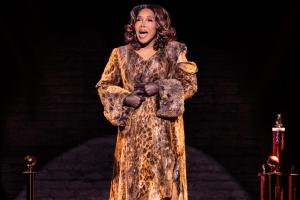
Tempress Chasity Moore as Grizabella, Cats: The Jellicle Ball Musical/ Broadway, 2026/ Photo Credit by Matthew Murphy and Evan Zimmerman
Grizabella (“Tempress” Chasity Moore) appears in the production only a few times, yet she manages to reveal her entire story. The audience weeps as she performs “Memory.” In the finale, the Jellicle leader Old Deuteronomy (André De Shields) bows low before her; he has chosen Grizabella to ascend to the Heaviside Layer.
The competition for the Grand Prize and the chance to ascend—to be reborn into a new life —forms the plot of the show. As in the original version, the goal is to select the most worthy cat. Guest judges and special guests join Munkustrap, the Master of Ceremonies (Dudney Joseph Jr.), to evaluate the mind-blowing dance routines. The words “old way” and “new way” appear on screens, allowing the audience to make comparisons.
The musical contrast was brought to life by “blowing the dust” off vinyl records and then “cranking up” the modern, beat-heavy arrangements of DJ Griddlebone (Ken Ard). Photos and videos were also projected onto the screen, chronicling the lives of legends such as the Broadway deity André De Shields (Old Deuteronomy) and Junior LaBeija (Gus the Theatre Cat) —a member of the original House of LaBeija for over 50 years and an icon of gay and ballroom culture. The absolute icing on the cake was the participation of André De Shields, who added a touch of Shakespearean drama to the show.
Audience members praised the production, noting that they “felt fully immersed in the ball,” “learned a great deal about queer culture,” and “gained a new understanding of Cats,” among other things. Many remarked that, with the original version, they had not previously “considered the work’s deeper meaning,” having focused instead primarily on the music and dance.
Indeed, the parallel personal and philosophical conflicts in Cats: The Jellicle Ball emerged more sharply. It is evident that both Cats and Cats: The Jellicle Ball serve not merely as entertainment but also as a platform to highlight social issues. This reimagined version of the musical, infused with new layers of meaning, introduced the general public to the history and evolution of New York’s ballroom culture from the late 20th century.


The Cast of Cats: The Jellicle Ball/ Broadway, 2026/ Photo Credit by Matthew Murphy and Evan Zimmerman
In this subculture, queer youth competed on the runway, often performing as a team (or “house”). The cat-themed celebration naturally evolved into a ball for gender-defined social outcasts, while the ballroom dance competition—once merely a spectacular dance—became a means of self-identification and expression.
The revival showcased how, through stylistic precision, one can breathe new life into an “old” musical. Remaining relevant is the privilege of works of genius; that is why they never age. They can be revived in their original form while retaining their relevance, or reimagined to better resonate with modern audiences.
Perhaps soon, when beings from other worlds live among humans—inevitably facing certain challenges of adaptation—Grizabella will appear in the musical as a humanoid from another galaxy. The “Jellicle Choice,” for instance, might allow her to return to her home planet—not empty-handed, but with cutting-edge technologies vital to the beings of the future…
The musical Cats has had a profound impact on global musical theatre, expanding the boundaries of the genre and the creative horizons of theatrical productions. One of the show’s early posters bore the slogan “Cats: Now and Forever!”—a phrase that proved more prophetic than its creators likely imagined at the time. Today, Cats ranks among the top five longest-running Broadway shows and is one of the top three record-holders for the highest number of performances. The latest revival, Cats: The Jellicle Ball, holds tremendous potential for the long-term legacy of Sir Andrew Lloyd Webber’s musical.
This post was written by the author in their personal capacity.The opinions expressed in this article are the author’s own and do not reflect the view of The Theatre Times, their staff or collaborators.
This post was written by Lisa Monde.
The views expressed here belong to the author and do not necessarily reflect our views and opinions.