




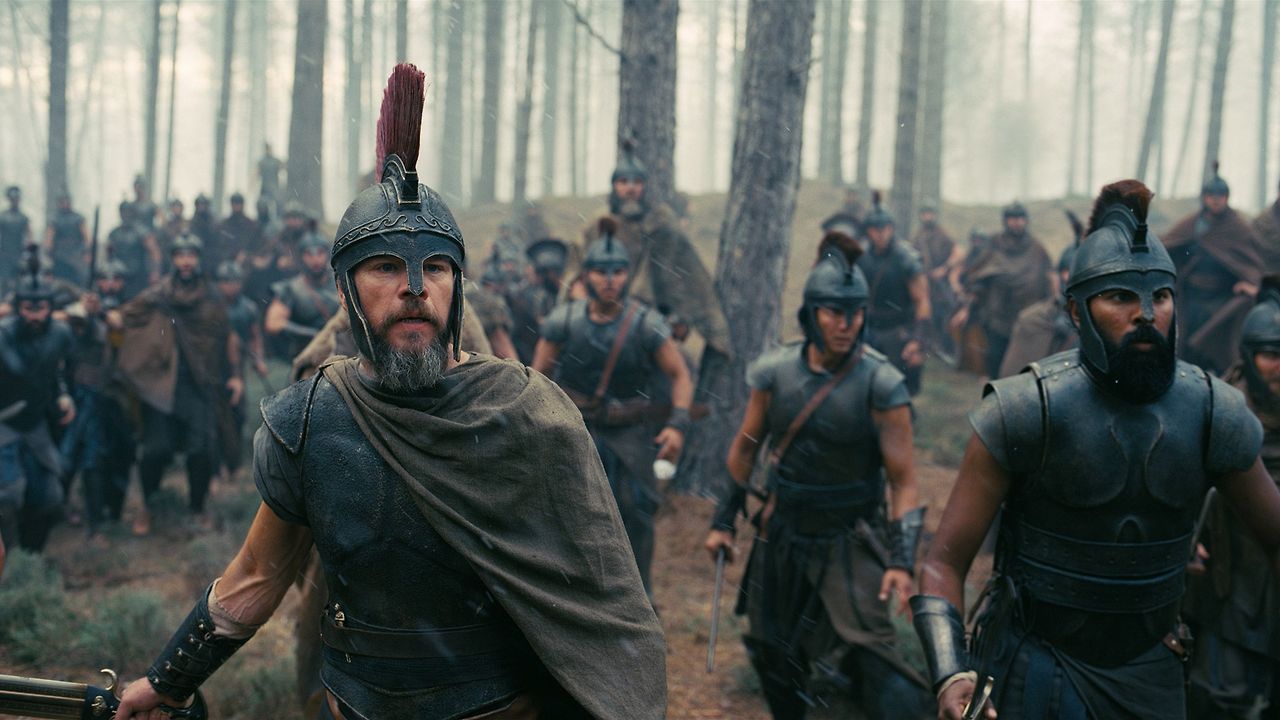
What stands out on the large canvas aren’t merely battles, but the more humble parts of film language that don’t usually receive the full IMAX treatment—sunsets and close-ups of human emotion on faces. Although the equipment needed to be refashioned, not having to plan different cameras for different scenes allowed a level of freedom for Nolan and van Hoytema to occasionally shoot off the cuff.
“Once you’ve committed to a format and you’re not having to make those choices and swap out camera systems, you’re going, ‘What can we do with this amazing tool?,’” Nolan explains. “The more we played with it and the more we were in these amazing locations—up a mountain in Sicily and looking at these incredible cloud formations coming behind the palace—[we were able to use] the camera in very spontaneous ways. That’s where it’s freeing, where you start to be able to get things that are occurring in nature—particular weather patterns, or be out on a boat in a pitching sea with it, things like that. That’s the excitement of where you’re taking the format, places you haven’t been able to use it before. Getting those insert shots and extreme close-ups—those shots are absolutely thrilling in IMAX, the same way an action scene is.”
Although IMAX worked with Nolan to create the blimp system for sound, the camera crew didn’t need to truly test it until many weeks into production, since filming started with the louder set pieces more traditional to the format. “We had shot a fair amount before we knew whether we would be able to do the whole film this way or not,” the director says. “When you’re out on boats, for example, people project over the waves. You’re able to record sound even with a loud camera; you’re able to use software to filter and get a usable track.” To know when the blimp apparatus truly worked, “it was really about the quiet moments. Halfway through the film, we got into the most intimate scenes, between Telemachus and his mother, Penelope. Those quiet moments were what we didn’t know how we would do it, how we would mount this camera on a dolly system, how we’d be able to get the actors to act with this large camera right there.”
“After we did the first of those quiet scenes, Hoyte and I looked at each other and said, ‘Yeah, we’re going to do the whole film this way. If we can do this stuff, then we can get everything,’” he reflects.
Sound problems were solved—but Nolan notes that there was still the issue of camera coverage of a conversation captured with these massive cameras with a blimp system encasing them. “One of the things I challenged the camera crew to do—and Keith Davis, our 1st AC (and focus puller), did a great job—I said, ‘Can we rig a system of mirrors [for the actors to see each other]?’ You have this giant camera with a cameraman, with Hoyte on the camera, and you’ve got an actor trying to see another actor around it,” Nolan explains. “We had to rig a system of mirrors where they could see each other and act to each other, rather than acting to a piece of tape on the side of the camera, which is often what happens—even with a regular camera system.”
What could possibly be next for IMAX to solve for Nolan and his epic films? The IMAX popcorn bucket video, in which Nolan and van Hoytema interact with a camera prototype, holds the clue to the next request. “When we saw the prototype [of the popcorn bucket], that was a pretty thrilling moment. But Hoyte and I both had the same reaction to it, which is, ‘If only the IMAX camera itself were that size!’ If it was a little bit smaller, it’d be a bit easier to use, in more locations… but it’s an incredibly faithful reproduction of what that machine actually is.”