




Return of the Buffalo – Tatanka Owe Akupi
On September 18, I made my way down to the National Museum of the American Indian at Bowling Green Park In lower Manhattan to begin an unforgettable journey following a herd of life-size buffalo puppets throughout the streets of lower Manhattan, in celebration of the symbolic return of the American buffalo which had become nearly extinct and in commemoration of our 250th anniversary. Created by Amir Nizar Zuabi in partnership with elders from the Lenape and Lakota communities and produced by St. Ann’s Warehouse, the Walk Productions, and KBH Arts, this special event took place from 5 to 7:30 pm. Native Pride Dancers in full regalia opened the event performing traditional dances in front of the museum.
As soon as I saw St. Ann’s Warehouse’s new season announcement about the Return of the Buffalo, created by Amir Nizar Zuabi, I remembered the thrill of meeting his “Little Amal,” the 12-foot-tall puppet of a 10-year-old Syrian refugee with whom I walked in the streets of lower Manhattan four years ago and its lasting effect on me. Larger than life buffalo puppets to honor resilience, strength and recovery, this was what I needed.
Forty massive buffalo puppets, how was this possible? To begin with, were they shipped from Cape Town, South Africa where “Little Amal” had been built? That seemed unlikely. I learned that the original puppet was designed and built by the South African company Ukwanda Puppets in South Africa and plans were digitally sent to the Production Team at St. Ann’s. Silovsky Studios in Brooklyn spent months building the understructure for the puppets, made of steel and plywood with layers of burlap bathed in glue and coloring with paper used for the ears and horns.
Once they were built, the puppets were placed on burlap stretchers to be transported to their various destinations. When repairs were needed, they had to be hoisted up to a lighting rig at St. Ann’s so that maintenance crews could get inside them.

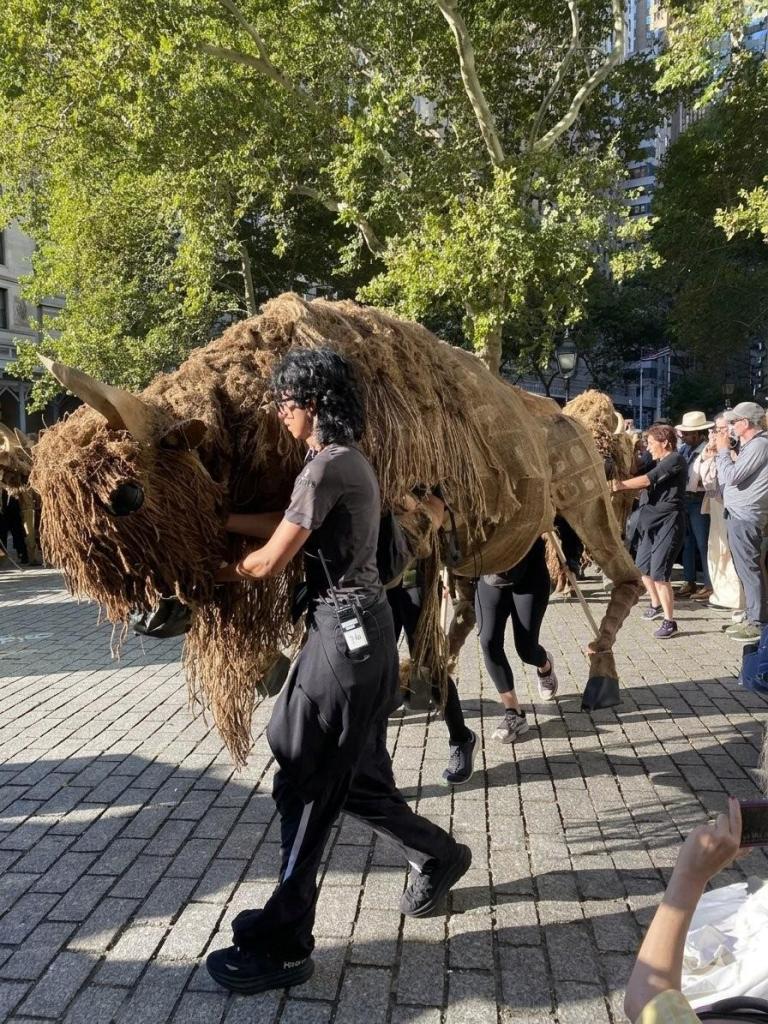
The first buffalo arrives in front of the Museum, followed by 39 others. Photographer: Philippa Wehle.
Finally, the herd began to appear. The first buffalo was led by a young man in charge of its head. You could feel how much focus and strength was needed to maintain the illusion that the animal was being held back. You could see the legs of two puppeteers underneath the puppet, one in front and one in the back who were equally masterful at driving and pushing their charge. They circled around the area in front of the museum inviting us to follow them to their next destination: Broadway at Exchange Place. The parade would take us all the way to Foley Square. The streets were blocked off for the occasion and the NYPD was ever vigilant. Along side of each buffalo were guides in charge of making sure everything was going well. A daunting task with large crowds following the puppets. This was not a stampede but a solemn procession parading through the streets of New York, accompanied with dancing and music to celebrate the buffalo’s symbolic return.
These were powerful beasts, 80 pounds each and 7 to 9 feet in length. They had been brought to life by an amazing group of newly-hired puppeteers who had spent several days in training to inhabit and guide them as they paraded through the streets, making sure they would arrive at their destination safely for two days.
Before the opening of the event, I had the opportunity to interview one of these newly appointed puppeteers, Craig MacArthur Dolezel, noted actor and teacher of Voice and Speech at HB Studios and a good friend. He had been selected to join the other volunteer “puppeteers,” a group of actors, dancers and artists from the United States and other countries who had come to St. Ann’s to attend a series of training sessions in preparation for this major event. Led by Puppetry Director Craig Leo, from South Africa, along with a small core group of ECo puppeteers from Europe and others, they would spend six days learning how to inhabit and direct their buffalos.
“At our first meeting we met the team who would help us become familiar with our puppets. I found it interesting that but we did not meet the puppets right away. They were lying on stretchers against the walls. We did not touch them.” Craig told me.


40 buffalo puppets lying on their stretchers at St. Ann’s Warehouse. Photographer unknown.
“Instead, we began a series of workshops designed to bring them to life in a believable way. Participants were given pieces of ordinary butcher paper that we crumbled to make into our puppet. “Breathe into it, bring it to life. Pay attention to it,” we were told. “If you stop paying attention to your puppet, it dies.” This exercise relates very much to the breath work I teach for Voice and Speech. I was struck by how much freedom was felt when individuals were channeling their piece of paper and not paying attention to themselves.”
“A certain amount of time was given to selecting which participants would work together, of course. We were lined up so that you could get people who were more or less the same height and size. I was chosen to become the back side of a puppet. I was responsible for the back legs and for breathing, for driving and pushing.“ I had to be fitted with a harness.” he told me. “So did the person playing the heart.”
“The next meeting, we started to do these small team building exercises. We haven’t gotten to the puppets yet. A lot of time was spent practicing walking together, breathing together and stopping together. Practicing a foot pattern, the back right foot, the front right foot, which is not difficult, but it gets much more complex when they introduced galloping later. Galloping: 1,2,3,4 both legs in the air! Or the Game of running in a herd. We practiced in puppet and out of puppet. And walked with our eyes closed. A lot of the practice went from being in puppet and being out of puppet and demonstrating the charges.
We had to learn a series of language commands, a combination of Xhosa, one of the languages of South Africa and Arabic terms. For example: “Yalla” Walk. “Ta” when the animal moves and stops. “Keshan” meaning charge at something or bolt, and “Suka,” come back into formation. Others were words for: stop, retreat, alert, ease up, disperse and circle something.”

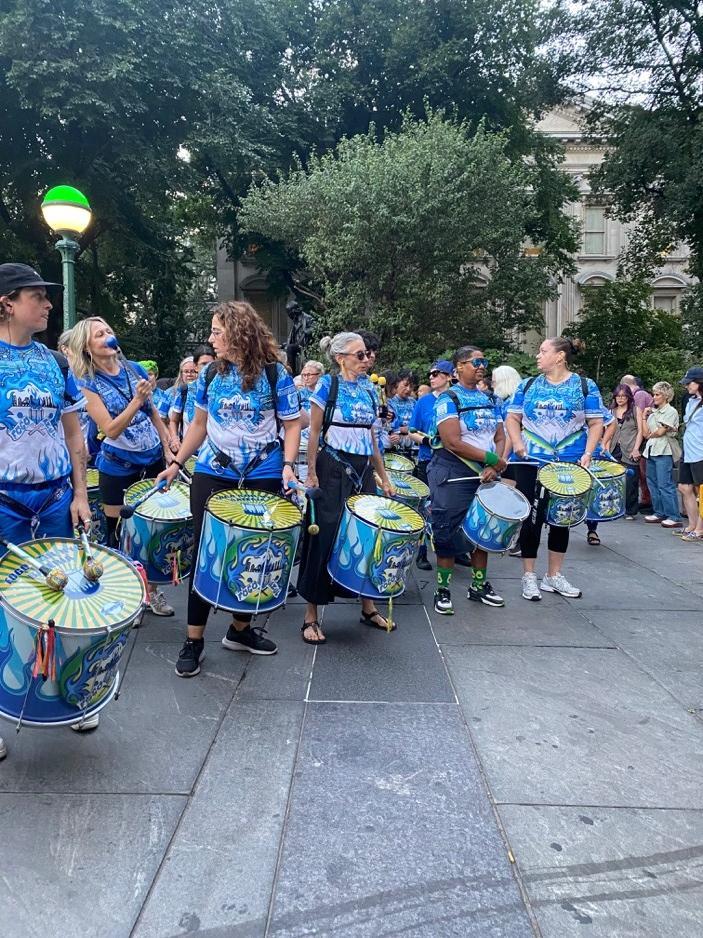
The Fogo Azul NYC Women’s Drum line leading the buffalo on their way to Foley Square. Photographer: Philippa Wehle.


The buffalos at City Hall Park, about to arrive at their final destination. Photographer: Philippa Wehle.
On Saturday the 19th, the buffalos were moved to Brooklyn for an afternoon performance. The cobblestone streets and hills presented new challenges to the 40 puppets and their amazing handlers. In Craig’s words: “It was a very different terrain.”We made it to the end and there was a beautiful ceremony that concluded in the park.” When I asked him for three words to describe his experience, he offered four: “it was heartening, fatiguing, resplendent and hopeful.” For me, it was about empathy and survival.
This post was written by the author in their personal capacity.The opinions expressed in this article are the author’s own and do not reflect the view of The Theatre Times, their staff or collaborators.
This post was written by Philippa Wehle.
The views expressed here belong to the author and do not necessarily reflect our views and opinions.