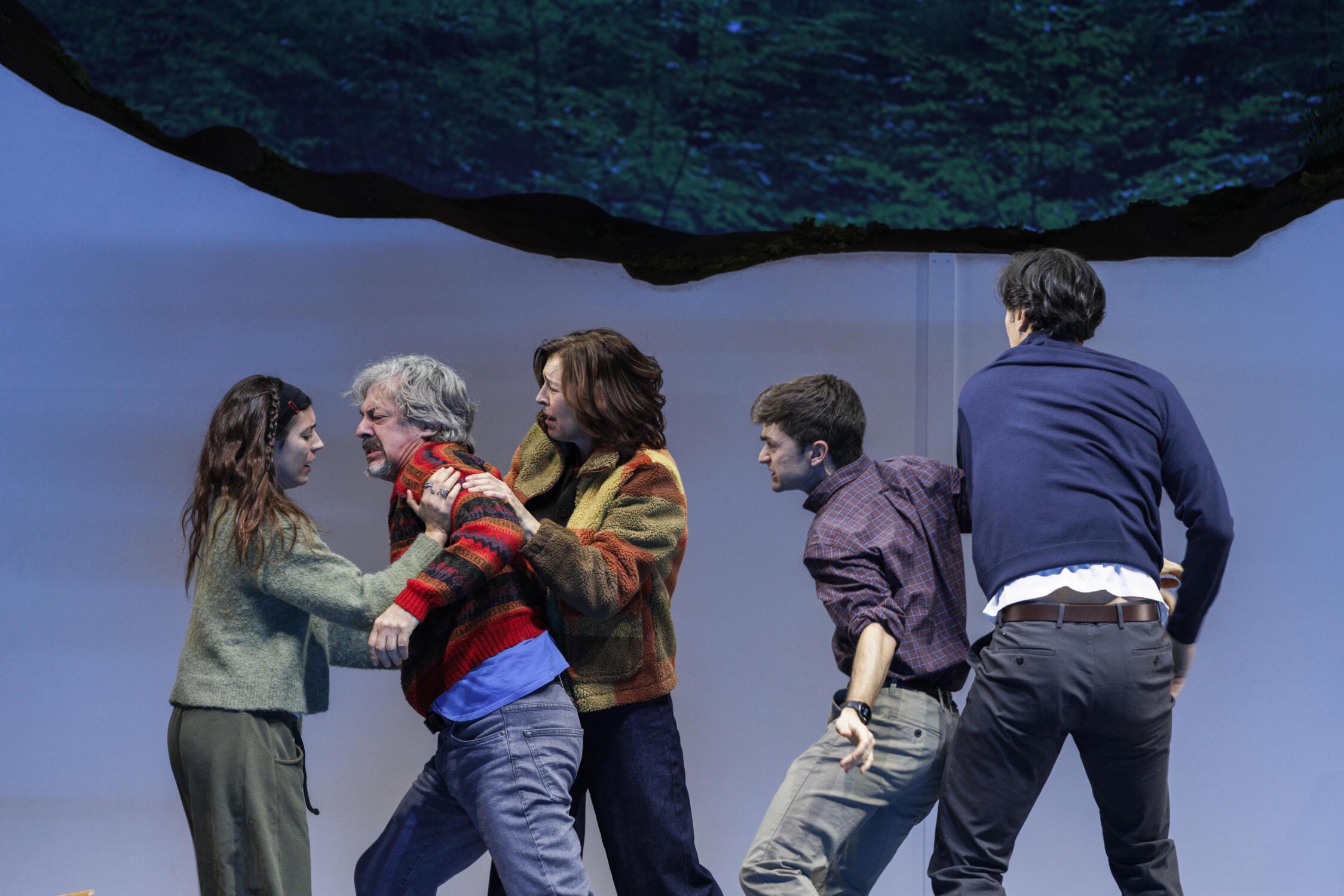







The Schnürschuh-Theater in Bremen was founded in 1976 and has been at its current location since 1994. For 2025 it received public institutional funding of 92250 € (compared with 34,3 million € for the municipal theatre in Bremen). It seats ninety-nine. Its program consists of theatre for children and adolescents, inviting schools to attend its morning performances. In addition, it offers a separate program for adults. While youth theatre focuses on the principles of tolerance and courage, theatre for adults is equally politically engaged and includes many adaptations of prose fiction. Most strikingly, Mirjam Neidhart’s adaptation of Der Vorleser, based on the 1995 novel by Bernhard Schlink, has been in the repertory of Schnürschuh-Theater since Neidharts’s world premiere production of 2004. The novel was made into a film by Stephen Daldry in 2009, under the title of The Reader, starring Kate Winslett, David Kriss, and Ralph Fiennes.
One of the new productions of youth theatre at the Schnürschuh Theater for the 2025/26 season is Nasser # 7 Leben (Nasser # 7 Lives). The play by Susanne Lipp was first presented in 2017 at the GRIPS theatre in Berlin, where it is still part of the repertory. It is based on Lipp’s extensive interviews with Nasser El-Ahmad (b. 1996). The play focuses on Nasser, the autobiographical narrator, who tells us and shows us significant moments and events of his life. It all started quite innocently, with childhood memories of his loving mother and his sweet younger sister, only slightly overshadowed by the frequently absent father. As Nasser grew up, however, he developed more of a mind of his own, and his views and ideas often clashed with the strict rules, set exclusively by the father, about what thoughts and what behaviour was acceptable within the context of the father and the extended family’s take on the religious laws of the Quran. Here, the concept of haram took on major importance. The father enforced his educational position with bullying and physical violence, the latter so extreme that Nasser found himself approaching Youth Services on his own accord in order to physically survive. He was found a place in a flat under the supervision of Youth Services shared by a number of adolescents of a similar age, created to provide protection and security together with independence. On a first occasion he was lured back home only to be beaten up again by his father. A mischievous peer informed his family of his homosexuality. Within the family context, this was the worst possible news that could come from their son, and even the mother, so far still very much on the side of her son, even if secretly, made a U-turn and lured Nasser back home once again. On this occasion he was drugged, put into the back of a car, and the journey started to Lebanon, presumably for him to be killed there to restore the family’s honor. At one of the border crossings on the way, Nasser was able to attract the officials’ attention and was returned to Germany, where he has continued living since, free from his family, progressing to school and life beyond.
The narrative flowed smoothly in predominantly chronological order, narrated by Nasser, who took on his younger self in selected scenes with his family, peers, and members of the social services. Abid Ciplak played Nasser, alternating efficiently between present time narrator and past, younger versions of his own self. Bubbling with energy, Ciplak commanded the full attention of the audience at any point during the 80 minutes duration of the performance. His moments of acute suffering were grippingly moving and never sentimental. He clearly enjoyed showing Nasser at different ages, with all the characteristics of the particular age ranges.
Holger Spengler played the father, Ibrahim, as a man who would never on his own even begin to question his dominant position within the family. Within the hierarchy, he deferred to his older brother, and he expected his son to defer to him. Wife and daughter owed him nothing but obedience anyway. When Nasser challenged this father’s authority by insisting on behaviour the father considered as haram, that natural authority was rendered insecure and the only way Ibrahim was able to respond was by bullying and physical violence. When he stood leaning over Nasser, with a chair raised high above his head, ready to strike the boy, Spengler came across as genuinely frightening and threatening. Spengler also played the social worker, a very gentle and well-meaning man, although apparently never quite grasping the family situation Nasser was in.
Magdalena Suckow played the mother, initially torn between her feelings as a mother for her son and her duty of obedience to her husband. She was, as much as possible, on her son’s side, without risking her own position in the family and without risking her son being treated even worse than without her interference. It was striking how convincingly Suckow presented the mother’s shift from attempted support to joining her husband and the extended family in executing the maintenance of honor. Suckow also convincingly played a member of the Social Services team, as well as some of the peers in the supervised flat share.
Jennifer Wollny played predominantly Nasser’s little sister: she was realistically believable as a young child, shifting between innocence and ignorance and the first signs of noticing that something is not quite right. As the sister grew up, Wollny succeeded in demonstrating how, in a scary way, the sister adopted, without questioning, her father’s position and joined the family in hating her brother, whom she earlier clearly adored as the older sibling. Wollny also developed marked individualities for the other characters she played, including Nasser’s peers in the supervised flat share.
Pascal Makowka‘s production was well paced; it shifted smoothly between harsh, cruel and brutal words and actions, Nasser’s narration, which included some funny reflections on the events, and some lighter moments with Nasser’s peers and some of the interactions among the social workers and between social workers and the adolescents placed in their care.
In line with company policy, the production will now be presented a few times for an adult audience, but predominantly for schools to attend during school hours, to serve as the basis for a further discussion of a topical issue.
This post was written by the author in their personal capacity.The opinions expressed in this article are the author’s own and do not reflect the view of The Theatre Times, their staff or collaborators.