



![18th Mar: The Ricky Gervais Show (2012), 3 Seasons [TV-MA] (7.2/10)](https://occ-0-1081-999.1.nflxso.net/dnm/api/v6/Qs00mKCpRvrkl3HZAN5KwEL1kpE/AAAABbVfeXX5YPUHP4ZtarHLbsMqV3J9lsanSBg_fPhX71tXY4Ko5zvTZxayohnr0zSYlbOogGc-Eaif5bDgSMAw3fsuOlQCob-Gx7ktmWcWqDrIPP6OdHUTpG7CDZZBl84TNErE_YVLPklE1ObdwPzmUu1x6ZlyKpCSWbMdes_FdXkqmQ.jpg?r=e26 "18th Mar: The Ricky Gervais Show (2012), 3 Seasons [TV-MA] (7.2/10)")






An Interview with Mr. Muanis Sinanovic (Slovenia), poet, writer, essayist, and critic.
Muanis Sinanovic (1989) is a Slovenian poet, writer, essayist, and critic. He has published four poetry collections, two books of essays, a fictional essay or essayistic novel, a satirical novella, and a short story collection. In 2012, he received the award for Best Debut of the Year at the Slovenian Book Fair, and in 2021 he was awarded the Kritishko sito for Best Book, presented by the Slovenian Literary Critics’ Association, for his poetry collection Krhke karavane/Krshlivi Karavani/ Fragile Caravans. His short story collection Na senchni strani blokov was nominated for the Marusha Krese Award, while his fictional essay Vse luchi was nominated for the Cankar Award. In 2022, he also received the Stritar Award for his body of critical work. He has appeared at numerous national and international literary festivals and has been included in Slovenian and international anthologies, most recently in Mein Nachbar auf der Wolke, an anthology of 20th and 21st century Slovenian poetry published by Carl Hansen Verlag. He also works as a translator from Serbo-Croatian language. He was co-curator of the international literary evenings Salon z razgledom at Cankarjev dom. His theatre poetry collection Fragile Caravans/ Krshlivi Karavani was translated and published in Macedonian by the Macedonian Center ITI/PRODUCTION in December 2025.
IAB: There is an essential tension between the individual and the collective in your poems. How do you conceive of the poet’s voice as both singular and communal?
MS: This is a key question of contemporary poetry. In modernity, its communal character began to disappear in the West. Even when it speaks about collective experience, it has to reinvent the ways in which to do so. With the individualization of the poetic subject, the elitism of poetry also increased. Yet in our time, experience is becoming ever more collective, and in the face of economic, political, and climate contradictions, it is becoming clear that a sustainable way of life can only be established through collective action. Just as activists or ordinary people are caught in these contradictions, I too am caught in them as a poet. I do not have an answer to them, but they certainly represent a key tension of the collection.
IAB: The title Krshlivi Karavani in Macedonian translation resonates with both fragility and caravan/movement, suggesting a tension between beauty and hardship of nostalgia. Was this interplay of beauty, grounding and evocations intentional from the beginning, or did it emerge in the process?
MS: It was as intuitive as it was deliberate. The creative process requires a certain intuitiveness, a surrender that allows you to express yourself without control. At the same time, it also requires control, so that intuition can flow into an artistic form that will be accessible to others. Since the publication of the collection, I have engaged much more deeply with the theory of neo-liberalism, globalization, and financialization. In retrospect, I would say that the collection captures the atmosphere of this globalized condition, its mobility, but also the fragility and fictitiousness of financial capitalism as it manifests in people’s everyday lives. Uncertainty is the key feeling of my generation. The nostalgia it once felt, but feels far less today, was a nostalgia for the tangibility and predictability of the world, for the presence of a collective in which the lost individual could find a place.
IAB: Your poetry often evokes urban nomadism drifting through cities, memories, and impressions. How do you see the contemporary city as a space for poetic exploration? Is the city a labyrinth of external silence or internal noise?
MS: Again, I would say both. Cities are centers of the flow of globalized financial capital. Where there is money, there are also power and glamour. I grew up in a small country without large cities. Today, our capital has around three hundred thousand inhabitants. We were raised in a pop culture that celebrated the life of big cities, and discovering them felt to me like diving into the illusion of endless possibilities, into an aura of glamour. At the same time, I moved frequently in my life, so this kind of mobility felt organically close to me. The poetics of cities in these poems is a projection of inner labyrinths onto the phantasm of the infinity of urban environments. An attempt to overcome the noise of the soul through projection an attempt that is always unsuccessful. But it can be poetic. Poetry is the realm where the unrealized ambitions find their aesthetic realization and sublimation.

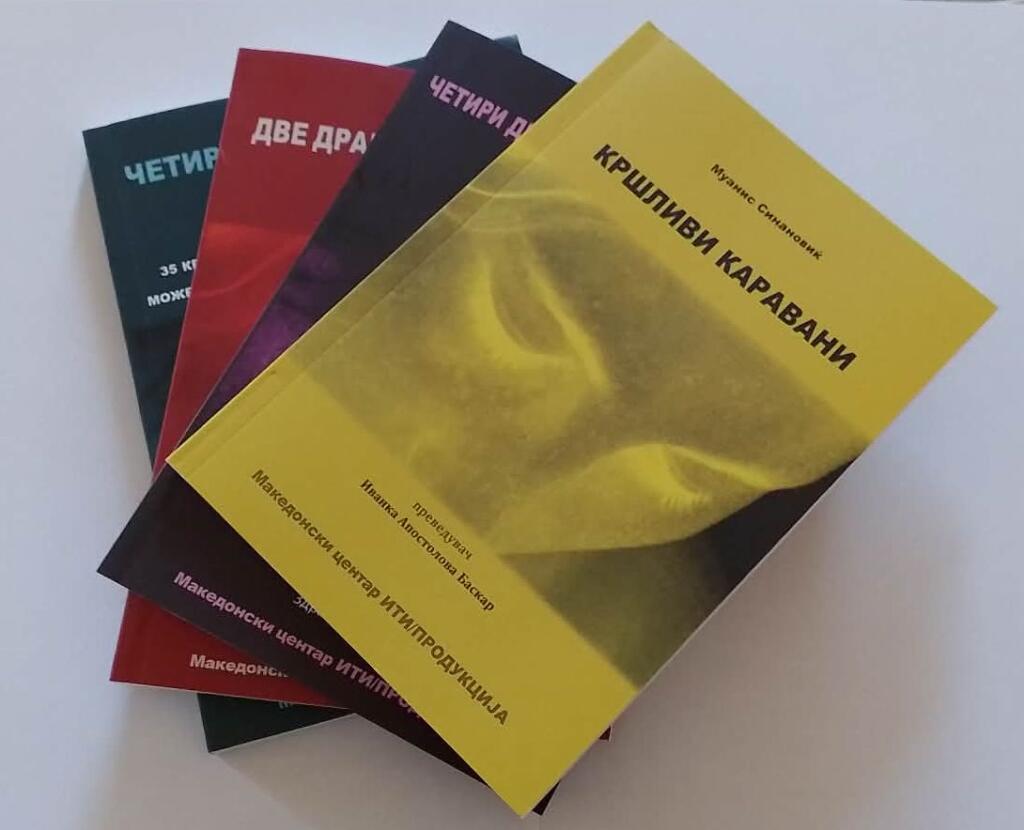
Theatre Poetry Book Fragile Caravans. Credits: ITI Macedonia 2025
IAB: In the landscapes of Krshlivi Karavani/Fragile Caravans, there is a sense of restless wandering. Is this restlessness a reflection of the modern condition, or something deeper, a poetic restlessness of spirit?
MS: It is about the restlessness of the contemporary world, which at the time I believed to be a specifically personal, individual restlessness. I once thought that only a few individuals, like myself, experienced a crisis of identity; today we see that the crisis of identity is widespread. This restlessness is the result of the loss of anything tangible, a loss imposed by capital. It imposes it through wars, hatred, precarious employment, and the high cost of rents and housing. At the time, I did not know that this was a collective experience. Perhaps it was precisely this unawareness that gave the poems an aesthetically significant dimension of mystery.
IAB: How do you translate physical places into poetic space? Are these landscapes tangible, imagined, or something in between?
MS: I have always thought in a highly spatial way. From an early age, I spent a great deal of time with maps, imagining spaces, manipulating images. I think more in images than in words. Frequent moves also often contributed to this, triggering a need to create inner maps and narratives of places. For me, this was something entirely natural.
IAB: Krshlivi Karavani /Fragile Caravans contains many allusions to literary history both Western and Eastern. How does the dialogue with literary ancestors shape your poetic voice?
MS: There is a great deal of irony and playfulness in the references. They also contain a trace of postmodern referentiality, which today may already be slowly becoming outdated. I believe we need an art that breaks free from playing only with itself and opens up more fully to the world. This is especially necessary in poetry, which has become elitist and I am no exception myself. Certainly, the imaginary of every poet is built upon the imaginaries of the poets who came before them. But is it really essential for poetry to refer to them? Is this not a form of narcissistic self-justification? In this, I followed a certain line of post-independence Slovenian poetry and the American poetic landscape, as well as the way of thinking about poetry that has influenced it.
IAB: There is a moment in your poetry where history becomes a mirror of introspection. How does reading the past help you illuminate the present?
MS: Human beings create the world under circumstances they inherit. Here I follow perspectives that derive from Karl Marx. The systematic uncovering of the continents of history that shape the present, that come together in today’s world, empowers us and provides orientation amid chaos. Of course, the course of history is entirely different from the image presented within the dominant ideology and in simplified high school curricula. It is often counterintuitive and demands radical shifts in perspective. Few are willing to undergo them. Yet the breadth one gains in this way, and the understanding of the present that comes with it, are invaluable for anyone who wishes to actively comprehend the world in which they live.
IAB: In what ways do you think your work reconfigures canonical voices (e.g., classical Arabic or Persian poetry) in a Slovenian context?
MS: I am not an expert in Persian or Arabic literature. However, I am interested in various esoteric metaphysics. By “esoteric” I do not mean New Age spirituality, but rather a deeper, traditional intellectual knowledge of spiritual matters. For me, this is in no way contradictory to historical materialism. Within this field, knowledge has often been articulated in the form of poetry. Slovenia has a strong tradition of poetry. In Slovenian culture, elements of animism have survived a cosmic experience of nature, a love of greenery and wilderness. At the same time, people are more reserved than elsewhere in the former Yugoslavia. They keep much within themselves; refined individuals often contemplate deeply and explore inner worlds. Here, I found an unexpected correspondence with the spiritual poetry of other parts of the world.


Muanis Sinanovic. Photo Credit: ArsLitera Slovenia.
IAB: Many poems resonate with Persian and Arabic cultural tones not as borrowed motifs, but as lyrical and spiritual vibrations. What draws you to these traditions? Is it the rhythm, mysticism, philosophical depth, or language sensibility?
MS: I would say that these are predominantly mystical and philosophical tendencies. In poetry, images and sounds connect beneath the surface; connections within language are revealed that differ from those in the physical world. This, precisely, is also characteristic of mysticism. Exploring or engaging with this tradition is a result of my background and my convictions, and also part of a search for identity.
IAB: How do you weave these cultural undercurrents so that they enhance, rather than overshadow the poetic voice rooted in Slovenia?
MS: An artist must have a sense of being embodied within a particular place and tradition that they feel deeply. This is the place and tradition in which they create. At the same time, it is good to remain receptive to other influences, through which one expands or questions one’s original situatedness. This cannot be erased or overridden unless one does so forcibly since it represents the point of departure.
IAB: Do you see your poetry as a bridge between cultures, a crossroad between East and West a caravan moving through linguistic and symbolic space?
MS: Certainly. There is also a slight turning of the orientalist tradition here, a shifting of perspectives within it. On the other hand, the division between North and South appears politically more crucial, a division that the East–West split merely mystifies. The wealthy North is the global bourgeoisie, living off the backs of the South the nations of Asia, Africa, and South America, as well as the Balkans.
IAB: Your poems often blend fragmented syntax with fluid imagery. How do you approach the relationship between form and meaning?
MS: I approach the relationship between form and content differently in different periods. Over time, I have been opening up more and becoming more accessible. In the collection Fragile Caravans, I gave precedence to my visual imagination, subordinating to it my usual sensitivity to the malleability of syntax. Cinematic quality, as you described it, comes to the forefront.
IAB: Some lines feel like echoes, not statements shimmering, half‑said, haunting. Is this an intentional strategy to leave room for the reader’s imagination?
MS: Certainly. In this collection, there are many suggestions or silences that, in this way, open up fields of meaning. It is a deliberate approach.
IAB: How do silence and pause function in your poetry as absence, threshold, or tension?
MS: Silence is a key component of poetry. Poetry strives to say as much as possible in the shortest possible way. Because it cannot encompass the whole within a brief form, it must point toward it. It does so through silences. And it is carefully chosen images and rhetorical figures that lead to silence as the space of possibilities.
Theatre Poetry Book Fragile Caravans. Credits: ITI Macedonia 2025
IAB: Slovenia occupies a unique cultural and geographic space at once Central European and boundary‑crossed. How does the Slovenian context inform your poetic sensibility? Is there a specific cultural tension, historical memory, or poetic identity unique to Slovenia that you feel your work engages with?
MS: Slovenia is indeed a unique, distinctive country. Slovenians are not a conquering people, and in the midst of industrial civilization they preserve a sensitivity to nature and to the environment. On the one hand, they are part of their surroundings, part of the European story; on the other hand, quietly just as they grew accustomed to during centuries of subordination they preserve their particular characteristics. Slovenian culture oscillates between remarkable boldness and mimicry. In these extremes, which are difficult to perceive from the outside, in these silences and ambiguities, there is much that is poetic.
IAB: What do you think defines Slovenian poetry today in mood, voice, or aesthetic vision?
MS: Today in Slovenia, two poetic currents prevail. One is intimate, contemplative, existentialist. It is situated both in everyday life and in imagined worlds. The other is direct, punk-inspired, political. It has developed over the past decade among younger poets. At times, frictions and polemics arise between the two, which is ultimately beneficial for the discussion of poetry. Evidently, this means that for some people poetry still carries such significance that it is worth arguing about it, pushing the debate to the very edge.
IAB: Do you see a generational shift in Slovenian writing new voices, new concerns, new forms?
MS: Yes, precisely in what I have described. In recent years, a direct political poetry has gained prominence, often engaging with questions of identity, the need to change the world, and similar issues. A fairly strong LGBTQ scene, which has established itself, is at the forefront of this development. This direct political stance, on the other hand, has been subject to aestheticist criticism most notably from a poet Urosh Zupan who, in the period after Slovenia’s independence, was regarded by my generation as a central model and who writes the kind of intimate, contemplative poetry I mentioned earlier. At times, these critiques are overly self-absorbed; they fail to notice that the world has changed drastically in the meantime, and that poetry is therefore changing as well. On the other hand, some of the newer poets also fail to recognize that straightforward punk provocation is no longer sufficient, since we have already experienced it. Transgression is no longer transgression once it has become the norm. And yet, between these two extremes, interesting things are happening.
IAB: Memory flows throughout Krshlivi Karavani/ Fragile Caravans like a river at once nourishing and elusive. How do you think memory functions in poetry as archive, witness, or questioning force?
MS: The question of memory is important to me personally as well, and I have engaged with it extensively. My life has been full of changes, and so my memory functions differently, too. Sometimes I completely forget important things, while I remember insignificant ones for years. I mix different periods together. Nonlinearity, the shifting between meanings, unpredictable linguistic dynamics these are important in poetry as well. Perhaps that is why I found myself in this medium.

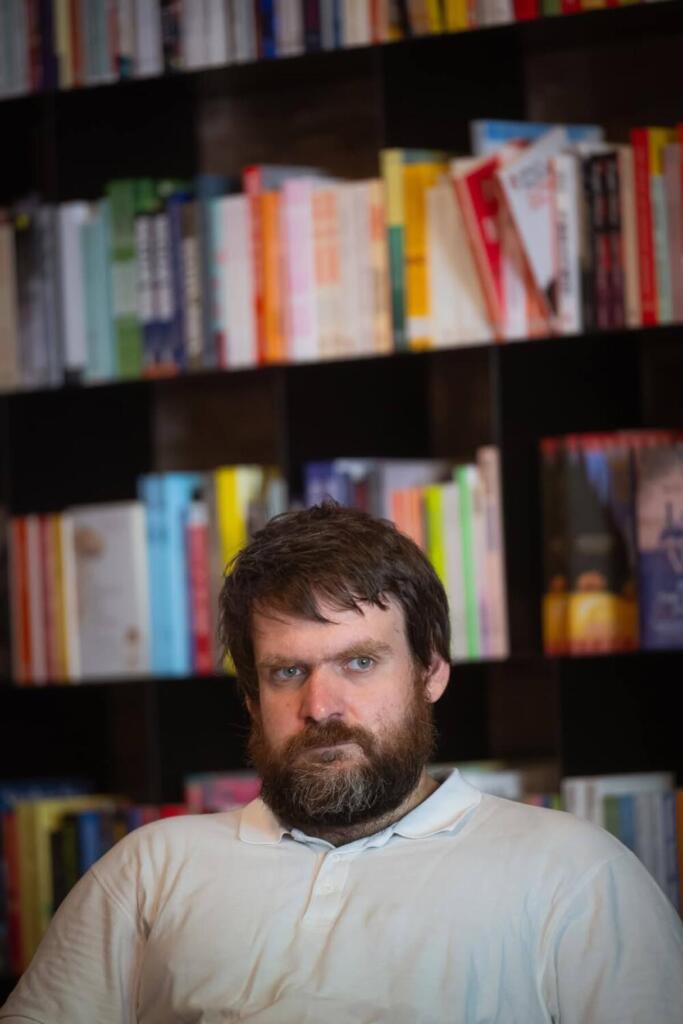
Muanis Sinanovic. Photo Credit: Mesto knjige Ljubljana.
IAB: There is a deep sense of loss paired with longing in your imagery. How do you reconcile these are they inseparable in your poetic worldview?
MS: They certainly once were. Precisely because of instability and constant change, there were personal losses and a longing for permanence. These are essential feelings and starting points of contemporary poetry. In recent times, however, both have calmed within me. Partly because I notice that the entire world is marked by feelings of loss and a longing for meaning. It is a collective experience. At the same time, through spirituality, I have come to realize that belonging, security, and a fixed personal identity may not be the most important things. What matters more is being present in the moment, ready to act, oriented outward rather than toward one’s intimate history. So my relationship to poetry is also changing. At the moment, I am in a transformative period in this regard, and I am writing mostly prose and essays.
IAB: Belonging in your work seems fluid neither fixed nor fully lost. Does poetry, in itself, offer a form of belonging?
MS: I think so, yes. When a poet finishes a poem, when its different levels converge and condense, a realization flashes through them: aha, this is it. Here, within this moment, there is meaning there is wholeness. But these are fleeting moments. That is why poets return to writing again and again, in order to experience them over and over.
IAB: When you sit down to write, where do you begin with image, emotion, memory, or language itself? How does the first line relate to the last?
MS: They begin with a certain emotion or spiritual impression, accompanied by an image. I then shape this image in my mind for some time, trying to sharpen and refine it. When I feel it is fully formed, I begin to translate it into the rhythm of verse. Although you may start with a more or less developed image, it is very important that something new, something unpredictable, happens in the course of writing that the poem itself surprises you and completes itself through your writing.
IAB: Do your poems come as intuitions first, or are they the product of sustained intellectual crafting?
MS: Intuition is the most important thing, along with the refining process I described in my previous answer. Without intuition, it simply doesn’t work. Perhaps that is what inspiration is. Today, many people mock the idea of inspiration, but I would not dismiss it entirely. Of course, inspiration alone is not enough. After that comes the mind, with its writing skills, which are perfected over the years, and must finish the job.
IAB: What role does solitude play in your creative process as silence, reflection, or confrontation?
MS: In life, I need a great deal of noise and a great deal of silence. I am a person of extremes. I enjoy loud things; I regularly go to football matches and cheer. I express my opinions. At the same time, I also need withdrawal and spiritual contemplation, where things begin to settle like silt sinking to the bottom of water so that the vision can become clear.

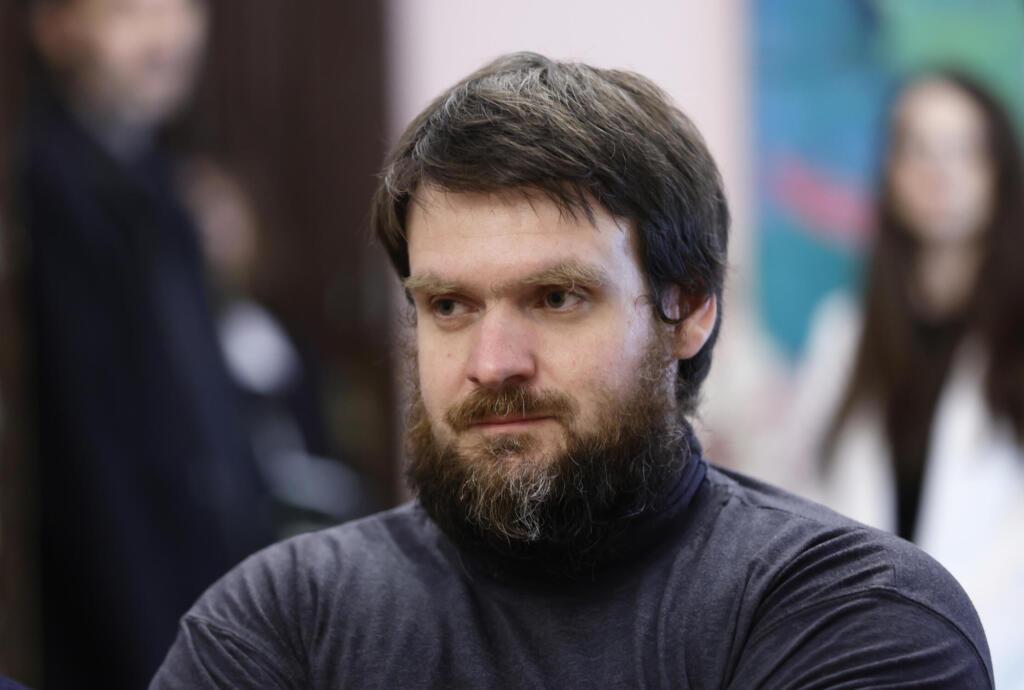
Muanis Sinanovic. Photo Credit: Borut Zivulovic BOBO.
IAB: In an age of screens, information overload, and constant noise, what is the role of poetry? Can poetry be radical not by declaiming loudly, but by opening inner space?
MS: I definitely think so. We need both new, innovative, loud poetry and poetry that brings into a world of noise and superficiality the component you mention. Poetry is an activity that, through its silences, withdrawals, and breaks in everyday language, actually creates a rupture. Of course, it will not change the world overnight, but it does create zones of freedom for its authors and for its readers and listeners.
IAB: What do you hope readers carry with them after encountering Krshlivi Karavani/Fragile Caravans? Should poetry alter perception, memory, silence, or self‑understanding?
MS: A very good question, but one that is impossible to answer. Just as it is impossible to say what I myself have taken away from writing the collection … What matters most is that the poems expand perception and enrich the inner world of readers.
IAB: If Krshlivi Karavani/Fragile Caravans had a sound, a landscape of sound, what would it be? A desert wind, a city hum, an echo in an empty room?
MS: Another very interesting question. Somewhere in there, the murmur of a stream should also be present. The city sounds, meanwhile, would be nocturnal, subdued perhaps combined with the soft hum of a taxi engine carrying you through it.
IAB: Do you see your poetic journey as ongoing caravan ever moving, always seeking?
MS: Without a shadow of a doubt. Every one of my books is different. Some poets and writers maintain the same approach over time. I, however, reinvent my writing with each new book. We’ll see how this will be expressed in my poetry. At the moment, I am preoccupied with the question of how to write poetry at all anymore. I find myself turning more toward prose poems, toward hybrid poetic–prose forms.
IAB: What is the deepest question poetry has asked you and has it offered an answer, or only deeper questions?
MS: Can language give words to the invisible world and to the deepest insight?
IAB: Finally, if you could speak to your own poetry from the future, ten years ahead, what would that very voice say to the poet writing today?
MS: You did the most that could be done in that moment. Thank you.
IAB: Thank you very much, dear Muanis Sinanovic.
(Skopje/Celje/Ljubljana, 2026)
This post was written by the author in their personal capacity.The opinions expressed in this article are the author’s own and do not reflect the view of The Theatre Times, their staff or collaborators.
This post was written by Ivanka Apostolova Baskar.
The views expressed here belong to the author and do not necessarily reflect our views and opinions.


