




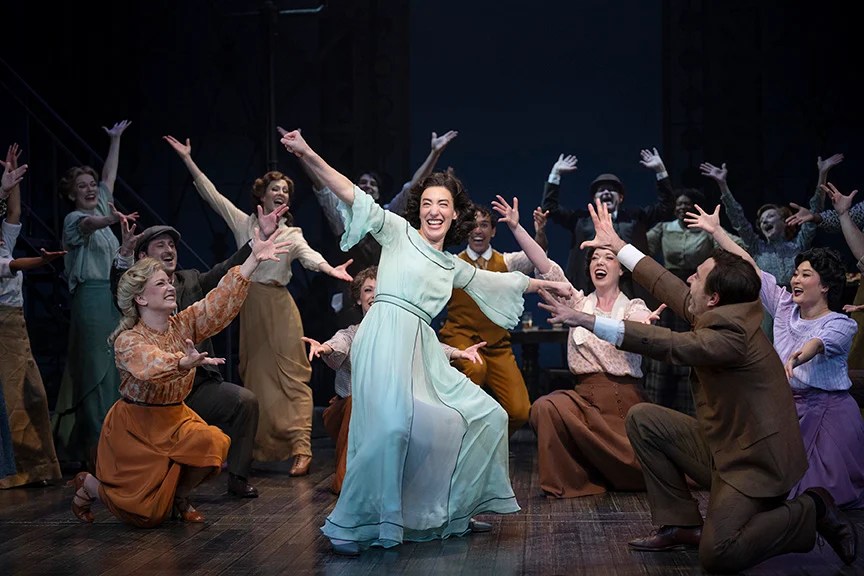
The Shaw Festival Review: A deeply felt leading performance and exhilarating choreography breathe new life into Broadway’s beloved musical
By Ross
Some overtures begin a musical. Others seem to unlock an entire lifetime of theatrical memories. Both are true as the first notes of Jule Styne’s unmistakable score fills Shaw’s Festival Theatre. Sara Farb magnificently steps into the light, surrounded by fragments of memory that drift around her, all before she even sings a single note. Sitting in the audience, I found myself caught in much the same current. Every production of Funny Girl arrives carrying decades of theatrical history. Barbra Streisand’s iconic film performance, Lea Michele‘s triumphant engagement with the role on Broadway, and countless stage productions I have seen over the years all arrived together, swirling through my thoughts alongside Fanny Brice’s own memories. Those ghosts inevitably accompany any new Funny Girl. Fortunately, Farb understands that trying to compete with them would be a losing proposition. Instead, she quietly builds a Fanny Brice who belongs entirely to her, and that becomes the Shaw Festival’s greatest triumph.
Farb never reaches for imitation. She embraces Fanny’s awkwardness, her quick wit, her fearless determination, and the aching vulnerability that sits beneath every joke. Her wonderfully natural comic instincts make the early vaudeville scenes sparkle, while her emotional honesty gradually deepens as success arrives and her marriage to Nick Arnstein begins slipping beyond her grasp. “I’m the Greatest Star” bursts with infectious confidence, “People” finds genuine and compassionate intimacy, and by the time the final reprise of “Don’t Rain on My Parade” arrives, Farb discovers an emotional strength that gives the closing moments real weight. I still missed hearing “My Man,” one of the film’s most devastatingly brilliant additions, but Farb makes an eloquent and powerful case for ending the stage musical as written. That challenge is built into Funny Girl itself.


I can’t watch the original stage version of Funny Girl without thinking about the film that reshaped it in so many of our memories. We lean in with affection, but also find ourselves missing some of the songs that became inseparable from Barbra Streisand, particularly “My Man,” “Second Hand Rose,” “The Swan,” “Roller Skate Rag,” and “I’d Rather Be Blue.” Those songs are hardly second-hand memories anymore. They’ve become part of the baggage we happily carry into every new production.
Unfortunately, some of the stage score struggles to match the electricity the film later introduced. “Cornet Man,” for instance, still feels like an oddly muted star-making vehicle for a performer destined for greatness. Under Paul Sportelli’s musical direction, however, Jule Styne’s glorious score never loses its emotional pull, carrying us effortlessly through moments of triumph, heartbreak, laughter, and longing. Isobel Lennart’s original book continues to show its age, particularly during an episodic second act that occasionally struggles to sustain its dramatic momentum. Rather than trying to disguise those weaknesses, director Eda Holmes leans into the musical’s emotional sincerity and theatrical playfulness, repeatedly finding pleasures that belong entirely to this production.

To be frank, I never expected “Rat-Tat-Tat-Tat” to become one of my favourite moments in this Funny Girl, but Parker Esse’s exhilarating choreography transforms it into one of the production’s genuine highlights. The precision of the tap dancing, the tightly synchronized ensemble, and the sheer athletic joy radiating from the performers inject the number with an energy I simply wasn’t expecting. Instead of feeling like one of the score’s lesser moments, it becomes one of the production’s biggest delights. The same joyful theatricality carries into “His Love Makes Me Beautiful,” where James Lavoie’s elegant costumes and striking visual compositions combine with Taurian Teelucksingh‘s wonderfully commanding opening vocal to create one of the evening’s most memorable stage pictures.
If Sara Farb anchors the evening, Matt Alfano (ShawFest’s White Christmas) provides many of its brightest sparks. He brings tremendous warmth, effortless charisma, and dazzling dance ability to his suitcase-tapping Eddie Ryan, serving as the perfect reminder of the vaudeville world that first nurtured Fanny’s ambition. His easy chemistry with Farb grounds their friendship in genuine affection, making Eddie feel less like a supporting character and more like one of the people Fanny can always count on when everything else begins slipping away, even if he loves her a bit deeper than she would like.

As Mrs. Brice, Patty Jamieson (ShawFest’s Brigadoon) matches him beautifully, filling her every appearance with equal measures of maternal exasperation, humour, and love. Together, these two gift us with their delightful vaudevillian turn in “Who Taught Her Everything She Knows?“ becoming one of the musical’s purest pleasures, while allowing both performers to shine exactly where their instincts and talents are the strongest. That success only highlights the limitations of “Find Yourself a Man.” While pleasantly performed, it feels largely like an extended diversion, existing more to occupy the audience while scenery shifts behind the curtain than to deepen either character or story.
Our leading man, Qasim Khan (ShawFest’s Gnit), offers up something else: a thoughtful, quietly wounded Nick Arnstein, emphasizing bruised pride rather than effortless charm. Although I never fully believed that Fanny would fall so completely under his spell at first sight, Khan does manage to give Arnstein enough emotional complexity to keep him from becoming simply the obstacle standing between Fanny and happiness. The other defining man in Fanny’s life is Florenz Ziegfeld, and as portrayed by Damien Atkins (ShawFest’s Jeeves & Wooster…), he is given an understated elegance, and just enough playfulness, that he dutifully and honestly anchors the theatrical world surrounding Fanny’s remarkable ascent.


Holmes (ShawFest’s Tons of Money) never loses sight of the production’s framing device, allowing every scene to feel like another memory drifting into focus before gently giving way to the next. James Lavoie‘s dynamic scenic design captures the glamour of the Ziegfeld era without overwhelming the intimate story unfolding beneath the spectacle, while Sonoyo Nishikawa‘s expressive lighting beautifully supports the production’s dreamlike flow, illuminating recollections as though they are appearing almost cinematically inside Fanny’s mind. Lavoie’s costumes are at their strongest whenever the ensemble fills the stage. The chorus dazzles in richly imagined showgirl finery, giving the musical’s biggest production numbers the visual exuberance their talents deserve. Fanny’s own costumes, however, tell her journey with a little less clarity. Her Act One finale dress arrives so suddenly that it feels like a too-loud leap rather than the culmination of the remarkable rise we have been watching unfold.
The opening image of memories circling around Fanny surprises, as it quietly becomes the audience’s experience as well. We arrive carrying our own recollections of Funny Girl, our favourite recordings, cherished performances, and impossible expectations. Sara Farb never asks us to leave those behind. She simply adds one more memory worth carrying home. Her deeply personal portrait of Fanny Brice joins that long conversation with grace, humour, and heart, making this Shaw Festival production feel like another beautiful chapter in a story many of us have been revisiting for years.
