





The Toronto Theatre Review: Crow’s Summer and Smoke
By Ross
A soft and nervous melody drifts into the air as Alma Winemiller stands beneath the stone angel that watches over the town square of Glorious Hill, Mississippi. She sings about wanting to “fly away,” her voice floating above the pool of water at the centre of the stage like a secret waiting to be disturbed. It is a striking opening image. Alma stands there with the careful posture of a young woman who has spent her life trying to behave correctly, shushing the restless interruptions of her step-mother while she waits for the man she has loved since childhood. The air feels heavy with anticipation. Somewhere in the quiet space between the angel’s wings and the empty park bench, Tennessee Williams’ Summer and Smoke begins to breathe.
This meticulous production from Crow’s Theatre, presented in partnership with Soulpepper Theatre Company and in association with Birdland Theatre, unfolds like a long summer evening that refuses to cool down. Director Paolo Santalucia (Crow’s The Wrong Bashir) anchors the entire world inside the rigid boundaries of a town square that feels both orderly and suffocating. Designed with geometric clarity by set and lighting designer Lorenzo Savoini (Soulpepper’s De Profundis…), the space seems to entrap its inhabitants inside a neat and unforgiving frame. The angel hovers above the fountain. The chairs and tables slide into place with careful precision. The town breathes in quiet rhythms shaped by sound designer Thomas Ryder Payne (Crow’s Rogers v. Rogers) and the elegant silhouettes of costume designer Ming Wong (CS’s The Inheritance). It is a place where propriety lives comfortably on the surface while something restless and raw smoulders underneath.


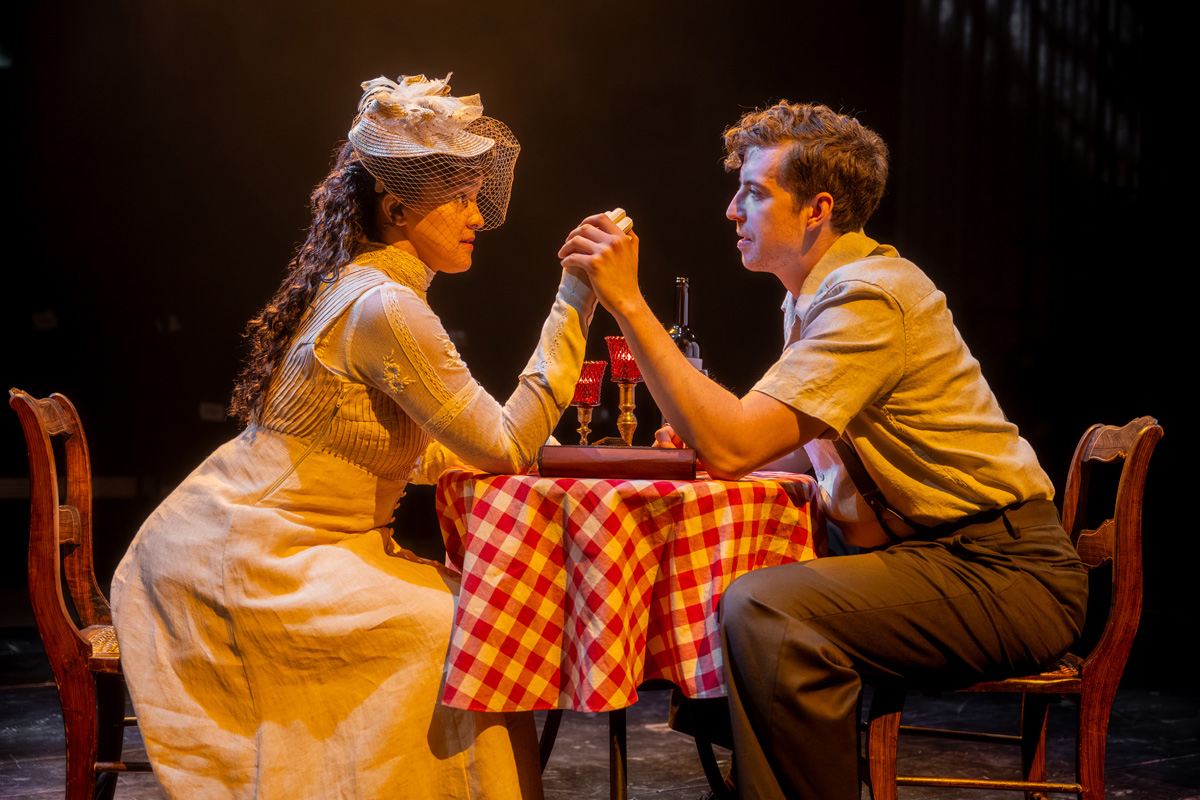
Into that careful, held-together stillness bursts the handsome and desirable Dr. John Buchanan Jr. His return lands with a crack and a flash when he tosses a firecracker beneath Alma’s bench, then shrugs with boyish mischief and blames “some little rascal.” It is a childish gesture that carries a deeper intention. John wants to startle Alma into life. He wants to shake loose the rules and rituals that hold her so tightly together. The two of them circle each other like magnets set at opposing poles, or tango dance partners unwilling to commit to the music. Alma, whose name means ‘soul‘, speaks with a delicate, affected diction and nervous grace. John moves through the square with an opposing loose confidence and teasing impatience, stepping easily across the boundaries that Alma uses to guard herself so carefully. Their encounters spark with curiosity, irritation, attraction, and a tension that feels ready to ignite. Or extinguished by the cool water of the town’s fountain.
At the centre of that dangerous, combustible tension live two vivid performances. bahia watson (Soulpepper’s The Welkin) plays Alma with a precision that captures both her fragile poise and the storm of nerves that vibrates within. Her voice carries the musical rhythms of Williams’ language expertly, while her body reveals the constant effort it takes to remain composed. Every polite smile looks slightly strained, every one of Alma’s signature laughs rings with the sound of someone trying to escape, while also attempting to stay safe. Across from her, Dan Mousseau (Buddies’ The Born-Again Crow) gives John Buchanan Jr. a restless, hypnotic energy that flickers between charm and recklessness. He provokes Alma constantly. He challenges her, teases her, and prods at the careful shell she has built around herself. Their relationship unfolds like an uneasy dance inside the square, with flirtation and argument, each trying to lead in this spirited cock fight to the death.

Around them strides a lively and expressive ensemble that fills the town with colour, contradiction, and musical atmosphere. Amy Rutherford (Soulpepper’s What the Constitution Means to Me) gives the production its sharpest jolt of electricity in two very different roles. As the watchful gossip, Mrs. Bassett, she observes the town with a knowing and judgmental curiosity. As Alma’s mentally unravelling mother, she becomes something far more unsettling and compelling. Mrs. Winemiller prowls through their home and square like a creature who has escaped the rigid rules that trap everyone else, not with wit or wisdom, but with a sneakier defence that cannot be challenged. She taunts her daughter with wicked delight, calling out “fight, fight” or comments about lust and love with gleeful cruelty while devouring cones of ice cream with manic relish. The performance exposes the darker future that waits for a woman who tries to suffocate her desires for too long, and we see and hear the darkness that might be waiting for Alma if she doesn’t act soon.
Filling out the red-trimmed square, the rest of the town adds its own textures to the simmering atmosphere. Bella Reyes (NTS’s Jane Eyre) brings vibrant life to both the flirtatious Nellie Ewell and the boldly sensual Rosa Gonzalez, allowing those characters to radiate the physical freedom Alma struggles to imagine in two very different embodiments. Kaleb Horn (Soulpepper’s A Streetcar Named Desire) moves between the melancholy, love-struck young poet and an equally struck wandering salesman whose arrival casually nudges Alma toward her fate. Beau Dixon (Crow’s Rosmersholm) lends steady authority to Reverend Winemiller and less so as Papa Gonzalez, while Stuart Hughes (Soulpepper’s Spoon River) gives unquestionable life to Dr. Buchanan Sr., the respected physician whose quiet dignity casts a long shadow over his troubled son.


Williams structures Summer and Smoke around a deep and painful conflict between spirit and flesh. Alma clings to the language of refinement and spiritual longing. John speaks the language of sensation and immediate experience. Each wants the other to cross that divide. Each believes happiness waits on the other side of it. Their conversations circle around that possibility like a never-ending dance lesson, sometimes tender, sometimes confrontational, often filled with the awkward silence of things left unsaid. The square becomes a kind of emotional boxing ring without the ropes to hold them in, where these two philosophies fight for control. Beneath the angel’s stone wings, the tension grows thicker with every passing scene, and we actively lean in waiting for the outcome.
As the season turns and the town shifts around them, the balance between Alma and John surprisingly reverses, brought on by tragedy and guilt. The woman who once guarded her soul with nervous vigilance begins reaching toward the world of sensation she once feared. The man who lived easily inside that world begins searching for something steadier, more soulful, and perhaps, more meaningful. By the time the two finally understand what they want from each other, the moment has slipped past them. The summer has burned itself out, and the smoke has evaporated into the humid night air.

watson carries Alma’s transformation with a devastating clarity. When she finally confesses that the woman she once was “died last summer in smoke,” the words land with the quiet force of a sad revelation. Something has cracked open inside her. The angel still watches from above. The fountain’s water still glimmers cooly beneath it. Yet the young woman who once stood there singing about escape now stands ready to step into the very fire she spent so long resisting.
Late in the play, John asks a simple question. “You were looking at me,” he says, recalling the moment when Alma’s gaze first betrayed the passion she had spent so long denying. The line lingers in the air beneath the watchful stone angel, beside the quiet fountain whose cool water has witnessed every confession, quarrel, and missed opportunity in that small Mississippi square. In this smouldering, emotionally volatile production, the answer seems to rise almost instinctively from the audience gathered around it. And that answer is a resounding “Yes“.