




![10th Apr: The Longest Yard (1974), 2hr 1m [R] (6.55/10)](https://occ-0-1381-999.1.nflxso.net/dnm/api/v6/0Qzqdxw-HG1AiOKLWWPsFOUDA2E/AAAABUrLQz74hgAzpsalfQ7z51ai4Zgqq2_YXn-Nt5YlXneWwY3jaaxrqAD5zxHqlKDvtaGXR7zaZk5CwiXEl6q3LKv9fWgcaF0AMm_L.jpg?r=189 "10th Apr: The Longest Yard (1974), 2hr 1m [R] (6.55/10)")


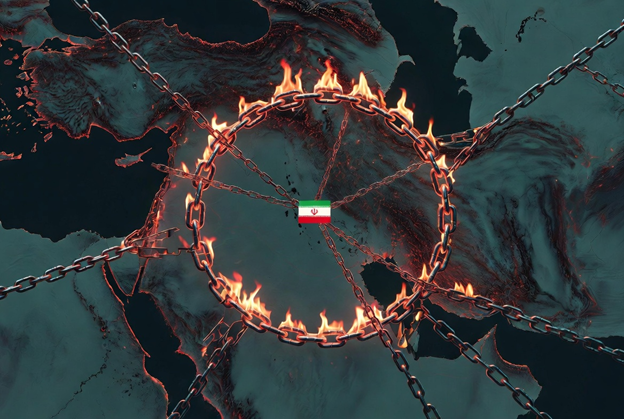



The Iranian flashpoint offers more than tests of air defences and nuclear sites. It exposes the evolving anatomy of Iran’s most ambitious strategic asset: the Axis of Resistance.
Decades in the making, this network of allied militias, political movements, and ideological partners span Hezbollah in Lebanon, the Houthis in Yemen, Shia militias in Iraq, Hamas in Gaza, and various remnants of Palestinian splinter groups. This network has long been presented by Tehran as a seamless “ring of fire” encircling and dominating its adversaries. In official Iranian rhetoric, this designed distribution functions as a unified deterrent: strike the centre, and the periphery ignites in co-ordinated retaliation.
It invokes the adage that change always comes from the edge.[1]
The events following Israel’s Operation Rising Lion against Iran in June 2025, and the recent, expansive U.S.-Israeli campaign launched in February 2026, inform a more fragmented story.
This brings to mind former boxing champion Mike Tyson’s famous comment on fight strategy: “Everyone has a plan until they get punched in the mouth.”
Rather than a disciplined symphony of resistance, the Axis reveals a patchwork of carefully calibrated, self-interested actions. Hezbollah launches rockets and drones toward northern Israel, but faces renewed Israeli pressure in Lebanon. Iraqi militias conduct sporadic drone strikes on U.S. positions, many intercepted with limited effect. The Houthis issue strong declarations of solidarity and occasionally launch missiles toward Israel, yet avoid full-scale re-engagement on the Red Sea front that risks provoking Saudi or Emirati retaliation. Hamas remains largely sidelined by devastating Israeli actions in response to the attacks on Israelis on October 7, 2023.
What emerges is no monolithic front but a loose, scattered coalition of actors balancing loyalty to Tehran against their own survival, local political constraints, and divergent incentives.
This pattern reveals a core truth about modern proxy warfare: centralized, regional sponsors such as Iran can supply weapons, training, and ideology, but they cannot fully command the behaviour of decentralized, territorially rooted groups in the manner a superpower can.
Each proxy operates within its own ecosystem of domestic legitimacy, resource needs, and risk calculations. Hezbollah, once Iran’s crown jewel, must navigate Lebanon’s fragile politics and the exhaustion of its own population after decades of conflict. The Houthis, strengthened by Red Sea success, prioritize preserving gains against Saudi Arabia and maintaining control in Yemen; they act when it aligns with those goals, not in concert with Tehran’s timetable. Iraqi militias, embedded in Baghdad’s power structures, face pressure from a government seeking normalization with Arab states and continued U.S. security co-operation.
The result is a network capable of harassment and asymmetric pressure, but far less reliable as its promissory and automatic multiplier. Its disaggregated and distracted condition emits wide behavioral variation.
The 2025–2026 escalations highlight strength and brittleness.
During the initial 12-day exchange in June 2025, proxies provided limited diversionary attacks that complicated Israeli and U.S. targeting, but did not fundamentally alter the tempo of direct strikes on Iranian soil. In the larger 2026 campaign marked by leadership decapitation strikes, most notably the killing of Supreme Leader Ali Khamenei, proxy responses intensified yet remained bounded. Hezbollah engaged in sustained border skirmishes and missile launches, while Israel conducted parallel operations without triggering all-out war in Lebanon. Iraqi groups increased drone and missile activity against U.S. assets, but many operations appeared performative, long on solidarity signalling and short on decisive retaliation that would risk broader coalition strikes against their bases. The Houthis were circumspect in using long-range strikes on Israel as low-cost demonstrations of alignment without fully committing their more vulnerable Red Sea capabilities.
These selective activations underscore the deeper evolution in proxy strategy.
Iran invested heavily in making its partners more autonomous: transferring drone and missile technology, enabling local production, and fostering ideological self-sufficiency. The payoff is durability: permitting proxies to operate even when Iranian command-and-control is disrupted by sanctions, assassinations, and direct strikes.
Yet autonomy and optionality come with a steep cost of control. Groups pursue their own political horizons.


Hezbollah seeks influence within Lebanese institutions, Houthis aim for recognition as a governing authority in Yemen, Iraqi militias balance anti-Americanism with patronage networks inside the Iraqi state. When Tehran’s survival is at stake, these actors offer support, but not at the expense of their core interests.
The Axis functions less like a disciplined army and more like a franchise operation: branded under the same ideological resistance, but run with significant local variation.
The information and cognitive domains amplify these dynamics. Just as direct combatants flooded global discourse with competing claims, proxies and their supporters generated parallel narratives as counter-measures, which I wrote about in some detail in the first essay in this series: Iran flashpoint showcases growing influence of battlefield lies.

Videos of Hezbollah strikes are amplified to project unified strength, while downplaying Israeli counterstrikes. Houthi statements frame limited actions as decisive contributions to the broader fight. State-aligned outlets and AI-assisted content portray the Axis as an unbreakable phalanx, even as independent reporting reveals co-ordination gaps and self-preservation. These calculated narratives serve two purposes: bolstering domestic morale in Iran and proxy territories, while shaping international perceptions of Iranian power. The myth of seamless proxy unity becomes another layer in the broader design and delivery of modern war lies – performatively projecting the appearance of coherence while fragmentation prevails.

What the Iranian flashpoint reveals about proxy networks is effectively double-edged.
On one hand, distributed resistance complicates response by great powers. Precision strikes on the Iranian homeland can be met with dispersed, hard-to-eliminate harassment from multiple theatres, raising the political and operational costs of escalation. This is strategically effective in the face of the massive asymmetry of capabilities. Scattered resistance has some advantage. On the other hand, this resilient decentralization limits strategic reliability. Iran cannot count on its proxies to absorb unlimited risk or synchronize perfectly with its own central objectives while adversaries can exploit these divergences and intrinsic vulnerabilities through targeted diplomacy, selective pressure, or de-escalation incentives to individual actors.
This reality challenges simplistic portrayals for all sides.
Tehran cannot credibly threaten total regional conflagration through its proxies if those proxies prioritize self-preservation. Wholesale regional destruction makes for a hollow threat. Israel and the United States cannot assume that degrading the Iranian centre will automatically collapse the periphery, yet they can calibrate responses to exploit the network’s internal tensions.
For global observers, the cautionary lesson against alarmist visions of an unstoppable Axis and dismissive claims of its irrelevance are worth minding.
Proxy systems endure because they are adaptive, not because they are invincible. And they are vulnerable.
As the conflict unfolds, it will follow a repeatable recipe: a mix of direct strikes, a twist of leadership turmoil in Tehran, and the stir of ongoing proxy maneuverings where and when the Iranian model of resistance enters new phases of stress-testing.
Future confrontations will likely extend these teachings into more technology transfer, greater emphasis on deniable operations, and continued narrative efforts to conflate incoherence. More noise, less signal. More uncertainty.
The underlying, persistent truth in modern war here and elsewhere is that proxies extend reach, but dilute command. They multiply options while introducing frictions. The Axis of Resistance neither shattered under pressure nor ignited its promised, unified blaze.
It flickered in the draft of its own distributed logic, revealing (once again) in 21st-century conflicts that the most carefully constructed networks remain subject to realism: imperfect human and political instruments calculated by self-interest.
***
[1] This concept has a long pedigree in political, economic and philosophical thought, in fiction and non-fiction, across Isaac Asimov, Frank Herbert, Rebecca Solnit and Stephen Jay Gould, among many others.
(Richard LeBlanc – BIG Media Ltd., 2026)
