







Adapted from the Booker Prize–winning novel by Irish author Paul Lynch, Prophet Song is staged by the ITA Ensemble (International Theatre Amsterdam) under the direction of Iranian-born German director Mina Salehpour. The production runs for 120 minutes without an intermission.
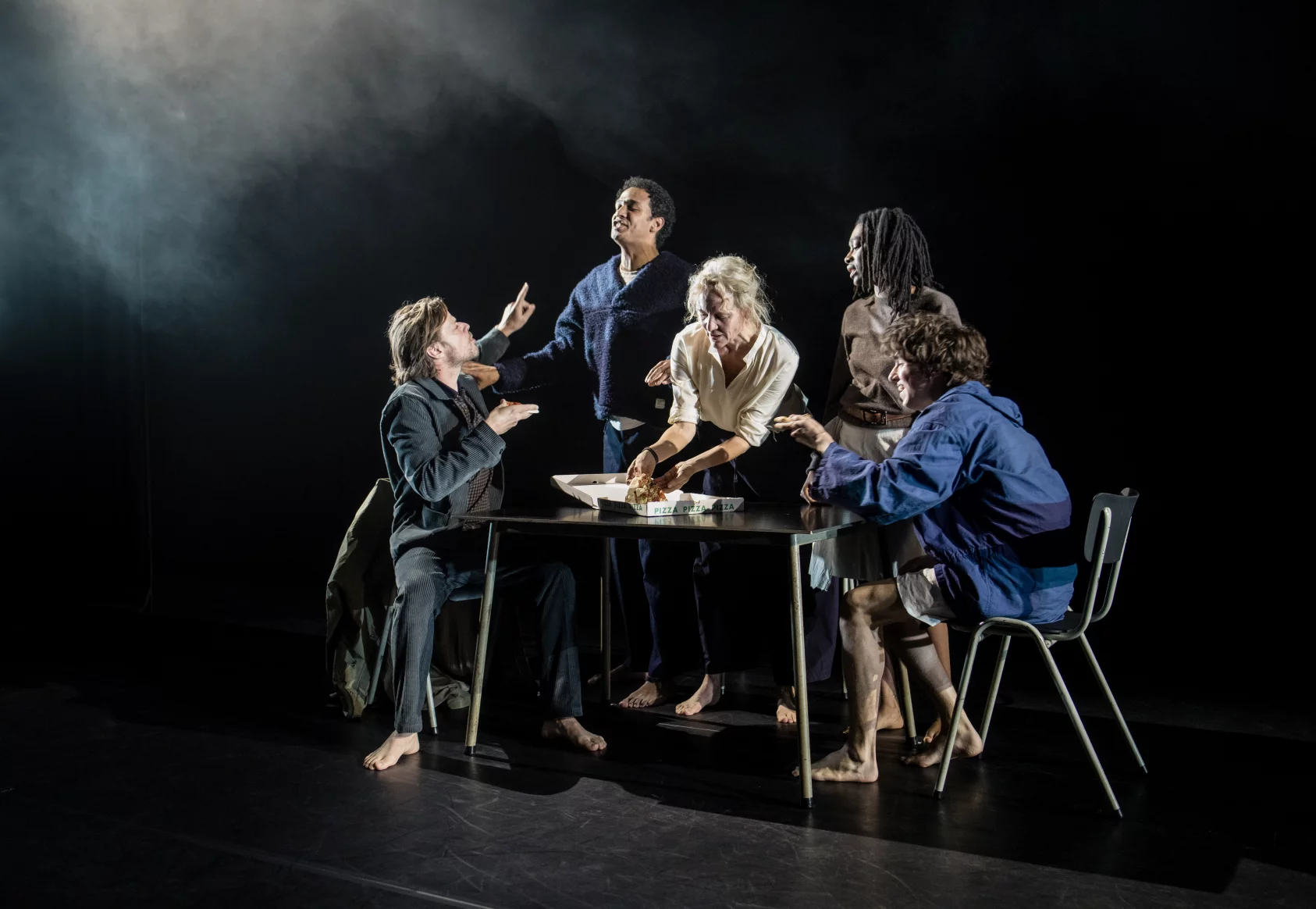
The ITA’s high-ceilinged theatre hall, with its balconies and classical architecture, immediately captivates the audience. The play is performed in Dutch, with English surtitles displayed on both sides of the stage to avoid obstructing the view. The stage itself is dimly lit, extending into what feels like a vast, cold emptiness. On the left, only a table and a few chairs suggest the interior of a home. The boundaries between private and public space appear to have vanished.
Eilish (Janni Goslinga) stands at the front of the stage, her arms held as if holding a baby, addressing the audience directly. Through her narration, we learn that someone is knocking at the door. The police are outside. From that moment on, we are drawn into the dark, unsettling atmosphere that will shape the entire performance.

Prophet Song, by Paul Lynch, adapted by Mina Salehpour and Lea Goebel, and directed by Mina Salehpour. © Andreas Schlager.
Prophet Song portrays how a democratically elected government gradually transforms into an authoritarian regime. In a country where civil liberties are restricted, emergency laws become permanent, and people are detained without indictment. The play follows a woman struggling to keep her family together as she loses everything, piece by piece. More than a story of political collapse, it explores the process of becoming accustomed to that collapse. The instinct to be shocked slowly gives way to quiet acceptance. In doing so, the play turns the audience into witnesses of a collective erosion unfolding within the veneer of everyday normalcy.
Eilish lives in Dublin with her husband, Larry (Sanne den Hartogh), and their children, Mark (Jesse Mensah), Molly (Ntianu Stuger), Bailey (Roman Derwig), and their baby, Ben, leading what appears to be an ordinary life. Eilish tries to hold on to that sense of normality as long as she can. Larry, an active representative of the Irish Teachers’ Union, is arrested after a union march protesting the government’s expansion of its powers under the pretext of national security, and he disappears. Eilish turns to every possible legal channel to see him, if not to bring him home, but the law no longer functions. The system produces only silence and uncertainty.

Prophet Song, by Paul Lynch, adapted by Mina Salehpour and Lea Goebel, and directed by Mina Salehpour. © Andreas Schlager.
Their son Mark is called up for compulsory military service before he is even 18. He refuses to join, goes into hiding and eventually disappears. The other son, Bailey, is injured during a street demonstration. Eilish searches for him from hospital to hospital until she is forced to identify her son’s body among dozens of others in a morgue.
From the moment Larry is taken, Eilish’s father urges her to leave the country and join her sister in Canada. She refuses for a long time. She cannot bring herself to abandon her husband, her home, her work and the life she knows. By the time she finally accepts that she can no longer stay, even her passport application is rejected. The state has already closed every exit. One by one, everything she tries to hold onto is taken from her. Eilish finds herself standing by the sea with her daughter and baby, waiting for a refugee boat. The play ends precisely at that threshold, suspended in uncertainty, between leaving and the impossible hope of staying.


Prophet Song, by Paul Lynch, adapted by Mina Salehpour and Lea Goebel, and directed by Mina Salehpour. © Andreas Schlager.
The vastness of the stage gradually reveals itself as one of the production’s most powerful dramaturgical tools. Its depth and width create the feeling of an exposed landscape rather than a traditional theatrical setting. The emptiness is striking. There is almost no fixed set; apart from a table, a few chairs, and props that appear occasionally, the stage remains largely bare.
Nearly fifty ensemble performers are used to create shifts in time and place through their positioning on stage and the careful use of light. At times, the actors appear as customers moving through a supermarket with shopping carts; at others, they lie beneath white sheets in a morgue or gather as protesters filling the streets. These transformations occur quickly and almost seamlessly, allowing the stage to move fluidly from one environment to another. While one scene unfolds in the foreground, another quietly begins to take shape in the background, reinforcing the narrative’s layered structure and making the collapse feel simultaneous, systemic, and impossible to escape.

Prophet Song, by Paul Lynch, adapted by Mina Salehpour and Lea Goebel, and directed by Mina Salehpour. © Andreas Schlager.
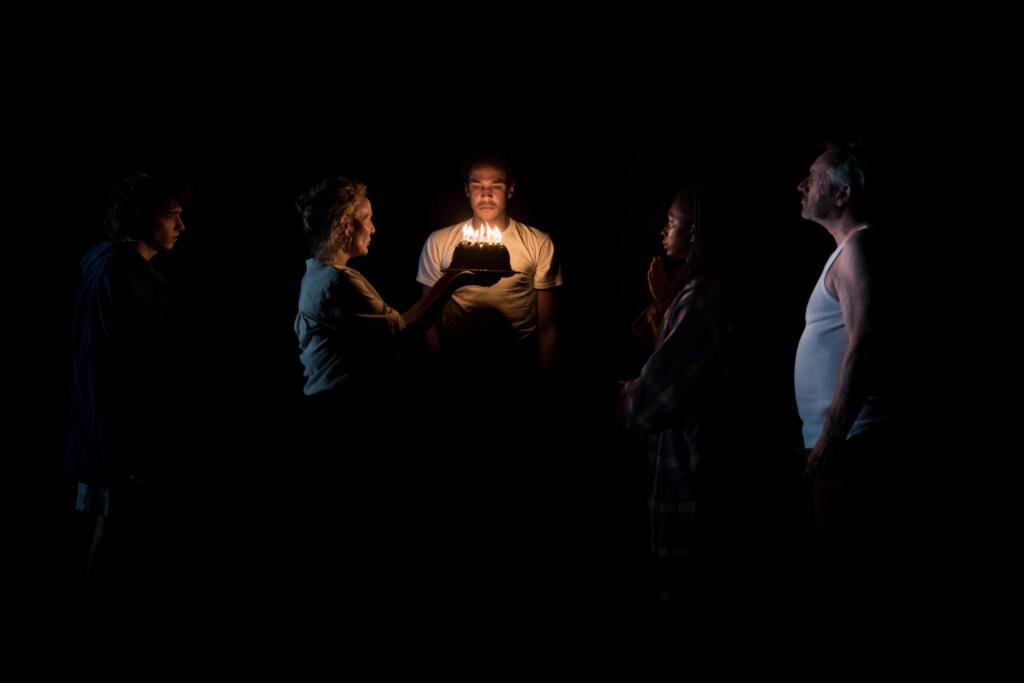
Mark Van Denesse’s lighting design almost acts as a character, quietly shaping the emotional landscape of the performance. For much of the play, the stage stays in dim, subdued light, allowing the vast emptiness of the space to set the mood. At key moments, the lighting shifts suddenly. The harsh fluorescent lights overhead evoke the unsettling brightness of a supermarket and the cold stillness of a morgue. Especially towards the end, water reflections across the stage suggest the edge of the sea, and the shifting light creates a mesmerizing sense of uncertainty. This subtle yet precise use of light heightens the emotional tone, drawing the audience beyond passive spectators and placing them directly within the tension of the stage.
The shifting structure between narrator and character, combined with the large ensemble, creates a rhythmic and fluid form. The performances remain restrained and controlled, maintaining a careful balance between emotional intensity and distance. The fact that actors take on multiple roles prevents the audience from identifying too closely with individual characters and instead keeps the focus on Eilish’s story.


Prophet Song, by Paul Lynch, adapted by Mina Salehpour and Lea Goebel, and directed by Mina Salehpour. © Andreas Schlager.
The baby Ben, who never physically appears on stage, exists only through the gesture of the actor playing Eilish, who holds her arms as if carrying a child. There is neither a prop nor a visible object; the actor embraces emptiness. This baby, whose very existence remains ambiguous, stands like the future itself: fragile, uncertain, and hauntingly undefined.
Prophet Song does not romanticize migration. Leaving is not presented as salvation, nor is staying glorified as an act of resistance. The line between leaving and staying gradually dissolves, and leaving ceases to be a choice, becoming a necessity instead. Yet the outcome of that necessity remains uncertain. By the end of the play, we are left on a threshold where even the possibility of escape is unclear. We witness the familiar reflex of those who believe, “nothing will happen to us,” who refuse to see the disaster slowly approaching. Rather than dramatizing individual tragedy, the play reveals the fragile line between denial and reality, questioning the distance between hope and the quiet process of becoming accustomed to the unacceptable.

Prophet Song, by Paul Lynch, adapted by Mina Salehpour and Lea Goebel, and directed by Mina Salehpour. © Andreas Schlager.
Today, the collapse shown in Prophet Song is no longer a dystopian fiction but a reality unfolding in many forms around the world. We live in a time when governments elected through democratic means gradually weaken the rule of law, expanding their powers under the excuse of “security;” when journalists, academics, and young people taking part in peaceful protests are forcibly taken from their homes during dawn raids, or killed on the streets; when dissent is criminalized, and wars alongside authoritarian regimes force millions to flee, leaving entire populations uprooted and children killed. According to the UNHCR’s Global Trends report, by the end of 2024, the number of people forcibly displaced worldwide due to persecution, conflict, violence, and human rights violations had reached 123.2 million (UNHCR, 2025). Forced displacement is no longer a rare story from somewhere else; it has become a global reality.
Prophet Song is not about one place but about a moment in history. It reminds us that democracy does not sustain itself automatically, that the rule of law does not survive on its own, and that loss rarely arrives all at once. It accumulates slowly, through small silences, small compromises, small acts of looking away. In the end, the play confronts the audience not only with Eilish’s story but with their own sense of safety.
Where is the threshold at which we convince ourselves that nothing will happen to us?
And once that threshold is crossed, will there still be any place left to escape?
March, 2026, Toronto
Reference:
United Nations High Commissioner for Refugees (UNHCR). (2025). Global trends: Forced displacement in 2024. UNHCR. https://www.unhcr.org/global-trends?utm_source
For full credits, click here.
This post was written by the author in their personal capacity.The opinions expressed in this article are the author’s own and do not reflect the view of The Theatre Times, their staff or collaborators.
This post was written by Berna Ataoğlu.
The views expressed here belong to the author and do not necessarily reflect our views and opinions.