




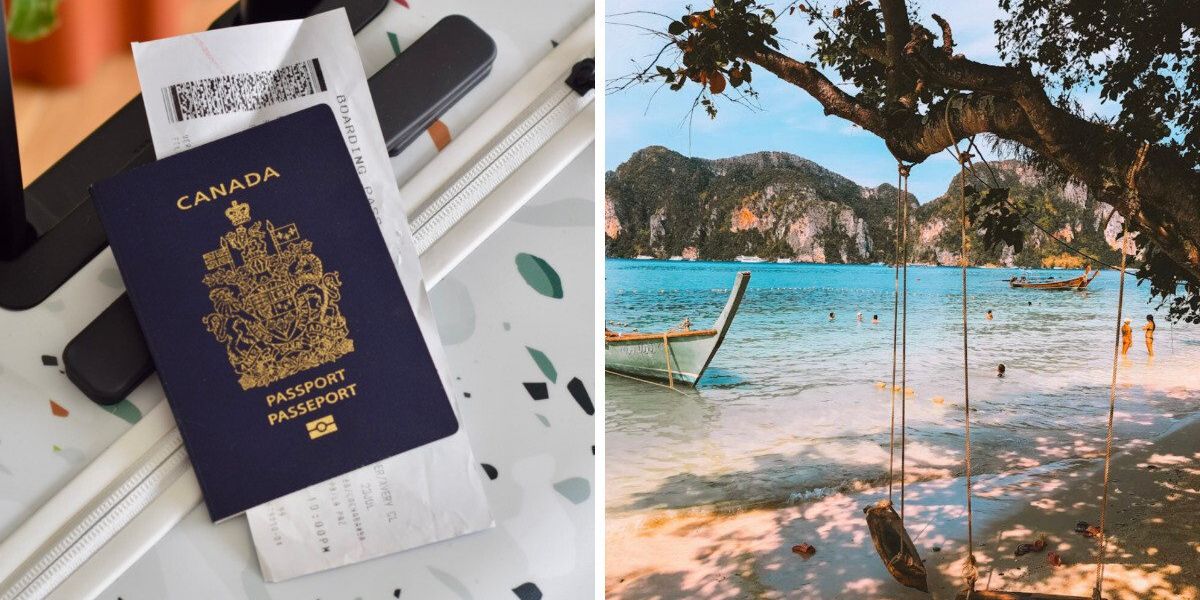
The Canadian dollar isn’t having its strongest year — but that doesn’t mean your travel plans have to suffer. In fact, there are still plenty of cheap destinations where the Canadian dollar will go a long way.
Where a central bank has kept interest rates low, allowed inflation to run, or repeatedly devalued its currency, the Canadian dollar will still stretch pretty far. It’s a pattern that Ronald G. Wayne, co-founder of Apple Computer Company and author of Tomorrow’s Money, has spent decades tracking.
“A currency is only as strong as the discipline behind it,” Wayne recently told Narcity Canada. “Where that discipline is weak, the Canadian dollar goes further. Where it firms up, the advantage narrows.”
The nine destinations below were selected with that framework in mind — each one offers a meaningful exchange rate advantage for Canadians right now, and each one is worth visiting on its own terms.
Keep in mind that a favourable exchange rate doesn’t automatically make a destination cheap, and it’s worth going in clear-eyed. Getting there is a separate equation, and long-haul flights to places like Japan or South Africa can be costly. Trips like those need at least 10 days to justify the travel time, too, so the math has to account for that from the start.
On the ground, how much the dollar stretches depends heavily on how you travel. Boutique hotels and private guides will narrow the advantage quickly; local transport and mid-range accommodation will extend it. Peak season pricing can close the gap in a hurry, so timing matters as much as destination.
With expert insight on each one, here are nine destinations where the Canadian dollar is working hardest right now.
Japan
Japan has a way of living up to the hype. Ancient temples, bullet trains, world-class food, and scenery that shifts dramatically from one region to the next — and right now, it’s surprisingly affordable for Canadians.
Why? Well, it comes down to the yen. “The yen is weak, and it has been weak for years,” Wayne told Narcity. “Ultra-low interest rates and a slow hand at the Bank of Japan have kept it that way, so the Canadian dollar converts into a great many yen and stretches comfortably across travel, dining, and daily life in 2026.”
The flight from Canada is a real line item, and Japan isn’t a shoestring destination — but on the ground, your money will go further than you might have expected. If it’s been on your list for years, 2026 is a window worth taking seriously.
Egypt
Few destinations carry the weight of Egypt — the Pyramids at Giza, the temples of Luxor, the Valley of the Kings, and the Nile itself, which has been drawing travellers for millennia. For Canadians, the timing adds another reason to go.
The Egyptian pound has dropped sharply through a series of devaluations tied to economic reforms, and the impact on exchange rates has been favourable.
“The Canadian dollar stands strong against it for lodging, tours, and local goods,” Wayne told Narcity Canada. Inflation is the main variable to keep an eye on, but the current window is strong.
Argentina
Buenos Aires has long been one of South America’s great cities — grand 19th-century architecture, a food scene built around beef and wine, and a nightlife culture that doesn’t get started until midnight. Go further south, and Patagonia opens up: glaciers, dramatic peaks, and some of the most remote wilderness on the planet.
And right now, all of it comes at a price that strongly favours a Canadian traveller. Argentina has repeatedly depreciated its peso, and inflation has compounded the effect, according to Wayne.
“Argentina has devalued its peso again and again, and inflation has done the rest,” he says. “Foreign currency goes a long way there.”
Vietnam
Vietnam stretches over 1,600 kilometres from top to bottom, and the range it covers is remarkable — the ancient port town of Hội An, the limestone karsts of Ha Long Bay, the frenetic energy of Hà Nội, and the street food culture that runs through it all. It’s a country that tends to exceed expectations without breaking the bank.
“Vietnam manages its currency closely and keeps local costs low,” Wayne says. “The result is simple: the Canadian dollar goes a long way on meals, transport, and a place to sleep. It is a consistent value.”
Turkey
Turkey spans two continents and feels like it. From the layered history of Istanbul’s old city to the surreal rock valleys of Cappadocia, where balloon flights at sunrise have become one of travel’s most iconic images, it’s a destination that consistently over-delivers.
The currency situation works strongly in a Canadian traveller’s favour right now, too. Turkey has weathered years of high inflation and a sliding lira, and the impact on exchange rates has been significant.
“For the Canadian visitor, that means local prices convert low, and the dollar carries real weight,” says Wayne. One caveat: domestic prices rise quickly, so some of that advantage can narrow, which is worth factoring in when you’re budgeting.
Colombia
Colombia has quietly become one of the most talked-about destinations in the Americas — and the country backs up the buzz. Cartagena’s colonial centre, the mist-covered coffee region, and a reinvented Medellín that bears little resemblance to its former reputation all make the case for a country that’s hit its stride as a travel destination.
The peso adds to the appeal, too. “The Colombian peso moves with oil, with interest rates, and with the country’s politics,” Wayne explains. “That movement is not a flaw to the traveller. It opens windows where the Canadian dollar converts especially well, and a patient visitor can use them.”
South Africa
South Africa covers an enormous amount of ground — geographically and experientially — and it consistently punches above its weight as a destination. Cape Town has Table Mountain, the Winelands, and a coastline that stretches farther than you can see in both directions. Kruger National Park and the Garden Route push the case for staying even longer.
The rand works in a Canadian traveller’s favour. It’s a volatile currency, regularly pressured by South Africa’s broader economic conditions.
“For the Canadian visitor, this volatility tends to work in your favour,” Wayne says, “particularly on lodging, food, and guided travel.”
Thailand
Thailand has been drawing travellers for decades and hasn’t run out of reasons to keep doing so. White-sand islands in the south, temple complexes in Chiang Mai, the controlled chaos of Bangkok’s street markets — it covers an enormous amount of ground at a price point hard to argue with.
“Thailand leans heavily on tourism, and the baht softens often enough that, paired with affordable local pricing, it favours the Canadian traveller,” Wayne says. The baht can firm up in peak season, though, so timing is worth factoring into your planning.
Mexico
Few countries offer as much variety as Mexico — the turquoise water at Tulum, the mountain cool of Oaxaca, the ruins at Chichén Itzá, and Mexico City, one of the great urban destinations in the Western Hemisphere. The range is genuinely hard to match, and the price point for Canadians makes it harder to overlook.
“The Canadian dollar remains useful in Mexico, where the cost of living runs below what you pay at home,” Wayne says. “The peso has had its strong stretches, so the advantage is real but worth watching before you book.”
Currencies shift, inflation corrects, and the windows that exist today can narrow quickly. If a trip has been on your list for a while, 2026 isn’t a bad year to stop putting it off!
Exchange rates fluctuate and the information above reflects conditions at the time of writing — always check current rates before you travel and factor in the full cost of your trip, including flights, accommodation, and travel insurance.