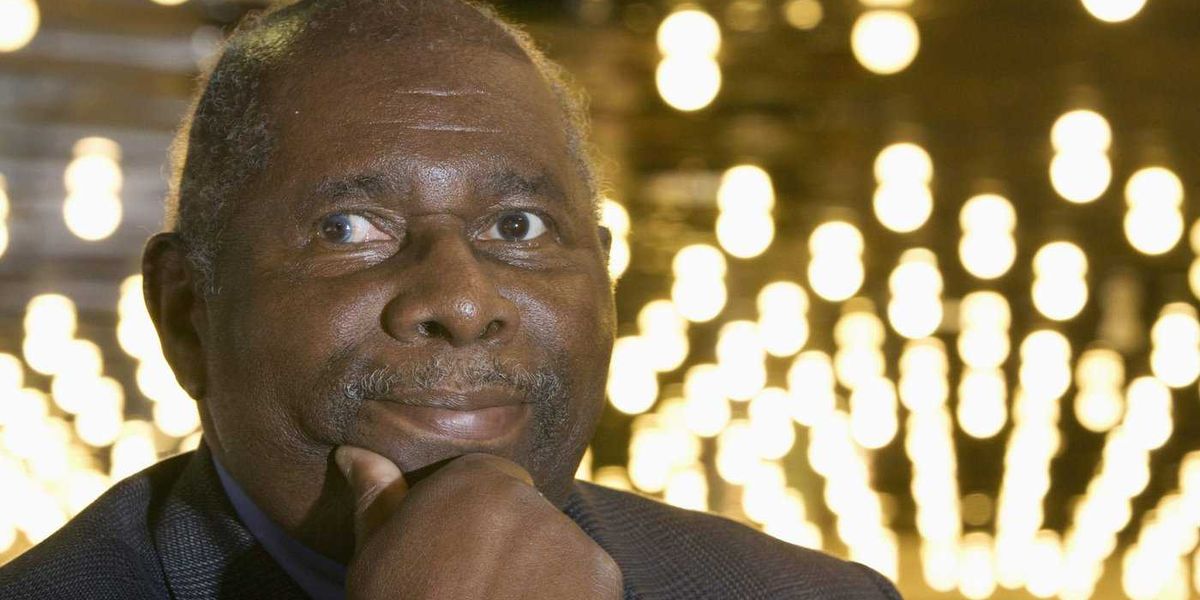





Canadian pianist Oliver Jones, whose varied musical career took him from classical to pop to jazz stages around the world, has died. He was 91.
In a statement posted online, Jones’s family and his record label, Justin Time Records, said the celebrated virtuoso passed away on Wednesday in Montreal.
“An exceptional musician, a gentle soul and a friend who touched so many live, his kindness and immense talent left a lasting mark on so many people and generations, and his memory will continue to inspire us,” they said.
The family asked for privacy as they grieve.
Jones rose to stardom from the same impoverished Montreal neighbourhood as friend and mentor Oscar Peterson, studying piano as a child under Peterson’s sister Daisy and beginning his performing career at age five.
Rooted in a classical education, Jones went on to a forge a more than seven-decade career that spanned nearly all genres and included recordings with such international luminaries as Peterson, Clark Terry, Ray Brown, Ed Thigpen, Herb Ellis and Red Mitchell.
At the height of his career, Jones was generous with his support for up-and coming artists, notably becoming one of the first jazz professionals to nurture and encourage a young Diana Krall. His song “Dance Again Diana,” from his 2006 album “One More Time,” is dedicated to her.
“There’s a lot of great Canadian musicians, singers that are coming up and no longer are we the poor cousins,” Jones said of the Canadian jazz scene in a 2008 interview with The Canadian Press.
“For so many years, when I first went to the U.S., we went over the border and the agent would say, ‘We don’t need you here, we have all the best musicians in the world.’ It was extremely hard for Canadians to get permits to go and work in the States.”
Growing up black in Montreal in the ’40s and ’50s was not easy. Jones often credited Peterson, a neighbourhood phenom who lived 15 blocks away from his childhood home, with inspiring him to become an accomplished jazz pianist himself. Pursuing dreams like these promised an exciting future far from the hardships of their parents, he said.
“A whole three generations prior to ours, the only jobs that we were able to get were that as porters or other menial jobs,” Jones said in 2008.
“It was a very precarious time for us, but we knew that we had to persevere. To have someone as young as Oscar who was determined … was a wonderful example for the rest of us to understand that nothing was going to be given to you for free, you have to go and earn it.”
Pianist Oliver Jones, centre, smiles as he receives the medal of the National Assembly at a ceremony, Tuesday, May 10, 2016 at the legislature in Quebec City. Jones is flanked by Quebec Premier Philippe Couillard and National Assembly Speaker Jacques Chagnon.THE CANADIAN PRESS/Jacques Boissinot
A child prodigy, Jones began playing in nightclubs at age 10 but never succumbed to the seedier temptations of showbiz life. He said he was proud that he didn’t smoke, drink, or do drugs, despite often feeling pressure to do so during his early years in jazz clubs.
“While I was growing up, I remember playing in clubs and people offering me drinks and I would say, ‘Thank you but no thank you, I’ll have a Coke or Seven-Up.’ And they’d say, ‘Well, you can’t be a jazz musician if you don’t drink’,” he said.
“Or (they’d say) that if you can’t smoke marijuana you’re never going to be a great musician. I think that was a problem for many, many years — it kept jazz in the cellars, in the speakeasys and it’s great pianists like Dave Brubeck and Earl Garner and Oscar Peterson and that, that have brought it to this level, brought it to the concert hall.”
Although jazz was his main passion, Jones spent some 16 years as an arranger/conductor in the more lucrative pop sphere. With his wife and young son in tow, Jones moved to Puerto Rico in 1964 to work as musical director and pianist for Jamaican singer Kenny Hamilton.
In 1980, Jones returned to Montreal, determined to pursue jazz professionally.
He would turn 50 before being discovered in the jazz world, winning over critics and scoring immediate fans with a phenomenal technique and a hard-swinging style.
Since the mid-’80s, Jones racked up a slew of jazz awards and honorary doctorates, netting the Order of Canada, SOCAN lifetime award and a Governor General’s Performing Arts Award for lifetime achievement.
In his later years, Jones would split his time between Montreal and Florida, but remained active with an average of 65 concerts a year.
Jones leaves behind a son, Richard.
This report by The Canadian Press was first published July 23, 2026.
By Cassandra Szklarski | Copyright 2026, The Canadian Press. All rights reserved.