




On 11 and 12 July, in Spoleto (Italy), there was the European premiere of a significant appointment with dance history and, in particular, with American late modern and postmodern dance and its enduring dialogue with the visual arts: the double bill dedicated to visual artist Robert Rauschenberg and his long-time collaborators Trisha Brown and Merce Cunningham. In the frame of the 69th edition of the Festival dei Due Mondi (also known as Spoleto Festival and directed by Daniele Cipriani), Dancing With Bob. Rauschenberg, Brown & Cunningham Onstage featured Set and Reset, a piece that epitomizes Brown’s choreographic signature, and Travelogue, a lesser-known work by Cunningham. Currently on tour, both works are performed by the Trisha Brown Dance Company (TBDC), whose dancers navigate convincingly the contrasting movement qualities of Brown and Cunningham. The production is also supported by a consortium of institutions, among them Dance Reflections by Van Cleef & Arpels and the Robert Rauschenberg Foundation.
The performance opened with Brown’s Set and Reset, a work created in 1983 whose filmed excerpts are widely available online. Yet experiencing it live with the dancers sweating and breathing on stage revealed an entirely different dimension, bringing into focus a wealth of details that are often difficult to grasp in recorded versions.

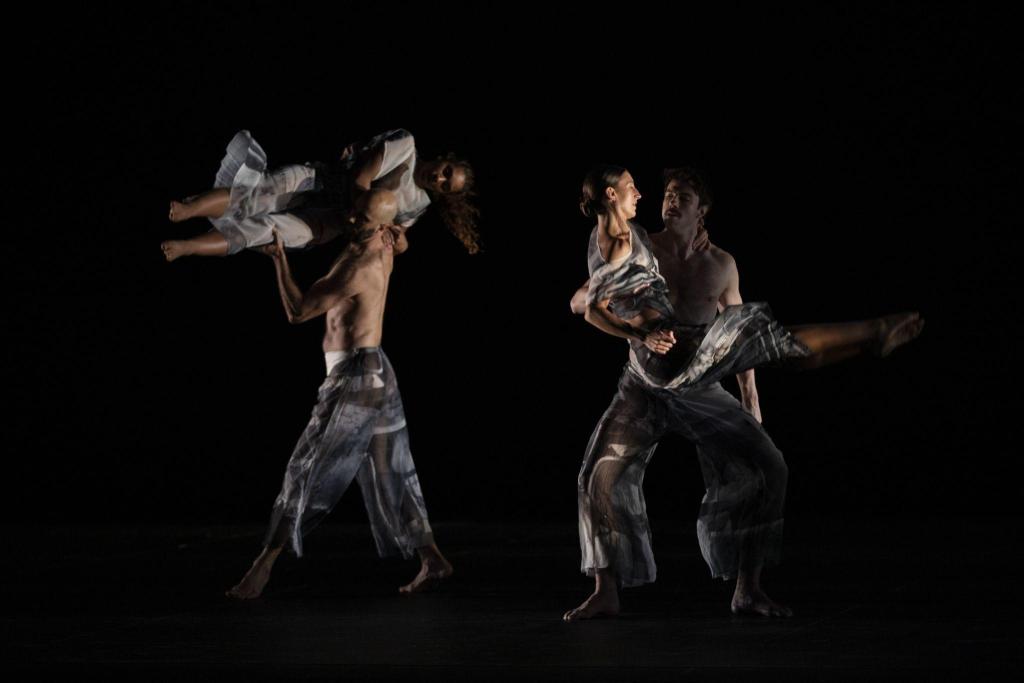
Set Reset. Photo: Damiano Mongelli.
On stage, Rauschenberg’s overhead geometric installation Elastic Carrier (Shiner) – a rectangular translucent box between two pyramidal forms of the same material – serves as a volumetric screen for a collage of black-and-white found footage. Moments after the projection begins, a small group of dancers enter on stage carrying with their outstretched arms a female body that moves parallelly to the floor, as if walking on a vertical wall — those familiar with the early works of Brown will immediately recognise a free adaptation for the stage of the 1971 piece Walking on the Wall (the title describes exactly what the work is about). Their bodies are covered with soft and loose see-through tops and trousers designed by Rauschenberg that feature his black-and-white photographs of urban and industrial sites. When the music starts, Long Time No See by another legendary artist, Laurie Anderson, propels the dancers through space with its repetitive, percussive and insistent quality. They move with the insuperable movement style that has characterised most of Brown’s works: lightness combined with buoyancy, limbs moving loosely but precisely, movement travelling sequentially in the body from one part to the other and fleeting geometry that quickly disappears. Gliding through space, the dancers suspend before yielding to gravity and Anderson’s music score seems to permeate their bodies, which respond to the percussive sounds with unexpected movement accents. Small groups enter and exit from the stage and dancers replace one another; as their arms cut the air for the rest of the body to occupy space, each entrance becomes a declaration and affirmation of presence. After approximately twenty minutes of uninterrupted flow, the end arrives rather unexpectedly, bringing a metaphysical dimension to the piece: a body is placed horizontally on the floor half off stage and half on stage while Rauschenberg’s film continues to play overhead. Does this sudden pause imply a short rest or does it evoke death?
Set and Reset belongs to the concluding phase of Brown’s choreographic research that focuses on unstable molecular structures – indeed the shifting clusters of the dancers resemble molecules in perpetual motion. As a work, it transfers and connects with the theatrical space her longstanding corporeal exploration of how to defy gravity, developed through her choreographic experiments in urban sites during the 1960s and 1970s. Today, more than forty years after its premiere, Set and Reset remains truly inspiring and remarkable for its integrated collaborative research across movement, music and visual art and it still conveys a spontaneity as if an improvisational exploration of spatial relations grounded within and in between the bodies. However, one aspect that proved more difficult to notice in the current reconstruction was the principle of visibility and invisibility that was so integral to Brown’s original conception and was manifested in the blurring of on- and off-stage movements thanks to the transparent stage wings designed by Rauschenberg. In this version, actions on- and off- stage were clearly separated, depriving the viewers from drifting their gaze across the whole stage.
Travelogue, which premiered in 1977, emerges as another interdisciplinary collaboration, with costumes and set design also signed by Rauschenberg. The opening scene reveals Tantric Geography, Rauschenberg’s bizarre and immobile vehicle where the nine dancers appear as silhouettes against a red-lit background; sitting on a row of wooden chairs interrupted by bike wheels. The idea of travelling, even if it is in one’s own imagination, is already present in the static multi-seater bicycle-like sculptural set.

Robert Rauschenberg’s Tantric Geography as part of Travelogue. Photo: Damiano Mongelli.
The piece is deliberately composed in episodes, continuously surprising the audience with disconnected actions: two dancers stretch a cord where various belongings, such as clothes and tins, hang; a dancer takes a ribbon and ties it in her hair while another wears the tins around his thighs, recalling the attire of a distant tribe as he produces subtle metallic sounds with his moves. Elsewhere, a small group of dancers adds on the top of their monochrome leotards – so characteristic of Cunningham’s works – a sort of fan-shaped skirts that, when open vertically, resemble colourful wheels. The dancers all together wear a caterpillar-like white cover on the top of their purple, red, yellow, orange and cyan uniforms, creating a collective body with many heads. Flag-like draperies of imagined or non-existent places roll down from the top of the stage – they could have belonged to Italo Calvino’s Invisible Cities but they actually echo Rauschenberg’s sewn fabric series called Jammers (1975–76).
Travelogue is visually strong, evocative of imaginary places and creatures. As the dancers pass through these shifting landscapes, they do not only interact with the props, accessories and costumes designed by Rauschenberg but occasionally they also change their way of moving – for instance, duets inspired by social dance from Latin America are fused with codified movements from Cunningham technique, creating unexpected choreographic encounters. John Cage’s composition Telephones and Birds (1977), performed live by three musicians, who are seated, quite hidden, at the bottom of the stage and make phone calls to different countries answered by automated machines, reinforces further the idea of travelling. Italy becomes one of the destinations for a visit to the Colosseum or a meal at an Italian restaurant for eating pasta. These calls combined with bird songs mirror the work’s playful accumulation of urban and natural places.

Travelogue. Costumes and set design by Robert Rauschenberg. Photo: Damiano Mongelli.
The double bill performance Dancing With Bob highlights the creative potential of interdisciplinary collaboration among choreography, music and visual art for a theatrical environment in two distinct ways. Rauschenberg’s set design and costumes for Set and Reset stand as a reminder of Brown’s earlier experiments in urban space while Laurie Anderson’s music score transforms the corporeal act of falling in space into a sonic trigger. This collaborative outcome emerges as a joint effort for a creative dialogue between the artists that is echoed in each other’s contributions. In Travelogue, choreography, visual art and music develop independently their own trajectories around the idea of travelling. However, the body remains the only instrument that manages to animate Rauschenberg’s props and costumes – which otherwise would have remained lifeless – in unique and evocative ways.
Above all, the reconstructions of Set and Reset and Travelogue embody history, rendering Dancing With Bob more than an homage to Rauschenberg. As the question on what renders a repertory contemporary remains open, both works enable us to also trace the enduring influence of Brown and Cunningham on today’s artists. As such, this living repertory is essential that co-exists alongside contemporary creation, not as a burden, but as a source of further inspiration and interrogation that may illuminate unpredictable artistic pathways.
This post was written by the author in their personal capacity.The opinions expressed in this article are the author’s own and do not reflect the view of The Theatre Times, their staff or collaborators.
This post was written by Ariadne Mikou.
The views expressed here belong to the author and do not necessarily reflect our views and opinions.