


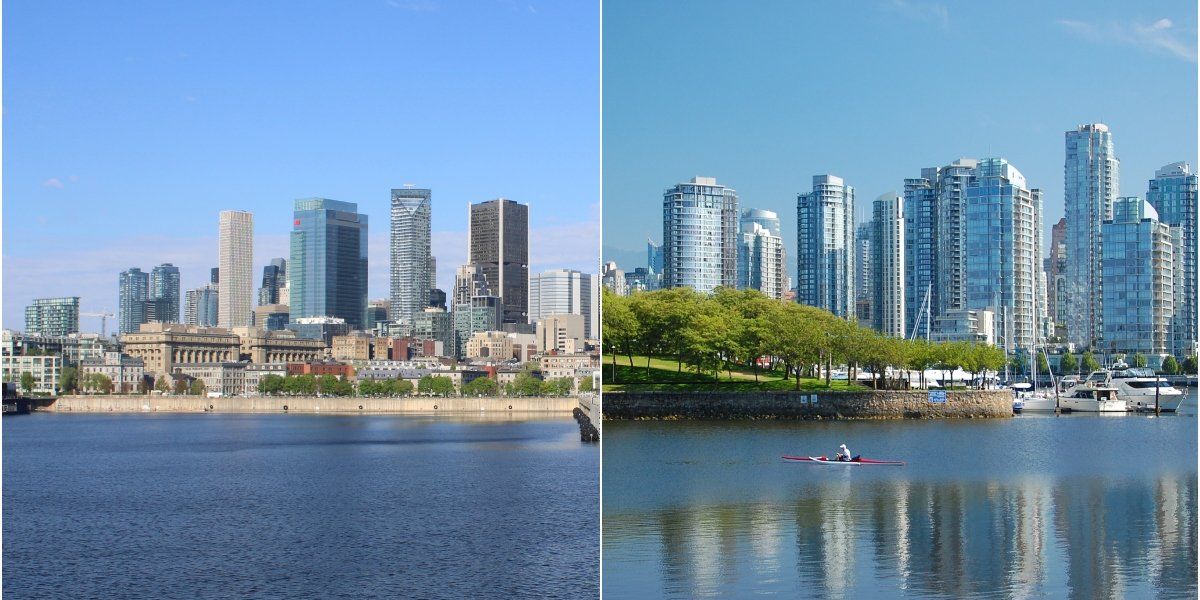



Montrealers love to complain about how expensive things have gotten, and fair enough, rent prices and the overall cost of living here have climbed a lot in recent years.
But zoom out to the rest of the country and Montreal still looks like a bargain, especially next to Vancouver, which routinely lands at the top of the list of Canada’s most expensive cities thanks to sky-high rents and some of the priciest real estate anywhere in the country.
Using the latest data from Numbeo (updated July 2026), along with some of our own figures, we lined the two cities up category by category. Vancouver came out more expensive almost everywhere, and in a few areas the gap is genuinely hard to believe.
Rent
A one-bedroom in downtown Vancouver averages $2,600, compared to $1,766 in Montreal, roughly 32% more. Head outside the core and the gap holds, with Vancouver at $2,228 versus Montreal’s $1,379. A three-bedroom downtown runs $5,000 in Vancouver against $3,154 in Montreal.
Overall, Numbeo puts rent in Montreal about 36% lower than in Vancouver.
Buying a home
If the rent gap stings, buying is where it turns brutal. The price per square metre for an apartment in downtown Vancouver averages $12,639, almost double Montreal’s $7,138. Outside the centre it’s $9,906 versus $5,368. This is the widest gap in the whole comparison, and a big reason Vancouver has earned its reputation as a place where owning property feels like a fantasy for a lot of people.
Groceries
Groceries are where it gets interesting, because Montreal doesn’t win them all. A few staples actually cost more here. Milk, bread and local cheese run a little higher in Montreal, while Vancouver charges more for meat and produce:
- Milk (1L): $3.26 in Montreal vs $2.96 in Vancouver
- Bread (500g): $4.47 in Montreal vs $3.86 in Vancouver
- Chicken fillets (1kg): $16.51 in Montreal vs $20.24 in Vancouver
- Beef (1kg): $19.71 in Montreal vs $26.83 in Vancouver
- Eggs (12): $5.11 in Montreal vs $5.91 in Vancouver
- Apples (1kg): $4.79 in Montreal vs $5.90 in Vancouver
The meat and produce differences win out in the end, and Numbeo puts Vancouver’s overall grocery prices about 18% higher than Montreal’s.
Transit
Montreal’s transit system is both bigger and cheaper to ride. A monthly STM pass for the island now runs $110, a bit less than Vancouver’s $114.40. Single fares are basically a wash, at $3.75 here versus $3.50 out there. The bigger win is what you get for the money, since Montreal’s metro-and-bus network covers a lot more ground.
Utilities
Monthly utilities are nearly identical. Basic bills for an 85-square-metre apartment come to $114 in Montreal and $116 in Vancouver. Where Montreal pulls ahead is internet, at about $59 a month versus $75 in Vancouver.
Dining out
Eating out leans slightly cheaper in Montreal. An inexpensive sit-down meal averages $23.50 here against $27.50 in Vancouver, and a three-course dinner for two runs $105 versus $120. The one exception is beer, where a domestic draft is actually a dollar cheaper in Vancouver. Small consolation.
Childcare
Here’s another eye-opener. Private full-day preschool or kindergarten averages $841 a month in Montreal versus $1,631 in Vancouver, close to double. Quebec’s subsidized daycare system helps a lot, and it’s a big part of why Montreal keeps ranking as one of the most affordable cities in Canada for families with young kids.
The big picture
Numbeo estimates you’d need around $9,500 in Vancouver to live the same way you could on $7,371 in Montreal, assuming you rent in both. That puts Montreal’s overall cost of living, rent included, about 22% lower.
Salaries close some of the distance. The average after-tax monthly wage in Vancouver is about $4,725 versus Montreal’s $4,140, roughly 14% higher. So a Vancouver paycheque goes a little further than the price tags let on, but not nearly far enough to close a gap that wide.
So the next time your rent comes up over brunch and someone starts venting, you’ve got a comeback ready: It could be Vancouver.