




Across the ages, there have been dynasties of actors, most recently, among others, Redgrave and Fox in the UK, Fonda and Barrymore in the USA, Cusack in Ireland, and Thalbach and Bleibtreu in Germany. In Germany, there are also some very successful (married) couples working together in the theatre, as dramatists, actors, directors, and theatre managers. I will be writing about Sabine Misiorny and Tom Müller; Theresa Sperling and Stefan Voglhuber, and Vania and Andreas Brendel. What they have in common is a focus on comedy.
Sabine Misiorny and Tom Müller founded their first theatre company, m&m Theater, back in 1993, in Wuppertal, followed, in 2015, by the foundation of Kammertheater Dormagen. Most of their productions were written in-house, with Müller writing the broad outline and dialogue and Misiorny providing the details. They also co-direct. In their early days, for reasons of marketing and publicity, they chose to use a pseudonym for writing and directing: T. B. Thompson, a homage to the British tradition of comedy writing, it indeed reviews and sometimes comments on the ‘British’ bite’ or sense of black comedy in T. B. Thompson’s plays and the ‘British’ edge of “his” productions. Dictated by financial necessity, the plays by Misiorny and Müller never require more than two performers (who at times play multiple characters, though) and can be put on with minimal requirements regarding set, costume and lighting design (Misiorny and Müller, 2003).
Theresa Sperling and Stefan Voglhuber founded the Reimeringer Theatermanufaktur in 2017, where they specialize on productions of comedies presented in Bavarian accent. Sperling studied German and Theatre in Munich before embarking on actor training. Voglhuber completed an apprenticeship as a bank clerk before his professional actor training. They have presented Bavarian dialect versions of existing plays (including such a version of Müller and Misiorny’s Zwei wie Bonny und Clyde [EN: Two like Bonnie and Clyde]) and have so far written and performed four comedies together, including Wohnen im Glück ([EN: Living in Happiness], see below) and Mordpläne mit Himbeerdame ([EN: Plans of murder with raspberry cake], see here).
Vania and Andreas Brendel met as fellow students of acting at the Schauspielschule Charlottenburg, graduating in 2011. They worked in the Berlin free theatre scene and founded the company Kulturkokotten. They moved to Bremen in 2019 and founded the company Theater Alter Ego in 2022. Andreas Brendel also founded the Indie Rock Pop Band Brendelson. Since 2019, they have worked repeatedly with me at the piccolo teatro Haventheater in Bremerhaven, in serval productions I directed; Vania Brendel also directed a production there, they acted in several productions they also directed, and they designed set, costumes, and light for all productions there since the summer of 2024. They took over the artistic management of the theatre from me in August 2026. I will be writing about their work in different contexts.

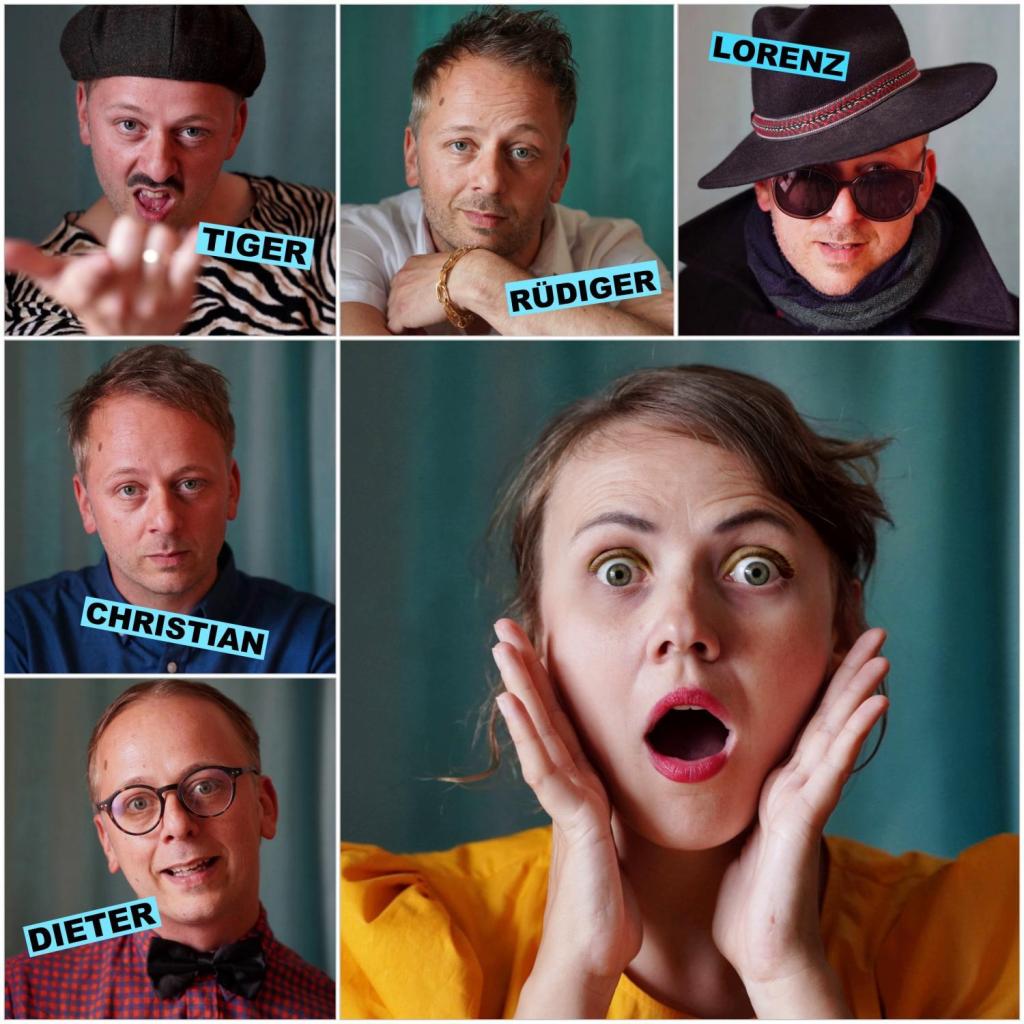
Vania Brendel and Andreas Brendel in Was Frauen Wollen by Sabine Misiorny and Tom Müller. piccolo teatro Haventheater, 2022. Photo credits: Brendel.
In Bremerhaven, the Brendels appeared in two plays by Müller and Misiorny, Was Frauen wollen (und Männer zu wissen glauben) [EN: What women want (and men believe they know)] and Machen wir die Weihnachtsfliege [EN: Let’s do the Christmas bunk]. In Was Frauen Wollen, Franziska is looking for Mr. Right and has dates with macho Rüdiger, inadvertently her ex-boyfriend Lorenz, would-be party man Tiger, mummy’s boy Dieter and, at the end of the play, Franziska happens to meet genuinely potential partner Christian. The scenes of her dates are set in a café, a gallery, a club, the flat shared by Dieter and his mother, and her encounter with Christian takes place at a local shop. In between those scenes, Franziska comments on the date just over, earlier dates of hers which we do not see, dating and love in general, and the forthcoming date.


Vania Brendel and Andreas Brendel in Machen wir die Weihnachtsfliege, piccolo teatro Haventheater, 2024. Photo credits: piccolo teatro Haventheater.
In Machen wir die Weihnachtsfliege, married couple Silvia and Paul are dreading the forthcoming Christmas with the in-laws and their families. They have been plotting wildly for a family-free Christmas, just the two of them together. To achieve this ideal Christmas, they have booked their respective in-laws into holidays over the Christmas period, under the pretext of them having won those holidays in some lottery or other. However, things go horribly wrong and Silvia and Paul end up expecting numerous family members all together at their place for Christmas. Through a series of further unexpected disasters, they end up on their own after all – or do they?

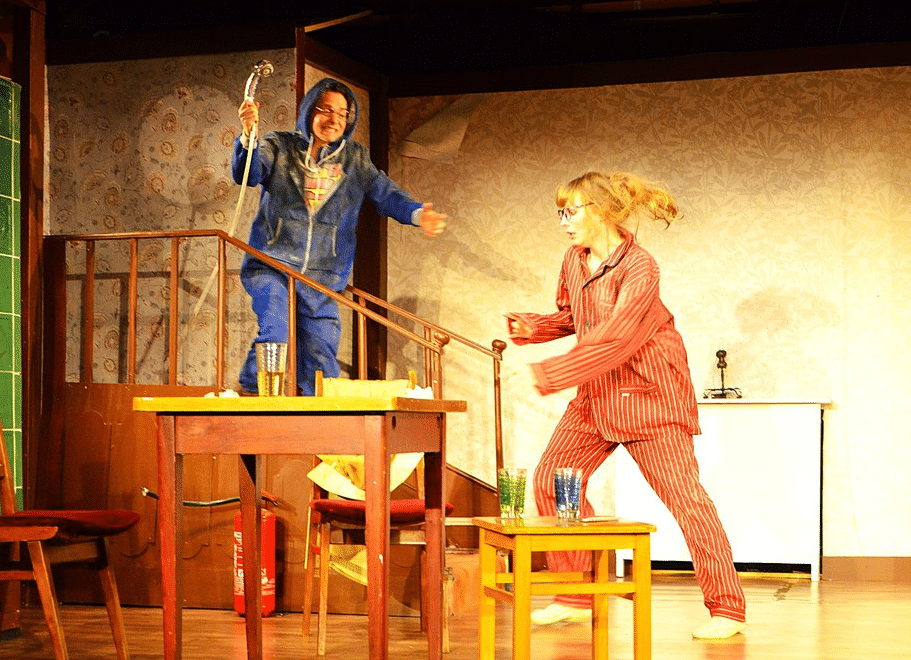
Ulrich Schaller und Eva Schröer in Wohnen im Glück by Theresa Sperling and Stefan Voglhuber. Boulevard Münster, 2026. Photo credits: Peter Petermann.
I already wrote about Mordpläne mit Himbeerdame [EN: Plans of murder with raspberry cake] by Theresa Sperling und Stefan Voglhuber, presented by Vania and Andreas Brendel at piccolo teatro Haventheater in 2026, in the context of crime on the German stage (see here). Wohnen im Glück [EN: Living in Happiness] was the first of (so far) four plays written and first performed (2024) by Sperling und Voglhuber. It was presented, among other venues, by Boulevard Münster in 2026. The play has all the hallmarks of successful comedy: a simple plot, lively action, lively characters, and many witty lines and funny situations. Tobias has inherited a house from his favorite (and only) aunt. He has moved all the furniture and possessions from the rented flat he shared with his girlfriend of three years, Sabine, into the new home and given up the flat. All of this was done secretly, without Sabine knowing, so that he can surprise her – he expects this initial surprise will make her open to accepting his proposal of marriage, which he has also planned for this weekend. They realize that the house is in fact near-derelict, and in the course of the play, they discover a rat in the toilet, the bathtub on the first floor falls through two ceilings all the way to the basement, a fire breaks out, the electricity fuses every now and then, water from the tap is yellow-brown, and so on. Disaster follows relentlessly upon disaster; the slapstick is hilarious, the double takes come fast and dry, and the witty banter is refreshing. The twist of events at the end is a very deus ex machina-like phone call (spoiler alert): the estate agent made a mistake. The house they are in is in fact indeed ready for demolition and not the object of the inheritance – instead, they have inherited a luxury villa.
In production, the timing of the punchlines for a farce like this is even more delicate than in more serious comedy, so as not to allow the audience to think further about the plot: as soon as spectators are given a chance to reflect upon the logic of the plot, the production will have lost them. The Boulevard Münster production, directed by Eric Voß, had precise blocking and break-neck speed as the characteristics ensuring farce to be convincing and funny. Eva Schröer was able to differentiate the various, distinct stages of despair across the play very well, ranging from not noticing via surprise, shock, disbelief, incomprehension, among others, all the way to screaming. The character of Tobias remained likeable, quite an achievement by actor Ulrich Schaller, despite the significant amount of chaos Tobias had caused and continued to spread on the basis of such considerable stupidity that it could easily have come across as just too much. Elke Ober had created a simple set which gave a very vivid idea of the derelict nature of the building and its interior, with cracks in the walls, and furniture that was very old and shabby – but sturdily built to support one or both actors when they jumped on top or across the furniture in their almost acrobatic struggle with their deteriorating environment.
As far as I can tell, none of the plays by Müller and Misiorny, or Sperling and Voglhuber, has been translated and / or presented in English – I am convinced their comedies would be attractive for UK or US audiences.
This post was written by the author in their personal capacity.The opinions expressed in this article are the author’s own and do not reflect the view of The Theatre Times, their staff or collaborators.