




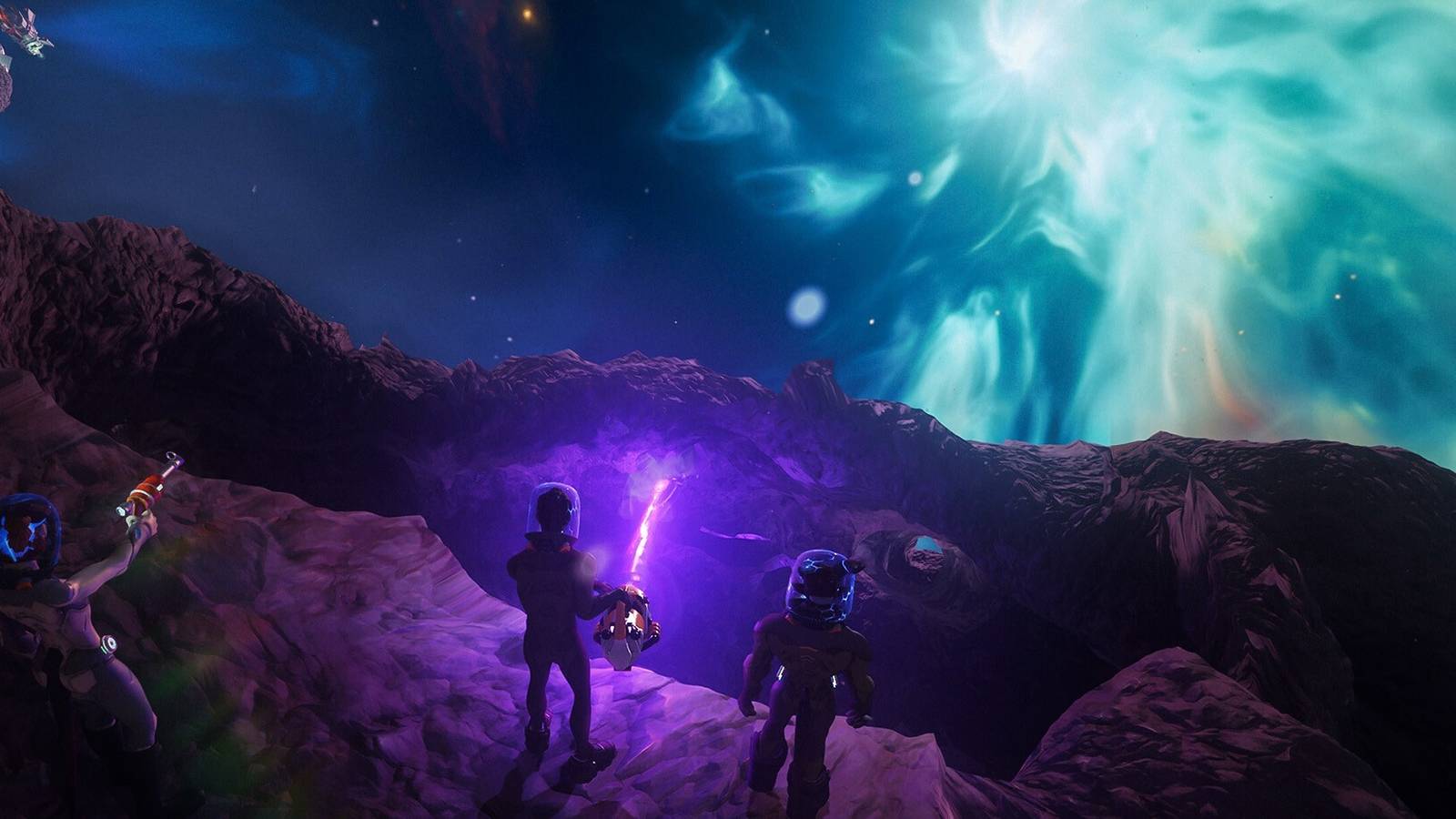
While my guided tour of the new MMO Stars Reach began in the stars, Raph Koster, the veteran behind Ultima Online and Star Wars Galaxies, wanted to quickly get to the surface of a planet. Not to show me combat. He wanted me to see the weather.
“This is the game I have wanted to make for 30 years,” Koster told Polygon.
In Stars Reach, rain falls. Water pools. Rivers carve paths through terrain. Lakes freeze in winter. Trees propagate. Forests burn. Cave ceilings collapse due to overmining. Every cubic meter of every planet has temperature, humidity, geology, and hundreds of material properties. Koster proudly explained how players can melt stone into lava, cool it into new rock formations, or accidentally create ecological disasters. I had a pretty simple question, devoid of judgment: Why?
“We are about bringing back that dream of an alternate world where you can be someone you aren’t in a place that’s impossible with your friends and have adventures and discover unreality,” Koster said.
It’s a line that sounds almost quaint in 2026, when online games are increasingly built around battle passes and engagement loops. Koster has never really been chasing games in the traditional sense, though. He’s a scholar of design and has multiple MMOs to his name, but what’s propelled him through nearly every era of video games is the idea that virtual worlds can feel alive. And if done in such a way, socially meaningful. Most of us won’t live long enough to see mankind step foot on Mars let alone Earth-like planets discovered beyond the Milky Way, so Koster really wanted to help us out before we’re all dead. The dream begins in earnest when Stars Reach enters early access this summer.
Koster says he originally pitched a version of the project as a follow-up to Ultima Online in the late 1990s. The idea survived through decades of technological change and shifting trends in online games. Only now, Koster believes, has the technology finally caught up to the ambition.
Watching Stars Reach in motion can feel overwhelming. The game spans thousands of planets connected by wormholes that can appear and disappear over time. Entire regions of space can become inaccessible. New worlds are discovered as the game evolves. Players can mine asteroids, terraform landscapes, build cities, craft starships, run businesses, become entertainers, establish governments, or simply explore.
Koster doesn’t seem that interested in telling you what to do. During the demo, he repeatedly emphasized that the game is designed around emergence rather than prescription. He is not coming for World of Warcraft’s lunch.
“MMOs aren’t a game genre,” Koster said. “They’re virtual places in which you put games.”
For Koster, one of the defining mistakes of the genre’s last two decades was narrowing the possibilities of what an MMO could be. From his perspective, text MUDDs beget Everquest beget WoW. Early sandbox worlds departed from the formula and experimented with player housing, economies, social spaces, and crafting systems (which he takes full blame for). But when WoW became one of the most successful games ever made and that all kinda went out the window.
“They did a phenomenal job,” Koster said. “But it does mean that a lot of the possibility space for MMOs was narrowed down.” He also thinks every other genre stripped MMOs of their parts, leaving them without defining features.
“MMOs originated live services, they originated community management, they originated subscription models, microtransactions,” Koster said. “These days, the whole game industry is essentially using tricks from MMO’s bag of tricks.”
Stars Reach is a clear attempt to go back to that original vision for the MMO and away from the “raid, rinse, repeat” model. Technology has come a long way to making Koster’s concept a (virtual) reality, and standing behind the curtain hearing his commentary is hard to separate from the fun of the experience. Watching our little spaceman melt a glacier to reveal a hidden alien laboratory is pretty cool. So is learning that every tree on a planet grew naturally through simulated ecological systems. Or that players can theoretically drive species extinct if they aren’t careful. Also, there are politics?
“MMOs aren’t a game genre,” Koster said. “They’re virtual places in which you put games.”
At one point, Koster showed off a thriving player settlement populated by dozens of residents. The town featured public parks, a transit system that could propel you deeper into the planet, and as I was surprised to discover, but maybe should have guessed by how orderly everything looked, civic infrastructure. None of it was inherently “designed” by Koster’s company Playable Worlds — it had been sanctioned and built by players.
“The mayor zoned the public areas as public parks,” Koster explained while walking through the city. A mayor? “There’s about 78 people here who are citizens of this planet and they elected a mayor.”
Like a version of Boys State that doesn’t immediately horrify you, Stars Reach players can establish laws and determine how resources are managed using all the levers provided in the game (and then some). Some communities may prioritize conservation. Others might choose industrial expansion. Others still may become chaotic experiments in self-governance. For Koster, these aren’t side activities; they’re the point.
“We are PVE first. We are not a player versus player until a post-launch faction system comes into the game. So we won’t be allowing people to just kill each other willy-nilly in the game. We are pro-social design in a whole bunch of different ways. Professions are built around helping one another. So we’re very much trying to build a game system that encourages people to collaborate. But we are giving some of these problems, hard problems, real problems to players to make the end game.”
Not everything in Stars Reach needs to be utopian, in theory. You and your friends could, say, take over and exterminate all life on a planet. Then you could strip mine the planet’s resources for money. You could be the king of a barren wasteland.
“The tragedy of commons for us is an endgame problem for players to decide themselves,” he said. “How do we want to manage our planet?”
That question feels especially relevant coming from someone who has spent decades thinking about online communities. Koster remembers a time when MMO designers genuinely believed they were building the future of the internet — until it super wasn’t.
“Social media came along and kind of stole all our shit.”
He isn’t just joking. Koster argues that MMOs pioneered much of what now defines the web: live-service thinking, community management, subscription businesses, even many of the social systems modern platforms rely on. The place they fell short was governance.
“Social media today is frequently horrifying,” he said. “I wish we had managed to solve some of those issues better in the MMOs, but it wasn’t a problem I was fully able to crack at the time. I think since then we’ve learned a lot.”
Stars Reach looks like his next, and maybe ultimate, attempt. Rather than treating moderation as problems outside the game, it’s built into it. Players can create rulesets that decide what kind of civilization they want to make and who is invited in. “If you want to think of this as being an MMO that works like Discord, where every zone is like its own server, but they’re still part of a larger thing, that’s not a bad way to think of what we’re doing here.”
It’s the same philosophy that shapes every other system in Stars Reach. In watching the demo, it’s easy to get caught up in the simulation: the weather, the politics, the ecosystems, the geology. But Koster doesn’t talk about those systems as technical achievements. He talks about them as tools to protect a feeling that he thinks modern games lose too quickly.
“You start seeing the machinery, and the magic falls away,” he said. “I’m all about: Let’s preserve magic as long as possible. Let’s make it an environment in which players really feel they can just play rather than grind.”