![16th Jul: Me Before Me (2026), 2hr 7m [TV-PG] (6/10)](https://occ-0-1381-999.1.nflxso.net/dnm/api/v6/0Qzqdxw-HG1AiOKLWWPsFOUDA2E/AAAABZzrTYr0xybm6BPcuSrP9_h3zH_uds8Na6kgLY1XEV_peivsqLNgtI_vsUxKa7mRH2FRbU8LQW2euDsQzFakV2wUr8Nqq-1gY4EDZNfd5dJ2wIYlffhF8IgaTFrKFNt0w5Ez2GmqdDzIJ8LijDpSUbx6gUp7MafMs7H_QTgai0K7KQ.jpg?r=30c "16th Jul: Me Before Me (2026), 2hr 7m [TV-PG] (6/10)")







Picture Credits: Netflix
Netflix has a reputation for pulling the plug too quickly — but the numbers tell a more nuanced story. An analysis of every US scripted series the streamer has released since 2016 reveals a platform that has quietly stabilized its cancellation rate over the past three years, even as the absolute number of axed shows doubled in 2025. The real risk, it turns out, isn’t surviving Season 1 — it’s making it to Season 3.
Note: This piece first appeared on Netflix and Chiffres – subscribe here.
For this study, the scope is limited to Netflix scripted series produced in the United States and released globally. These are the programs for which we have the most reliable information regarding their fate, as various media outlets systematically report renewal or cancellation decisions.
Elsewhere in the world, such tracking is far less consistent, leading to significant uncertainties. American series also tend to generate the highest viewership overall.
Throughout the following analysis, a clear distinction is made between series that had a planned ending (even after several seasons) and those that were abruptly canceled shortly after their release. Series for which a final season is announced before its premiere are regarded as complete works whose creators maintained control over their narrative arc until the end, rather than unfinished projects halted mid-development.
Netflix US Scripted Series Released in 2025
In 2025, Netflix released 23 new scripted series, 8 of which were limited series. Of the remaining 15 series, 9 were renewed and 6 were canceled.

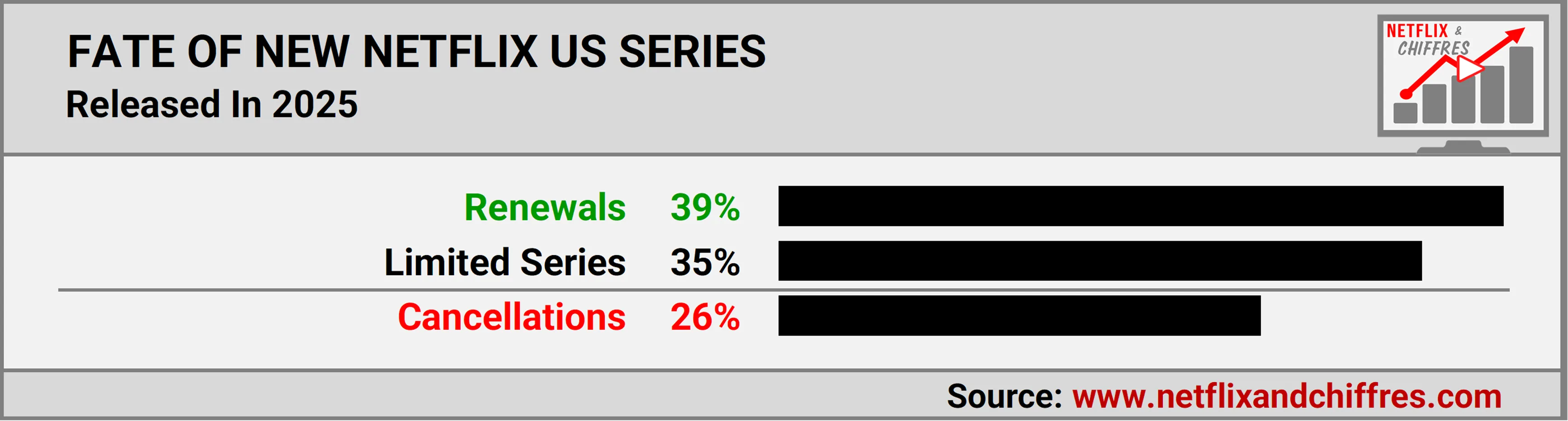

In 2025, therefore, one-quarter of new US series met a premature end, while 74% were either renewed or concluded properly as single-season limited series.
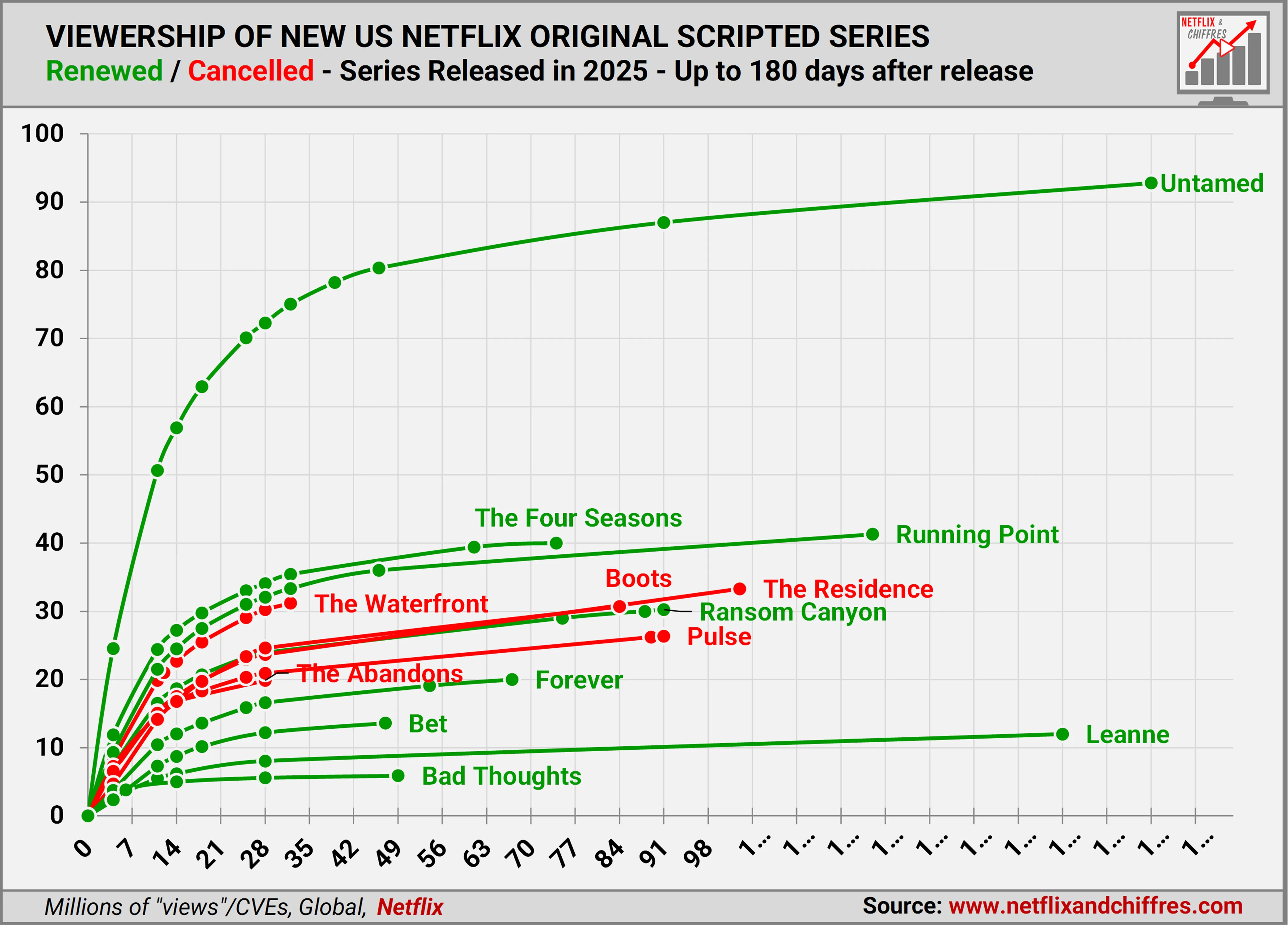
What is more interesting is examining the viewership of canceled versus renewed series, as there is ultimately little logic to the decisions. The US Netflix series canceled in 2025 did not have the lowest viewership in the batch, but they were not successes either.

New and Returning Netflix US Scripted Series Released in 2025
The Trends Since 2016
New US Netflix Scripted Series
Looking at the fate of new American Netflix series released over the past decade reveals several trends. First, Netflix almost systematically renewed shows in 2016 and 2017, with 75–80% of its new US series receiving a second season.
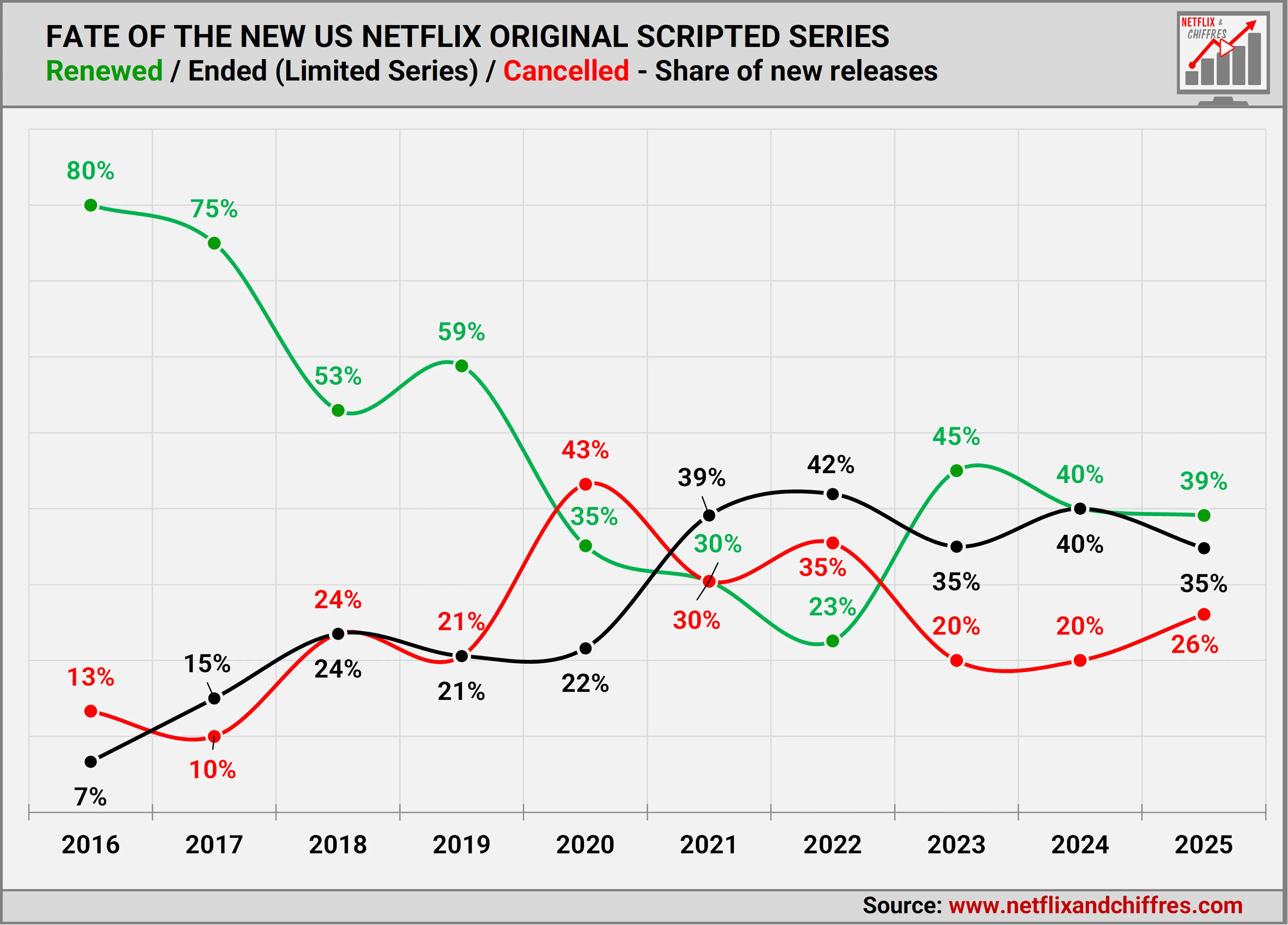

This rate steadily declined until 2022, hitting a low of only 23% of new American series being renewed. 2022 marked the infamous “Netflix Correction,” when the streamer lost subscribers for the first time, sending the entire US streaming sector into a downward spiral and leading to a drastic reduction in production volumes. Conversely, the cancellation rate for these new series peaked in 2020, a period inevitably disrupted by COVID-related cancellations.
The primary adjustment variable has been limited series, which have seen impressive growth within Netflix’s lineup. They rose from just 7% of new releases in 2016 to 35–40% in recent years, with a sharp increase observed since 2021.
Over the past three years, percentages have remained relatively stable: 40–45% renewals, 35–40% limited series with planned endings, and 20–25% outright cancellations of new series.
Looking at absolute title counts rather than percentages, Netflix was most generous in 2019, renewing 20 new American series. This was followed by 16 outright cancellations in 2020 due to the pandemic, and 11 in 2022.
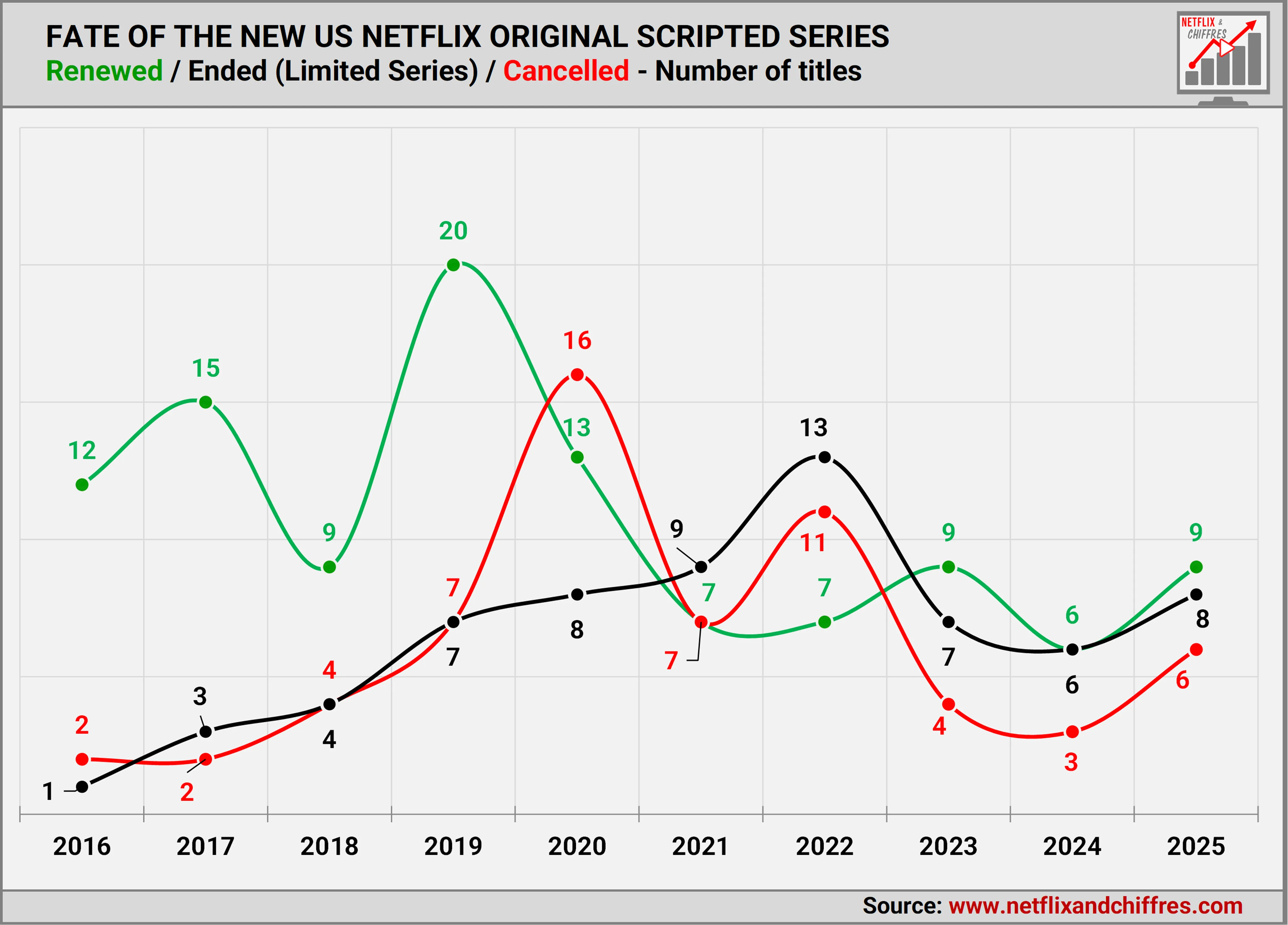
Although the cancellation rate rose from 20% to 26% between 2024 and 2025, the more striking fact is that the absolute number of cancellations doubled, increasing from 3 in 2024 to 6 in 2025.
New and Returning US Netflix Scripted Series Released Since 2016
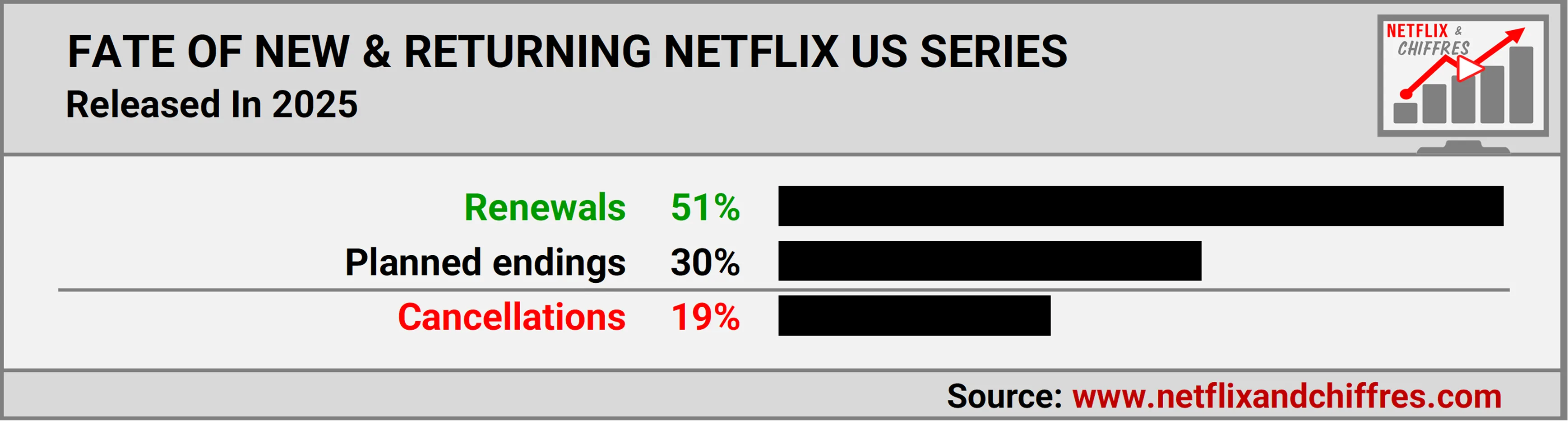
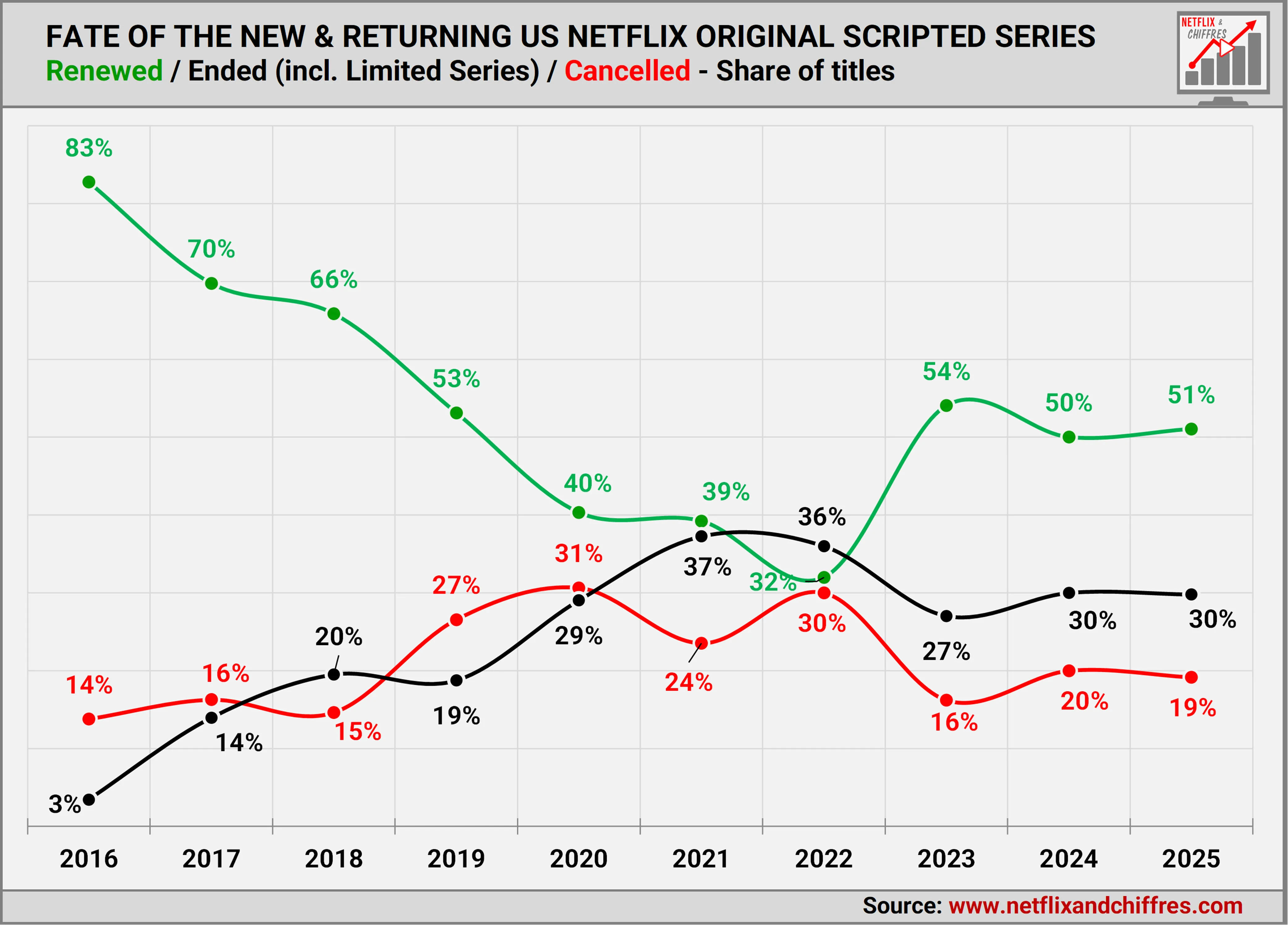
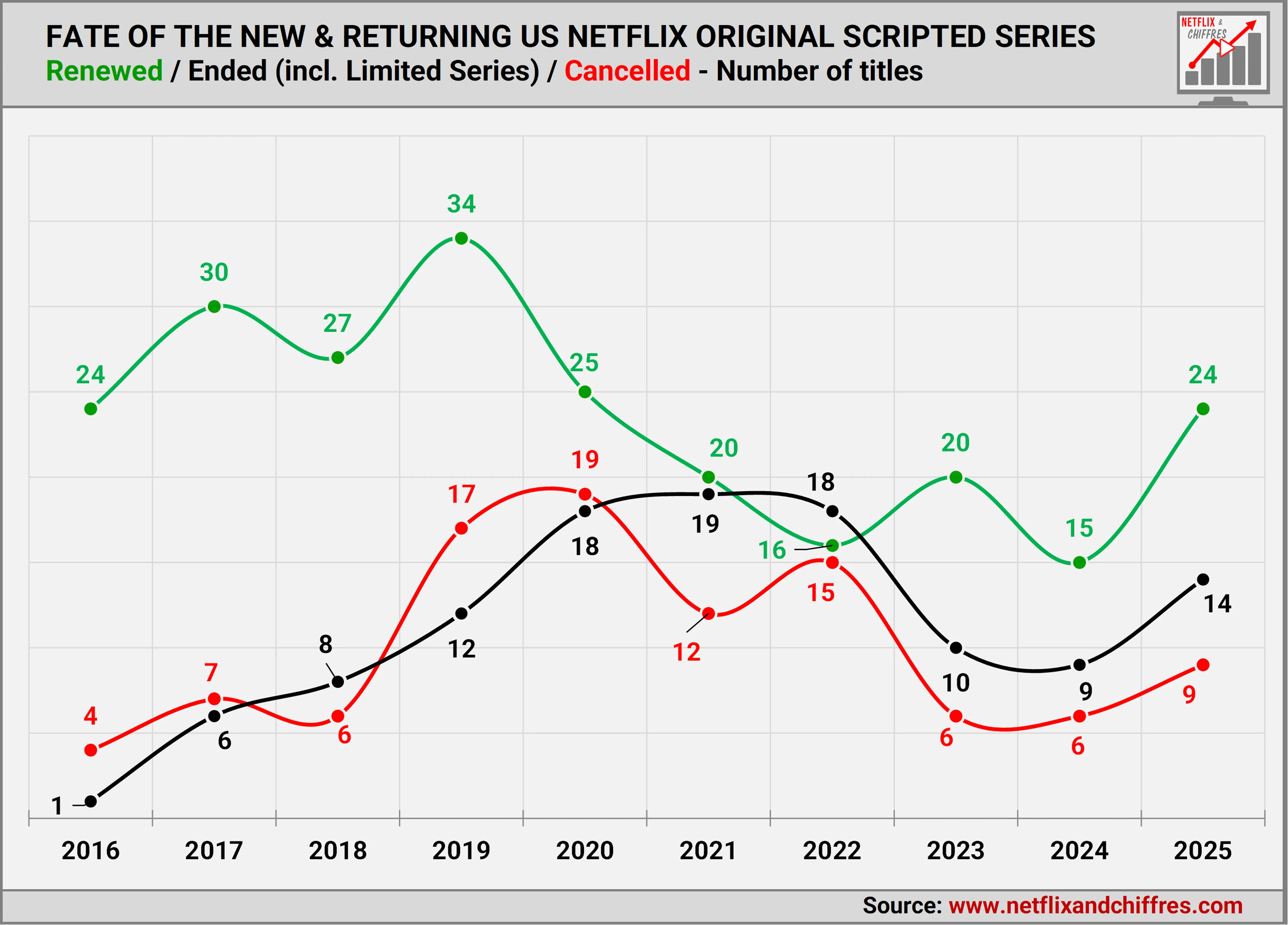
If we zoom out completely to look at all American Netflix series released since 2016 (including both new shows and returning seasons), the renewal rate has remained stable over the past three years, hovering between 50% and 55%, while the cancellation rate fluctuates between 16% and 20%. This is a notably low figure; one must go back to the 2016–2018 period to find similarly low cancellation rates. The data also clearly highlights the highly uncertain period of 2020–2022.



![Fate Of New Us Netflix Scripted Series Season After Season Bar Graph]](https://www.whats-on-netflix.com/wp-content/uploads/2026/05/fate-of-new-us-netflix-scripted-series-season-after-season-bar-graph.png "Fate Of New Us Netflix Scripted Series Season After Season Bar Graph]")
A few series still have uncertain fates, even at the top of the pyramid. For instance, Virgin River has been renewed for an eighth season, but it remains unclear whether this will be its final one. It has the opportunity to set a record as the longest-running original American Netflix series, surpassing The Ranch, which lasted eight seasons.
Among other series with ambiguous destinies are Mindhunter (which remains in limbo, given that Netflix expressed willingness to produce a third season if David Fincher agrees and the budget remains manageable), Russian Doll (Natasha Lyonne recently stated she is developing a third season to pitch to Netflix), and Sweet Magnolias (Season 5 arrives in June, but it is not yet known if this will be the final season).
So, what is Netflix’s cancellation rate? There are as many answers as there are ways to calculate it. What is certain, however, is that if we base our assessment on the 2/3 renewal and 1/3 cancellation ratio, we land exactly on the rate Bela Bajaria announced in 2020. At the time, she defined this as the industry’s standard renewal rate.