




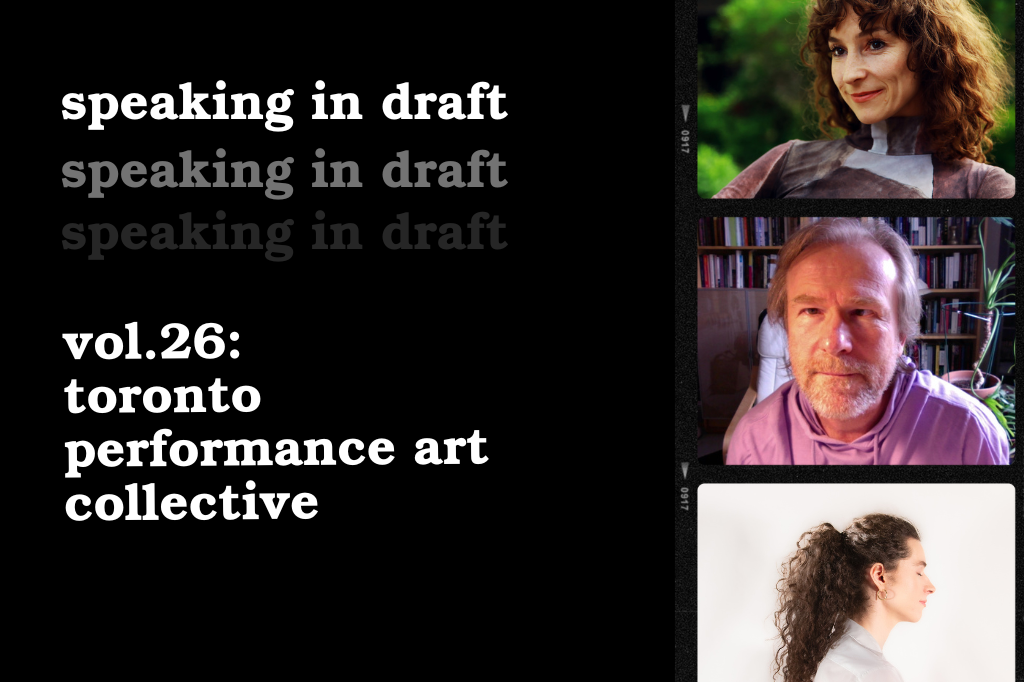
Speaking in Draft is an interview series in which Intermission staff writer Nathaniel Hanula-James speaks with some of the artistic voices shaping the Canadian performing arts today. The column invites artists to share nascent manifestoes, ask difficult questions, and throw down the gauntlet at the feet of a glorious, frustrating art form.
There are two kinds of theatre artists: those who crave longer development processes, and those who crave shorter ones. Depending on the project, I have been both.
On the one hand, most new plays are a lot like Pokémon: they need to evolve through several stages before they reach their final form. (Plus, unlike in the world of Pokémon, you have no idea whether to expect a Venusaur or a Blaziken.) That process can take years, especially for large-scale projects. I’m a firm believer that artists require well-funded, long-term opportunities for this type of sustained inquiry, with alternating phases of activity and contemplation. Even productions of well-worn classics benefit from longer rehearsal processes than a fast and furious three-and-a-half weeks. (The Shaw and Stratford Festivals are two examples of organizations that have the resources to extend rehearsal processes and let productions marinate.)
On the other hand, many theatre-makers I talk to yearn for work that can act as a lightning-fast response to our social and political moment: a bold artistic statement made right now, for the now. I think this is one reason why the “theatrical temperature” (to borrow a phrase from director Peter Brook) at a staged reading of a work-in-progress can be, in my experience, much higher than at a performance of a fully realized production. What these events might lack in polish, they often make up for in immediacy. (As a dramaturg who works on many new play sharings, I fully admit to a bias here.)
This binary is no doubt simplistic. Some of the most immediate and indelible performances I’ve ever seen took a decade to develop. By contrast, sometimes a project is so intent on responding to the moment that it trips itself up and stumbles. But especially as Ontario’s conservative government has piled up scandal upon scandal in recent months, questions of immediacy and responsiveness in performance have been on my mind. How do we respond to the now, right now?
While following this train of thought, I saw an open letter from the 7a*11d festival on Instagram. Organized by the volunteer-run Toronto Performance Art Collective (TPAC), 7a*11d is an international biennial of performance art that has been operating for close to 30 years: it’s the longest-running festival of its kind in Anglophone Canada. The open letter, released on May 5 along with a request for signatures, alleged that mistakes on the part of the Canada Council for the Arts, amid significant changes to its application portal, had caused the collective to lose composite funding on which they depended. As a result, they would have to cancel their upcoming biennial, planned for October of this year.
I was curious to find out more. And besides, if I was interested in immediacy, who better to talk to than performance artists?
In early June, I spoke with three of the collective’s seven current members via video call. Our conversation focused on what makes performance art its own radical discipline distinct from theatre, dance, or opera. (I was also relieved to learn that, following the release of the collective’s open letter, the Canada Council had recognized its error and entered into good-faith talks with TPAC about its original application.)
Paul, Shalon, and James were infinitely patient with my entry-level questions. As interdisciplinary festivals like SummerWorks gear up in the coming months, I know that I’ll be challenging myself to veer from well-worn paths: to peer into the cracks and crevices where artists are getting their weird on — right here, right now, in forms that barely have a name yet.
This interview has been edited for length and clarity.
Could you each talk about how you came to performance art as a practice?
James Knott (JK): I’ve been performing in an independent arts practice capacity for almost 10 years. I’ve been affiliated with 7a*11d for almost the same amount of time, and I’ve been an official member of the collective since 2023.
My own personal philosophy is that performance art is something you fall into accidentally. I don’t think that anyone at five years old is like, ‘I want to become a performance artist.’ In my estimation, there’s no immediate reward structure for this medium; I think the reward is actually something that you mine and find through community. There isn’t necessarily a lot of glamour or draw to performance art, aside from the need to do it.
Shalon T. Webber-Heffernan (STWH): I was a theatre kid during my whole childhood and teen-hood. Then I started smoking weed and became conscious, and disowned theatre. After a long and winding road, I ended up doing a PhD in theatre and performance studies. I think at the end of the day, performance and art generally have always been a language that I understand.
As a curator, I love performance because it’s a different language for working through ideas, and because I’ve always had a deep fascination with presence: the experience of being in the moment is something I’m constantly chasing. Live performance is one of the ways that I can access that, and it’s easier than going on a Zen Buddhist meditation retreat — which I’ve also done.
There’s something about being live, with a sweaty, stinking, gross, dirty body, that’s just — you’re in it. There’s some kind of alchemy going on that’s addictive to me. I think 7a*11d is sort of the dealer, if you will! It’s keeping us all hooked onto this weird obsession.
JK: Toronto performance dealer! That’s crazy.
Paul Couillard (PC): I’ve got some relationality here in my pocket. You want some?
JK: That means Paul’s the mafia boss.
PC: Yeah, I’m the old guy. I fell into performance in the 1980s, when I was living in Ottawa. I was working for the government and feeling like my soul was dying. I thought, ‘I’ve got to do something, or I’m going to kill someone: probably myself, but maybe someone else.’ Then I went to a performance art event at SAW Gallery, which is an artist-run centre in Ottawa, and saw a performance by Rachel Rosenthal. I sat there stunned at the end of the performance. I thought, ‘That’s what I have to do with my life.’
I quit my government job and went to SAW, without any idea of how the art system worked. I said, ‘I want to do performance,’ and they said ‘sure.’
I made a first performance, which was very successful, but I knew that I didn’t really know what I was doing. So I went to Los Angeles and actually studied with Rachel Rosenthal. I started working at artist-run centres, and anything that passed my desk that called itself performance, I would program, so I could see how it worked.
I moved to Toronto in 1989, and ended up founding FADO Performance Art Centre. I ran that for 14 years. Through FADO, we started the 7a*11d Festival in 1997.
Could you tell me more about the beginnings of the festival?
JC: Performance art had been very active in Toronto in the ’70s to mid-’80s. Then there was a huge crash, and everybody was saying that performance art was dead. But there was this huge resurgence in the mid-’90s. It had a lot to do with people who were teaching performance at institutions like OCAD [the Ontario College of Art and Design] and UTSC [University of Toronto Scarborough]. We held a grassroots meeting in January 1997, so that all these different communities of people who were working separately could meet each other. Out of the 24 people that went to that meeting, 12 of them became the organizers of the first 7a*11d festival in August of that year.
Intermission rarely covers performance art. It seems to me that there’s an invisible barrier dividing art forms that have a longer history of categorization and canonization — dance, theatre, opera — from the kind of performance you’d experience at 7a*11d. How would you define performance art’s place in a broader ecology?
JK: I’ve formulated a personal definition for the distinction of theatre and performance. It’s a little bit heady, but these things kind of are. Both mediums use performance as a technique or tactic. But theatre uses characterization and plot as a means to a narrative end, whereas, generally, performance art uses poetic gesture to a conceptual end.
STWH: I’m a person who can’t stand the siloing. I had a meeting with Michael Caldwell, the artistic director of SummerWorks Performance Festival, last week. The conversation turned to, ‘Why aren’t these communities talking to each other?’ Obviously there are different techniques and forms, but I think there are so many interesting things about the bleed over, particularly where it’s messy. Right now, you’re seeing organizations like Toronto Dance Theatre very much doing programming that’s bordering on performance art, especially since Andrew Tay took over; and in lots of experimental theatre, as well.
And for you, Paul?
PC: I guess I’m the purist! In terms of my own practice, a lot of theatre people would say, ‘I’m a storyteller.’ I’m not a storyteller. What I do is create situations, because I don’t know what the story’s going to be when the performance starts. The story’s going to be created with the audience.
But there are many, many kinds of performance art! If you want a rough definition, my teacher, Rachel Rosenthal, said, ‘Performance art has time, space, and the performer’s body.’ What I’d add to that is, ‘and a relationship to the audience,’ because that’s the only thing that separates performance from everyday life. There’s some kind of witnessing or relationship going on that’s being acknowledged.
Performance is a place for everything that falls outside other parameters. I’m interested in forms that don’t have anywhere else to go.
JK: Not to support the idea of a silo, because I agree that we only benefit as a culture from connecting and being in conversation. But between theatre and performance art, I think there’s a different approach generally to process. I find that theatre tends to take a lot of time. The gestation period is very involved, and it’s often very collaborative in a maximalist way, even if it’s a small show. Whereas the performance art ethos — not always, but oftentimes — is ‘get in, get out.’ If there’s no venue, where’s the hole in the wall? It’s going to happen, then it’s going to be done. That’s an over-generalization, but I think theatre sometimes isn’t as flexible in its creation and performance processes.
STWH: As a curator, that part’s extremely evident. I work with dancers, with theatre people, and with performance artists, so I see clear as day behind the curtain. The theatre people are like, ‘Where’s our rehearsal?’ What rehearsal? The dancers are like, ‘I need five months of studio time paid for by a grant,’ and you’re like, ‘Excuse me?’ Because in performance, it’s exactly as James is saying.
JK: As a curator of performance, you ask an artist, ‘What are you planning on doing?’ And the response is no information, or ‘I don’t know,’ or ‘I’m not going to tell you,’ or ‘We’ll figure it out. I need a dead fish.’ Three months go by, and you’re like, ‘I still don’t know why you need the dead fish. Could you let me know?’
For you, what’s the importance of 7a*11d to the performance art community both in Toronto and internationally?
JK: Referencing the resurgence of performance in the mid-’90s that Paul was talking about, I think that performance is a medium that’s often born out of necessity. That’s why you’ll see certain kinds of people from certain kinds of backgrounds, and with certain kinds of bodies, often approach making work through performance. That’s why, when I was a student, I was starting to incorporate performance into my practice.
When I graduated, it was in 2017, during Trump 1.0. Now we’re in Trump 2.0, and I think during both of these times, you can see a resurgence in young people, especially, interested in the reflexivity and responsiveness that Paul is talking about: the spontaneity and visceral quality that performance can afford, that can embolden messages of political activism or embodiment. 7a*11d is one of the only organizations that seeks out and curates that kind of work: work that often doesn’t get space or financial support.
STWH: Performance art is punk as hell. Punk has always been important, but especially now, in the face of — everything — and in particular increasing bureaucratization in the arts, we need to fight for these scruffy, scrappy live art practices. Punk is not dead, because we have performance artists, and we need to fight for them.
That’s the last line of the article right there! As someone who doesn’t come from a performance art background, I appreciate you answering what I’m sure are 101-level questions.
PC: All performance questions are 101-level questions, in the sense that it’s about meaning. I got into performance because I felt like I had no meaning, and I had to go somewhere where I could make meaning. Performance is a form that’s always contested because, as conditions change, the meanings need to change too, and sometimes the way they’re expressed requires new forms. You’re always going back to basics, because all the tools that already exist don’t feel adequate at the moment. So in that sense, it’s always 101.


WRITTEN BY
Nathaniel Hanula-James
Nathaniel Hanula-James is a multidisciplinary theatre artist who has worked across Canada as a dramaturg, playwright, performer, and administrator.
LEARN MORE