





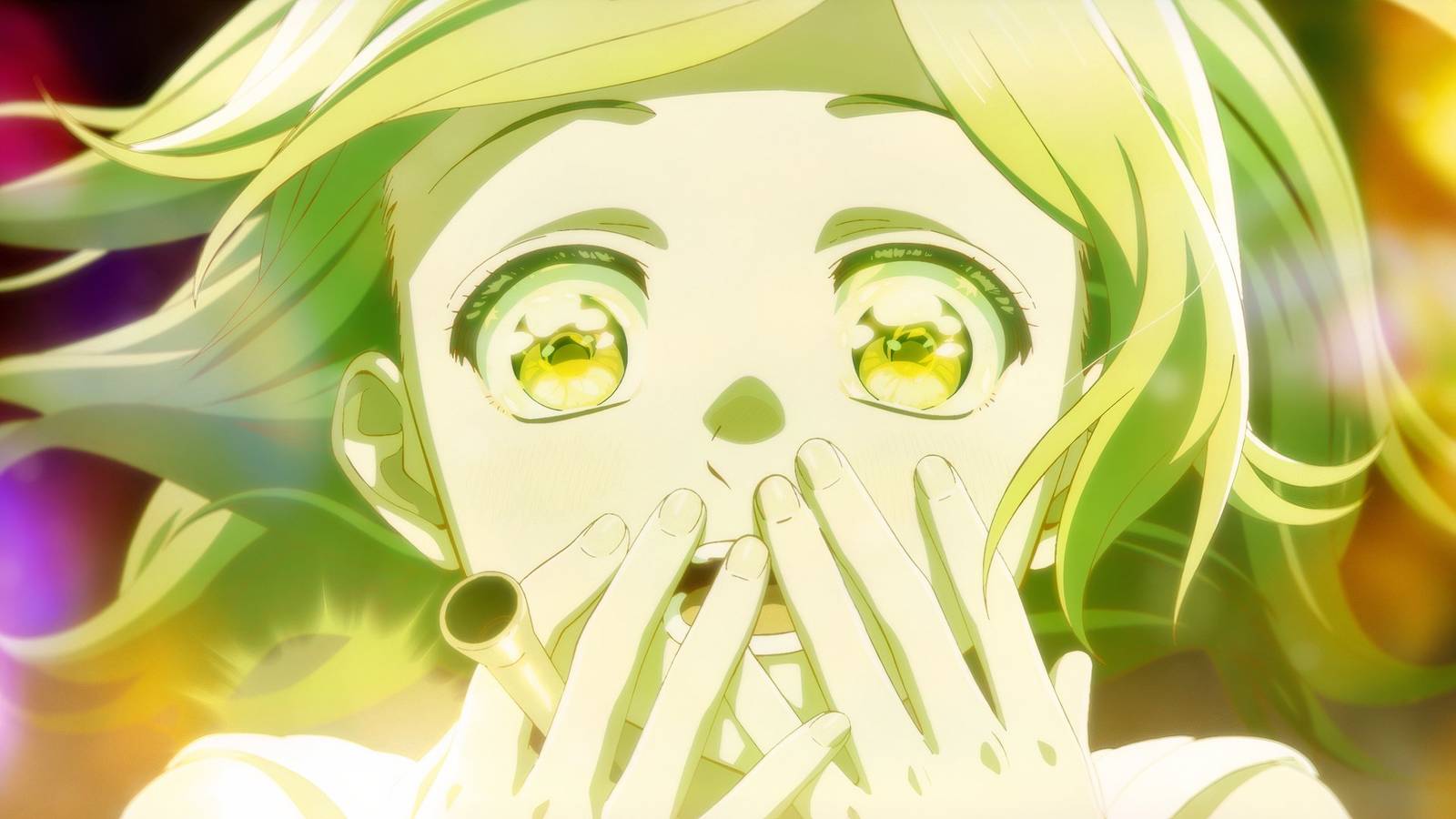
In Witch Hat Atelier, protagonist Coco believes she lives in just another magical fantasy world where witches are born with magic running through their veins. But very quickly, we learn the truth: anyone can perform magic if they use the right kind of ink and draw the correct runes and sigils. After Coco accidentally uses the magic contained in a forbidden grimoire, she’s quickly thrust into a new life as a witch’s apprentice. While this premise alone is enough to make Witch Hat Atelier an intriguing watch, what makes it one of the most refreshing magical anime to debut in a long time is its surgical attention to detail.
In most fantasy anime, magic is treated as something innate: a bloodline gift, a hidden power, or a mysterious force accessible only to the chosen few. Even some of the genre’s best modern series, like Frieren: Beyond Journey’s End, intentionally keep their power systems vague. As an immortal elf, Frieren has no theoretical upper limit for her mana. There’s some logic there, but it means we have no clear expectation as to how her human apprentice Fern can compete with Frieren in terms of raw magical output, or how their companion Stark can slay a dragon with a single blow from his greateaxe. In Frieren, some people are just built different. Magic and its power scaling are more about mythological vibes than anything else.
That’s not necessarily a flaw, but it’s certainly a stylistic choice. Some of the greatest fantasy stories ever written operate on emotion and atmosphere rather than strict internal logic (just look at The Lord of the Rings with its ever-shifting wizard hierarchy). But it does highlight a recurring problem with magic-focused anime: magic is often treated as an abstract force governed by destiny or arbitrary power scaling rather than something viewers can meaningfully understand.
Witch Hat Atelier takes the opposite, almost egalitarian approach. Magic behaves less like divine power and more like a refined craft. Every spell stems from intentional design. Circles must be drawn perfectly. Symbols matter. Make one too long, and a burst of flame might go out of control. Watching characters learn magic in Witch Hat Atelier feels closer to watching artists or scientists refine a craft than watching heroes unlock new powers. Anyone can do it if they hone their craft — even if witch society hides that truth from the masses.
Witches aren’t chosen because they’re part of rare bloodlines or have big mana pools. They’re simply people who learned how magic works. That single idea completely transforms the genre.
In most fantasy anime, magic resembles aristocracy. Certain people are born special while everyone else exists outside the system. Even when those worlds contain “rules,” those rules often remain intentionally vague. Characters become stronger because of emotional awakenings, hidden potential, or sheer narrative necessity. The audience accepts these leaps because the stories prioritize spectacle and feeling over clarity.
In Witch Hat Atelier, the magical aristocracy takes on a new meaning. The revelation that magic can be learned by anyone instantly reframes the world around it. The secrecy surrounding magic is manufactured. Knowledge is hoarded. Access is restricted. Magic isn’t exclusive because it must be — it’s exclusive because powerful people decided it should be. Forbidden magic is dangerous, hence why it was forbidden.


That gives Witch Hat Atelier a kind of grounded clarity that few fantasy anime even attempt. The magic system isn’t just aesthetically beautiful, it’s intellectually satisfying. When characters improve, you understand why. When something goes wrong, the consequences make sense. The audience learns alongside the protagonist Coco, instead of merely observing incomprehensible displays of power from afar. And while her fellow apprentices are all supposed to be there, Coco feels like a fish out of water — yet one that demonstrates time and time again that she’s resourceful, smart, and dedicated to the craft. In a world where magic functions in this particular way, that’s all you really need to become a strong witch.
Fantasy doesn’t always need rigid systems to succeed. Frieren remains phenomenal precisely because of its dreamy, folkloric ambiguity. But after years of anime built around vague mana discussions and endlessly escalating power levels, Witch Hat Atelier feels almost radical in its belief that magic should actually make sense — but also in the way it proudly proclaims that the pen is mightier than both the sword and the wand.

![14th Jul: Quarterback (2026), 3 Seasons [TV-MA] – New Episodes (7/10)](https://occ-0-1381-999.1.nflxso.net/dnm/api/v6/0Qzqdxw-HG1AiOKLWWPsFOUDA2E/AAAABUdMQvYlQS5Df1Cb6ZHamL1ROUqPYIVsp0MDHEVP65r9tCPi1qavj_3S7qoedadKRWlU1_22NBhQWqbJpc1GZMffsgzBA0JOCz2rPl0NTpHO__ucnQoGDzlPo4yahNAsnYP3H25cvWqe0o4eIsXN85GMaY-4WKDP0msWVm11.jpg?r=da3 "14th Jul: Quarterback (2026), 3 Seasons [TV-MA] – New Episodes (7/10)")