









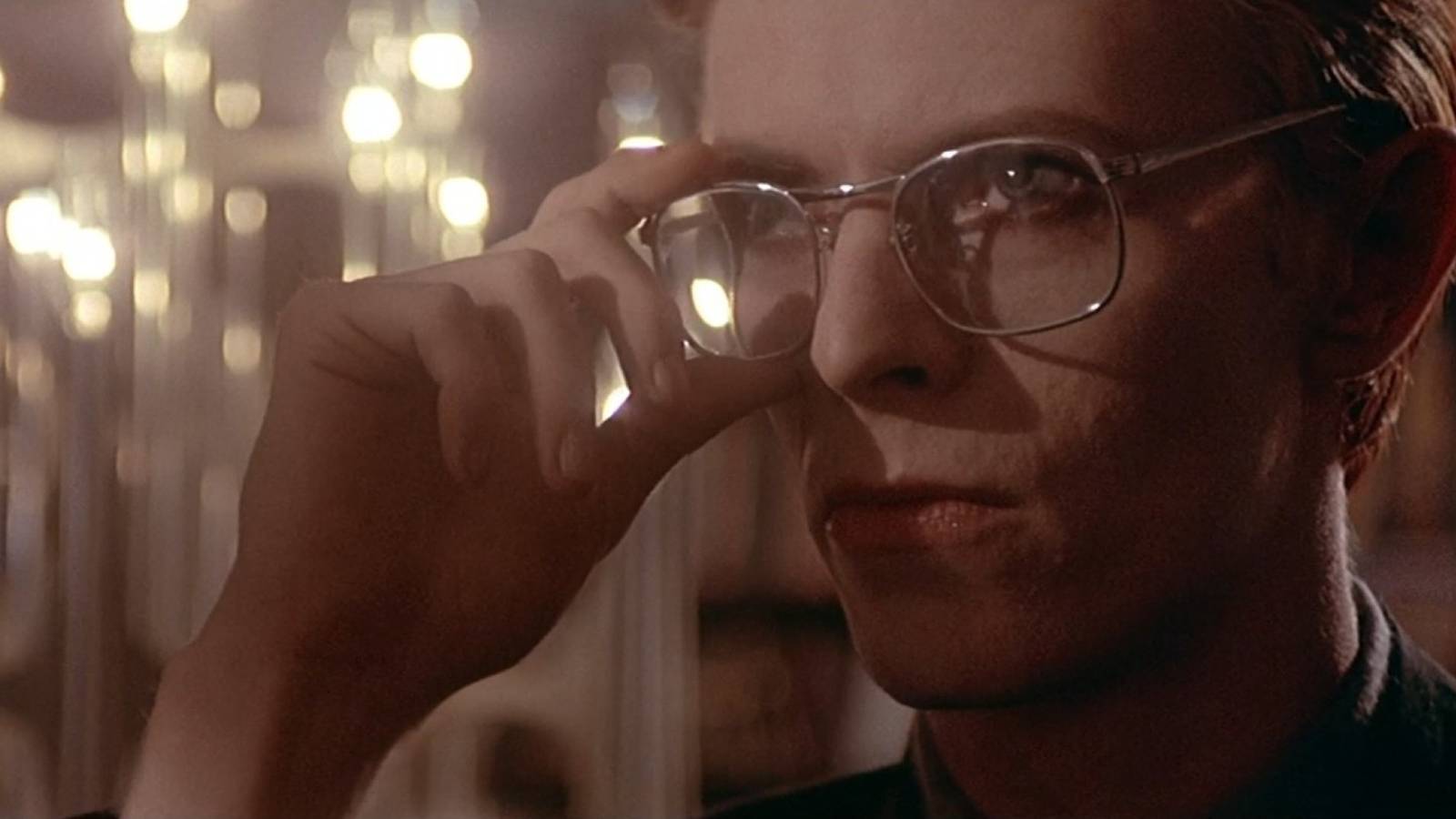
There are plenty of options for a pop star looking to transition into cinema. They can take a campy part in a silly movie that winks at their celebrity, as Lady Gaga did in Machete Kills; a music-centric role that shows off their day-job skills in a different context, as Gaga did in A Star Is Born and the Joker sequel;, or a character that pivots away from their pop persona and musicianship entirely, as Gaga did in House of Gucci. Beyonce has also dabbled in all three, with movies like Austin Powers in Goldmember, Cadillac Records, and Obsessed, respectively. But when David Bowie made the leap on March 18, 1976, he did something stranger for his first major film role.
Bowie would eventually take the route of the musical showcase (Labyrinth) and the serious-actor pivot (The Prestige). Maybe his brief Zoolander cameo counts as the silly, winking one. But his first Hollywood film is strikingly unusual, even for an artist as singular as Bowie.
The Man Who Fell to Earth casts Bowie as an alien from another world, just as some of his albums did. That’s not so unusual. The weird part is that Nicolas Roeg’s film doesn’t use any of Bowie’s music. It’s not an adaptation of the androgynous, alien rock star he famously “played” on Ziggy Stardust and the Spiders from Mars and accompanying tours, even though the story is obtuse enough to form the basis of a concept album. Instead, Bowie plays an alien who arrives on Earth to raise money to save his own water-deficient planet. This involves posing as a British businessman named Thomas Jermone Newton, patenting a series of inventions from his home planet, and becoming rich enough to build a ship that can transport large quantities of water back there.
Though Newton has a family on his planet — they’re the only other aliens shown, in brief flashbacks — he takes up with a human girl named Mary-Lou (Candy Clark), who introduces him to earthly pleasures of sex and alcohol. He’s also fascinated by television; it’s vaguely implied that these various opiates of the masses are responsible for his mission going awry, though the government takes direct action to impede Thomas’s progress.
The actual events of The Man Who Fell to Earth could probably be dramatized within the length of a TV episode. Instead, it runs for 140 minutes in its original cut. It was trimmed down to two hours for its initial American release (and some streaming versions online are indeed that shorter edition), which caused some critics, including Roger Ebert, to wonder if the extra cuts made it harder to lock onto Bowie’s wavelength. I suspect it may not have made much of a difference.

Complicating the story is Roeg’s unusual form of fragmentation. His images are frequently straightforward in both clarity and beauty. Like in Don’t Look Now, the psychological thriller he made before this one, he composes countless memorable shots, here working with the advantage of photographing one of the most angular, compelling faces in pop music.
What we’re looking at and why is rarely in doubt in the moment. The scenes appear to follow each other logically: Newton arrives on Earth. He visits a patent attorney (Buck Henry) to help him form his company and patent his inventions. He befriends a scientist (Rip Torn). He meets Mary-Lou. Stepping further back, though, they’re more broadly disorienting. Gaps in time are frequently elided. Some changes in circumstances, like Newton’s business success, happen largely offscreen. Later, it’s clear Thomas is captured and imprisoned with governmental cooperation. It’s less clear why, exactly, this happens, and equally unclear when his captors appear to eventually lose interest.
This all makes The Man Who Fell to Earth sometimes more challenging than rewarding. On the other hand, it also feels authentically alien in a way that more straightforward sci-fi movies do not. The New Mexico scenery that Thomas gazes upon is frequently awe-inspiring, a tribute to Earth’s natural beauty that the film’s elliptical storytelling style undermines. The audience doesn’t feel settled into the narrative or the environment because Newton doesn’t quite fit, either. At one point, someone asks what he does for a living. “Oh, just visiting,” he says, answering the question by failing to properly address it. He does sometimes act like an indolent tourist, as things that humans prefer to think of as leisure — television, alcohol, sex — seem to have an outsized effect on him. Or maybe we’re just seeing our own behavior and reclassifying it as alien.

That wavering line between human and otherworldly is also where the casting of Bowie pays off, at least in terms of achieving the filmmaker’s aims. For many viewers, Bowie functions as a familiar face — his mystique seems like a major reason this movie has been revisited so often over the years — that anchors the film even as he gives a quietly remote, sometimes pose-heavy performance. His shapeshifting quality as an artist, cited so often that it’s become a cliché, here is literalized when we see Newton in his alien form.
Yet Newton never seems to grow much emotional range, either, at times no more expressive than a poster version of its pop-star focus. Under the Skin, a contemporary sci-fi movie that takes some cues from this one, does something similar with the sometimes-flat effect of star Scarlett Johansson, also playing an alien disguised in a human form. Yet that alien’s gradual accumulation of human qualities has an opaque beauty, even as her human inquiries threaten a horrific end. The Man Who Fell to Earth is a sad movie too, but not a particularly moving one. Roeg depicts our world with striking beauty, and then traps Bowie in it. Maybe it couldn’t ever have worked the same way with his music, so frequently thrilling or transporting. Some classic Bowie songs might create the mistaken impression that a pop star might actually save us.


