





Falk Richter was born in 1969. He studied linguistics, philosophy and theatre directing at the University of Hamburg, the city in which he was born. He has since developed a noted and international career as a theatre and opera director and dramatist. He has also taught at several drama schools in Germany and Europe.
His play The Silence received its world premiere in French, directed by the author, and with Stanislas Nordey, at Théâtre national de Strasbourg on 1.10.2022. The first German language production followed at the Schaubühne in Berlin on the 19th of November 2023, directed by Richter, and with Dimitrij Schaad. The production has continued in the Schaubühne repertory since.
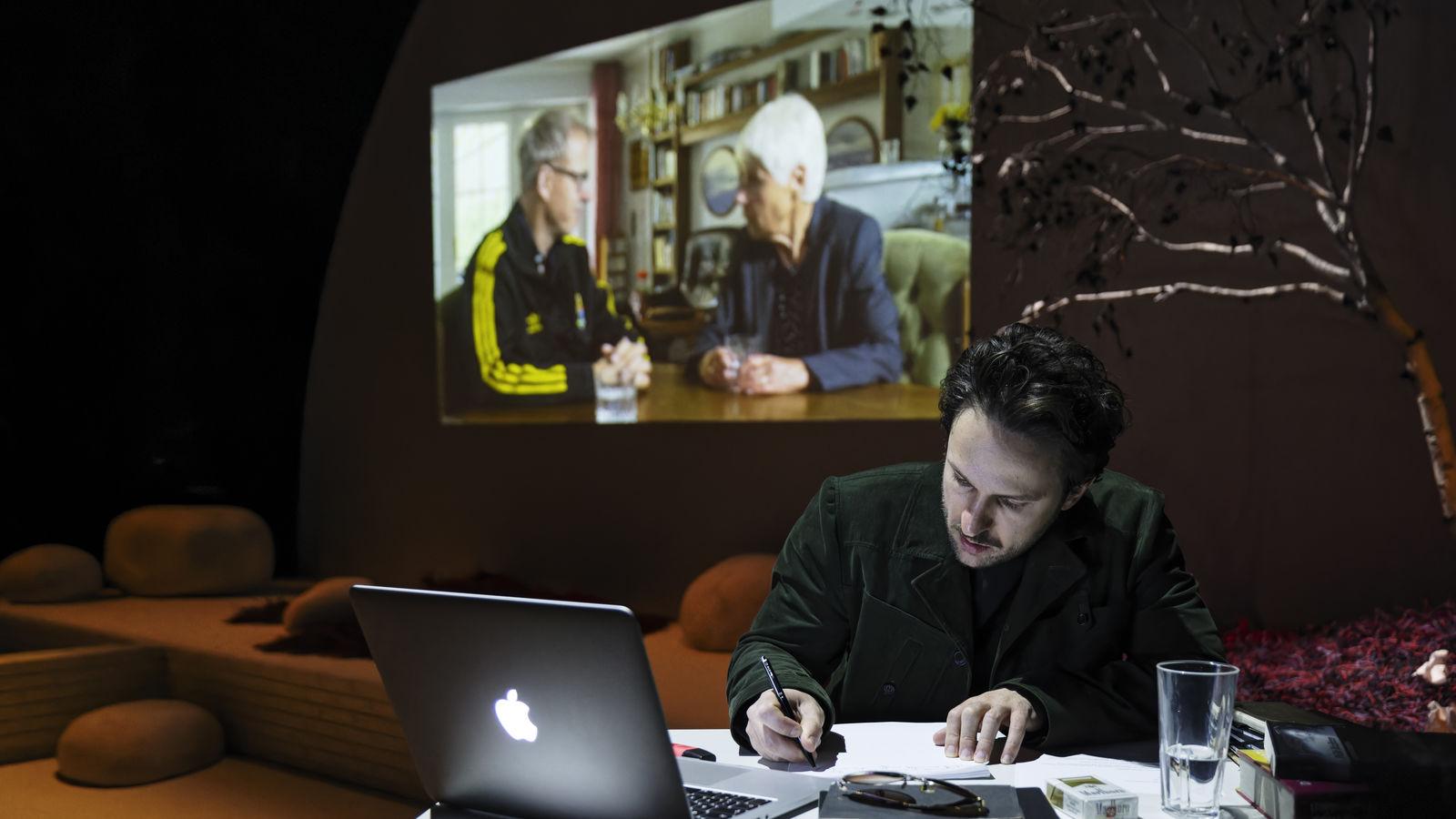
Richter has categorized his play as autofictional. The main character is Richter himself, who tells the audience the story of Richter’s life, combining memories and reflections of events, other important people in his life, his feelings and his interpretation of his feelings and the feelings of others. Self-reflexivity is the key to the play and the performance: the evening wittily started with the actor, Schaad, commenting on him returning to the Schaubühne; commenting on the Schaubühne as the leading stage of Berlin and even of all of Germany, commenting on the characteristics of theatre at the Schaubühne, highlighting its emphasis on the aspect of performativity. Schaad also drew the audience’s attention to the intimate nature of the space, where the spectators are arranged in a semicircle around the stage in steeply rising rows inspired by the Globe Theatre. In such an intimate space, and with the play demanding utmost subtlety and intimacy from the actor, any disturbance would necessarily distract both actors and audiences – could the spectators therefore please really not use their mobile phones for any kind of activity during the performance, could they please refrain from eating, drinking, unwrapping sweets, whispering to each other, and could they please save their fits of coughing to the times in the performance when video would be shown while he would remain quiet? During the performance that followed, after the actor had shifted into character, on one occasion a spectator in the front row increased his physical comfort by resting a foot on the edge of the stage: Schaad walked over calmly, shook his head and pointed at the offending foot.
The performance lasted for a good two hours without interval, there was not a moment in those 120 Minutes where the narrative was lagging. There was a good balance between storytelling and reflection by Schaad, and the intriguing video footage interspersed at appropriate moments: at some point in his life, Richter had realized that many questions that he would have liked his parents to answer, about their lives especially in the context of the Second World War, had never been asked, or if they had been raised, the answers had not satisfied him. Given that his father had already passed away when Richter felt the need to come to terms with those aspects of the past, and given that his mother had, to date, avoided, or so he felt, addressing those questions as fully as necessary and possible, his mother had agreed to sit down with him and record his questions and her answers on video for posterity. We saw selected footage of these conversations between mother and son.
We found out about his mother’s upbringing, how she met her husband, her relationship with him, his return several years after the end of the second World War, following undisclosed suffering as a prisoner of war, suffering that would have a lasting impact on his own life and that of his family, never spoken about, never revealed, never discussed, forever hidden within the depths of his mind. The video conversations and Richter / Schaad’s comments and reflections of those were eventually put into perspective by reference to Richter’s therapist: people who have encountered such harsh conditions cannot possibly afford to drag those memories up from the secure places within their minds where they have been suppressed: doing so would do more harm to them and their environment than leaving them to fester in the state of suppression.
Juxtapositions of factual narration, reflection and video material worked well in imbuing the evening with an exciting intellectual and emotional texture. Richter’s chosen tone and Schaad’s rendering of it were such that the audience’s attention was sustained and supported throughout, without lapse, without becoming unnecessarily drastic, depressing, superficially shocking or gratuitous. Instead, the storytelling was above all characterised by clarity, honesty and openness, at different paces, at times fast, energetic, lively, and at others slower and more reflective. It was always movingly passionate and allowed its spectators sufficient mental and emotional space for their own further reflection without forcing itself up on them.
This post was written by the author in their personal capacity.The opinions expressed in this article are the author’s own and do not reflect the view of The Theatre Times, their staff or collaborators.