






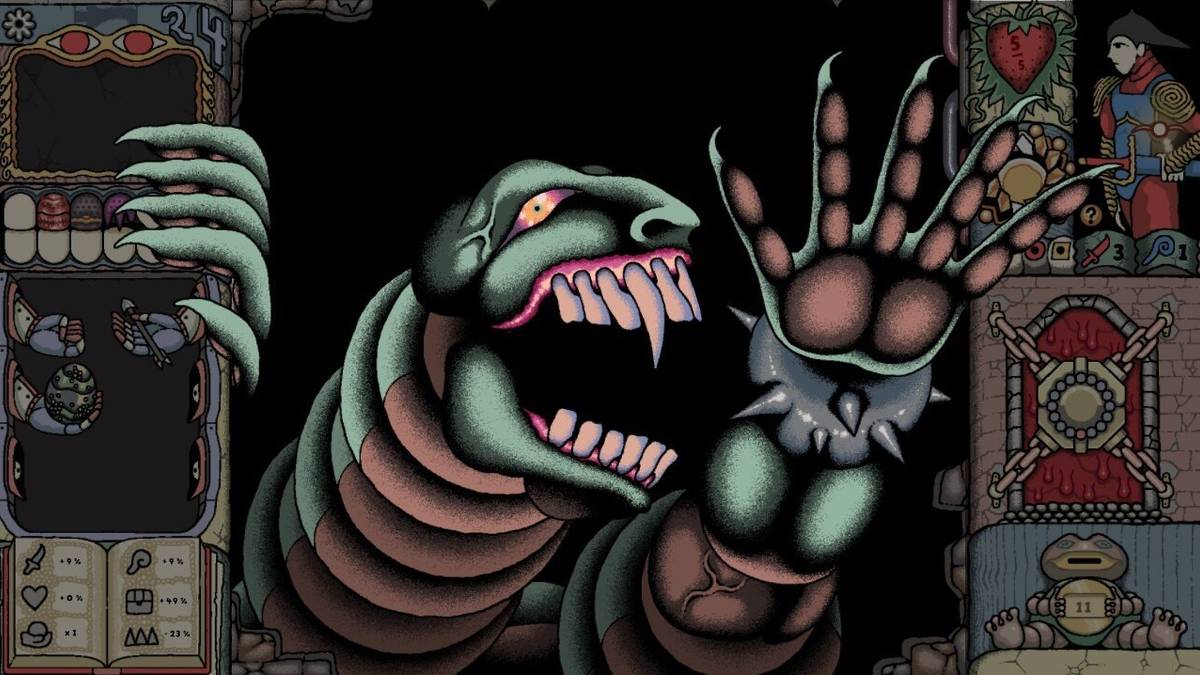
Back in January, I called Sol Cesto “my first favorite game of 2026.” The visually arresting roguelike launched in early access last May, but I discovered it right as the new year was beginning. It instantly blew me away. I became so obsessed with it that I eventually had to put it down or else I’d risk burning myself out on it before its 1.0 release. Thankfully, I didn’t have to abandon it for long. The full version of Sol Cesto is out now on Windows PC, so now I can formally submit that it’s the most hypnotizing game I’ve played so far this year.
Sol Cesto isn’t your typical dungeon crawling roguelike. Well, actually it is, but it brilliantly deconstructs the genre into something unrecognizable. Set in a world where the sun has vanished, you select a hero and take them on a trip underground to find the lost star. You’ll survive floor after floor, slaying monsters, opening treasure chests, and finding passive buffs that let you rebuild your character’s stats. Simple enough, right?
Whatever you’re picturing it looks like is most certainly not what Sol Cesto is. Each dungeon floor is presented as a grid with four rows and four columns. There’s either a monster, trap, chest, or healing strawberry inside each box. To unlock the exit and get to the next floor, you need to clear a certain number of boxes by clicking into them. The catch, however, is that you can’t choose which boxes you want to interact with; you have to click on a row. Luck takes the wheel at that point, because your character will move to one of the four boxes in that row at random, with a 25% chance to hit each. If you click on a row that contains two enemies and two treasure chests, you’ll have a 50% chance of landing on a square that gives you gold or a 50% chance of landing on an enemy that deals damage to you.
It’s a video game risk-reward system boiled down to its essence. Every move you make is a gamble shown to you in percentages. You need to clear a certain amount of boxes to proceed, so you’re forced to make some risky clicks. It sounds like a frustrating game of chance, but it’s engrossing and contains some surprising strategic depth. If there’s a row with a healing item, I might decide to take my chances on a risky floor full of enemies first in case I take damage that I can heal back when I circle back to get that item. Do I get greedy and go for an extra treasure chest after the exit opens? A 75% chance to get gold is a safe enough bet, right?
Where Sol Cesto really gets hard to put down is how it twists that idea with buildcrafting. The further I explore, the more I pick up teeth, which act like passive buffs. They don’t give me fancy powers that change my attacks like in Hades 2; all of them simply alter the odds. One tooth might raise the base chance that I’ll land on a chest, but lower my chances of landing on a strawberry too. Or one could raise the likelihood that I’ll land on a monster that does physical damage, while lowering my chances of landing on a magic attacker. Each character has a different resistance level to those two damage types, and they can be tweaked during a run.
A surprising amount of build potential spills out of that. I might choose to upgrade my character’s magic defense during a run, picking teeth that raise my likelihood of landing on magic enemies that deal little to no damage to me and making it less likely that I’ll land on a physical attacker that can hit me hard. The more teeth I select, the more those even 25% odds change. That row with two enemies and two chests can become more like a 20/80 split if I really focus my build towards one strategy.
There will still always be a chance of landing on the wrong box, but items like bombs, protective bubbles, and stun hammers allow me to make each gamble even safer. Each character also has a special move that recharges every few boxes cleared, and that adds another layer of strategy. The Wizard, for instance, can mark two boxes and clear both of them when landing on one. The Knight’s power, on the other hand, lets him select a vertical column instead of a row. There’s just enough variance in those moves to give each hero a distinct strategy with varying degrees of mastery required. Stringing together a successful run is unbelievably satisfying as a result, as it feels like you’ve defeated the very concept of luck itself.

As strange as this all might sound, the genius of Sol Cesto is that it isn’t doing anything all that different from a standard roguelike or RPG. Buildcrafting is a matter of simple min-maxing, no different from how you’d assign stats to your Elden Ring hero. Making a decision of whether you want to go for that extra treasure, even at the risk of taking more damage, is analogous to any action game that tempts you down a hidden path. Plenty of games operate on hidden math that fuels a layer of enticing risk-reward; Sol Cesto just shows you the literal percentages instead of hiding them from you. It is a video game dissected, with each floor presented as though you’re looking at the design documents for a dungeon crawler. It’s like peering into the origins of a species before evolution gave a creature its fancy adaptations.
That idea even sells Sol Cesto’s remarkable art style. Hand-drawn by comic book artist CharioSpirale, the gloomy fantasy style almost makes it look like ancient illustrations popped off of some tapestry and learned to wobble around. Some are simple, like little slimeballs that call back to the real foundational RPGs. Others, like a wild-eyed demon boss with twisted fangs and a lumpy throat, are the kinds of extravagantly drawn monsters that may have haunted your dreams as a kid after you caught some weird European cartoon on TV. Thinky Games likens the look to “pre-Columbian Mesoamerican art,” evoking the image of expressive figures carved into walls whose shapes are so abstracted that they begin to look like aliens.
The look is modern and classical at once, and that’s how Sol Cesto plays too. It’s unlike anything I’ve ever played, and also exactly like everything I’ve played. Maybe it’s a missing link.

![10th Jul: The Nun (2018), 1hr 36m [R] – Streaming Again (5.7/10)](https://occ-0-7328-92.1.nflxso.net/dnm/api/v6/0Qzqdxw-HG1AiOKLWWPsFOUDA2E/AAAABT99wDJwHcKfF742WGHvkhZk6pedpGAqgsa6L4CjKEq8s57brjt04T3I4PQaq7Tb4j8flp8AFyo8dsqMvwRXeKjujqgeLHeLhbsM.jpg?r=3ee "10th Jul: The Nun (2018), 1hr 36m [R] – Streaming Again (5.7/10)")