





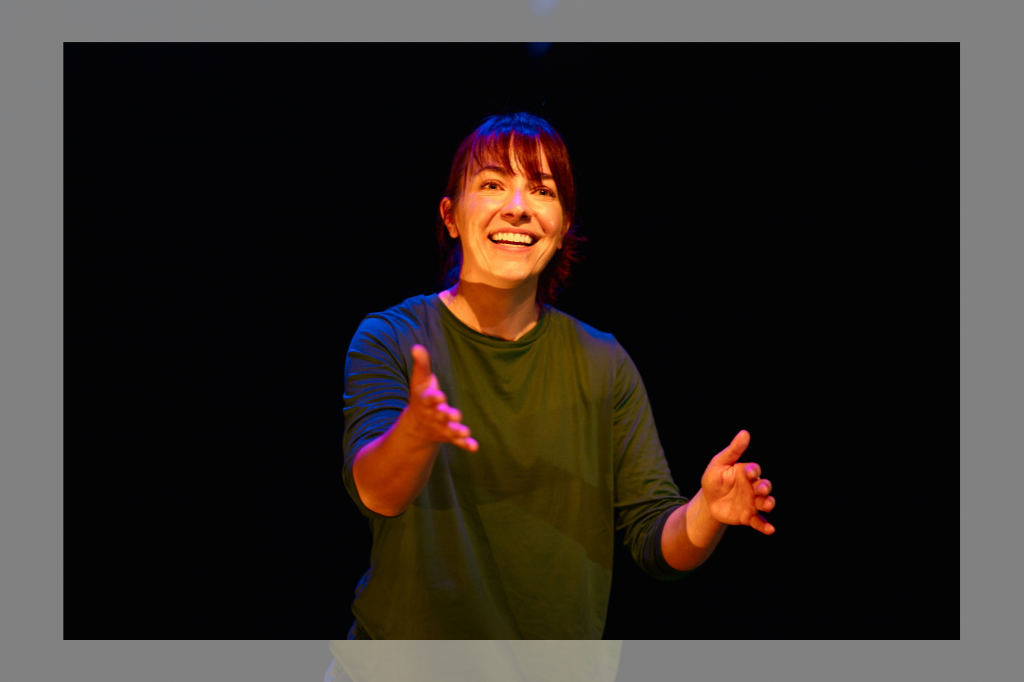
In one of Vitals’ most arresting moments, Anna breaks into a dance. The paramedic has just survived an emergency call in which her own life was at risk. Panic floods the room. To steady herself, she moves: first as release, then almost as possession, riding loud punk growls and a hard nightclub beat until her body becomes a startling image of trauma searching for an exit.
Rosamund Small’s solo play about emergency medical work gives coping its own brutal grammar. Sometimes it is movement. More often, it is bluntness: a way of speaking about death when sentiment would be useless, and perhaps dangerous. After its 2014 premiere, Vitals went on to win Dora Awards for outstanding production and outstanding new play in the independent theatre division. Small built the script from interviews with frontline health-care and EMS workers, whose jobs require them to make life-or-death decisions in real time while carrying the emotional residue of everything they have seen. Twelve years later, the show returns to Toronto in a Second Act Actor Productions staging that feels heightened and unsettlingly personal.
Anna is played by Dr. Janet McMordie, a practising physician who began acting alongside her medical career during the COVID-19 pandemic. Her medical experience gives the performance an unusual charge. She brings into the Factory Theatre Studio a physician’s understanding of emergency care: its speed, intimacy, and pressure. In the language of the German documentary-theatre collective Rimini Protokoll, she becomes an “expert of the everyday”: someone whose real-world expertise enters the performance as its own form of theatrical truth.
To ground this collision of performance and lived experience, director Alaine Hutton keeps the stage stark and unadorned, leaving McMordie’s body and voice exposed in the bare black-box space. A few concrete elements remain: a rubber basin filled with water, Ski-Doo boots, paramedic vests scattered on the floor, and two side-by-side chairs that suggest the cab of an ambulance. Behind the playing area, red and blue lights sometimes pulse, evoking the rhythm of an emergency siren.
The play’s narrative takes shape through Anna’s account of a series of emergency calls — part testimony, part release. Each episode leaves another mark on her, exposing the pressure, absurdity, and psychic toll of the job. McMordie makes that accumulation visible: shoulders squared, elbows angled outward, posture upright and ready to spring.
Anna’s tone is matter-of-fact and direct, but flashes of bitterness surface through her blunt dark humour. The jokes are often crude, even off-colour, and McMordie delivers them with the dryness of someone for whom shock has become routine. Their inappropriateness gives the situations a harder, more lived-in reality. Humour becomes a survival mechanism: detachment as a way of managing trauma and defusing panic.
But Vitals also explores the network of relationships that makes Anna’s work possible. Through her stories, we come to know her co-workers, from the tough, emotionally intelligent Amir to the anxious, unreliable Harry, who once managed to get lost while driving an ambulance to Sunnybrook Hospital. The play cuts through the glossy image of health-care workers as haloed heroes, bringing us closer to people working through exhaustion, hypervigilance, and horror.
Part of what makes the script so gripping is how deeply Small embeds it in Toronto’s geography. From Castle Frank station to High Park, from Kingston Road to the Eaton Centre, Anna remaps the city through emergency, giving concrete shape to an experience that might otherwise feel distant and abstract.
That topography speaks to Anna’s own relationship with the city. Subway stations, schools, and intersections are no longer neutral places, but coordinates in a landscape of bodies in crisis: a map of private catastrophes. Her memory as a Torontonian and her memory as an EMS worker have fused. The job cannot simply be left behind. It follows her home, altering her everyday life, and the way she sees the people and places around her.
What makes this mapping political is that it moves us not only through Toronto’s geography, but through its social body. The calls cut across class, age, and circumstance: a banker who shoots himself, teenage girls attempting suicide, toddlers gasping through asthma attacks, a working-class woman found mutilated, a neglected baby, a neighbour bleeding behind a familiar door. The city that emerges is not the smooth multicultural postcard that Toronto likes to project, but a stratified landscape of suffering. The play forces into view the varied, brutal realities that we often learn to ignore.
Leaving Factory Theatre, I found myself noticing the city differently: an unhoused man lying on the sidewalk between Bathurst and Queen; later, an ambulance siren cutting through my thoughts as it raced toward the Trinity Bellwoods neighbourhood. I wondered whether I would have registered either moment in quite the same way had I not just seen Vitals. After hearing Anna’s story, Toronto does not look quite the same.
Vitals runs at Factory Theatre until May 10. More information is available here.
Intermission reviews are independent and unrelated to Intermission’s partnered content. Learn more about Intermission’s partnership model here.

WRITTEN BY
Alessandro Stracuzzi
Alessandro Stracuzzi is a Toronto-based theatre critic and performance researcher from Italy. He holds an MA in Performance Studies from the University of Milan, and writes about contemporary theatre, performance, and experimental practices. His criticism has appeared in Stage Door, Our Theatre Voice, Stratagemmi, and Fermata Spettacolo.
LEARN MORE