


-0-1280-0-720-crop-fill.jpg?k=236e105618 "twenty excellent films about women seeking revenge • Journal • A Magazine • , Life in canada")
![24th Jul: Class Crush Crisis (2026), 8 Episodes [TV-MA] (6/10)](https://occ-0-8164-92.1.nflxso.net/dnm/api/v6/0Qzqdxw-HG1AiOKLWWPsFOUDA2E/AAAABYEcxV0xgavnEqm2iMp74DpqleW8UQ6YgKt_SDS118IAElBvYiFOeaHC5SWNsJ6dyfIt0-7M-GN7aXMgJZBBZ3vJO5NGa_QCmxZhH3t1JJS7V7RHmxr6njLZ6_XxLAq-DhunYgQh0xOpXaE6JX9P8vDYI5vsawmv_TE1zg0RfMbkDk2SS0aLYeF9wECjOvhdZ-wv2QnnGIbF4UmzsWEpTIOwzYLnFvj91L8PNgiQNFpqj25304U3eybb6ALQbFC-86rg8pEIuWufBUm0mGbckdBbwRkoG_T9rWM5D-Fql_gPPqyQN9f7BMGBTmco3A.jpg?r=f8f "24th Jul: Class Crush Crisis (2026), 8 Episodes [TV-MA] (6/10)")



I’ve been coming to Dakar, Senegal for nearly 10 years, basing myself here for the last two. I’ve eaten more meals at beachside restaurants than I can count, and danced many nights away along the corniche. Yet, until recently, I had never spent a day in the ocean.
Dakar has a deep connection with the sea. As the westernmost point of Africa, the city is surrounded by the Atlantic Ocean, and fishing and wave riding have been embedded into the culture for centuries. I decided it was time to get in the water.
Aside from being on my doorstep, I chose Dakar instead of global hotspots like Portugal and Morocco for a few reasons beyond convenience. Tourists who visit Dakar mainly head for the obvious – the Renaissance Monument, Gorée Island – but the surf scene sits in plain sight, known to locals and a small community of travellers in the know.
Dakar’s coastline also offers high-quality swells and uncrowded breaks for beginners and advanced surfers alike, while the beaches themselves remain lively to enjoy before and after a session. For me, learning in a West African country was exciting because I would mainly see people who look like me in the water – an added but necessary bonus.

I chose to start my surfing journey in Yoff, heading to Plage BCEAO. A coastal neighbourhood in the north of Dakar, Yoff is a traditional Lebou fishing community where religion and the ocean are central to daily life. It’s also one of the longest beaches in Dakar.
Communal and animated, especially in the evenings, the area is a no-brainer for surf schools to set up shop. Many of the local surfers are Lebou, as are those in nearby Ouakam and Ngor, two of Dakar’s other surf spots.

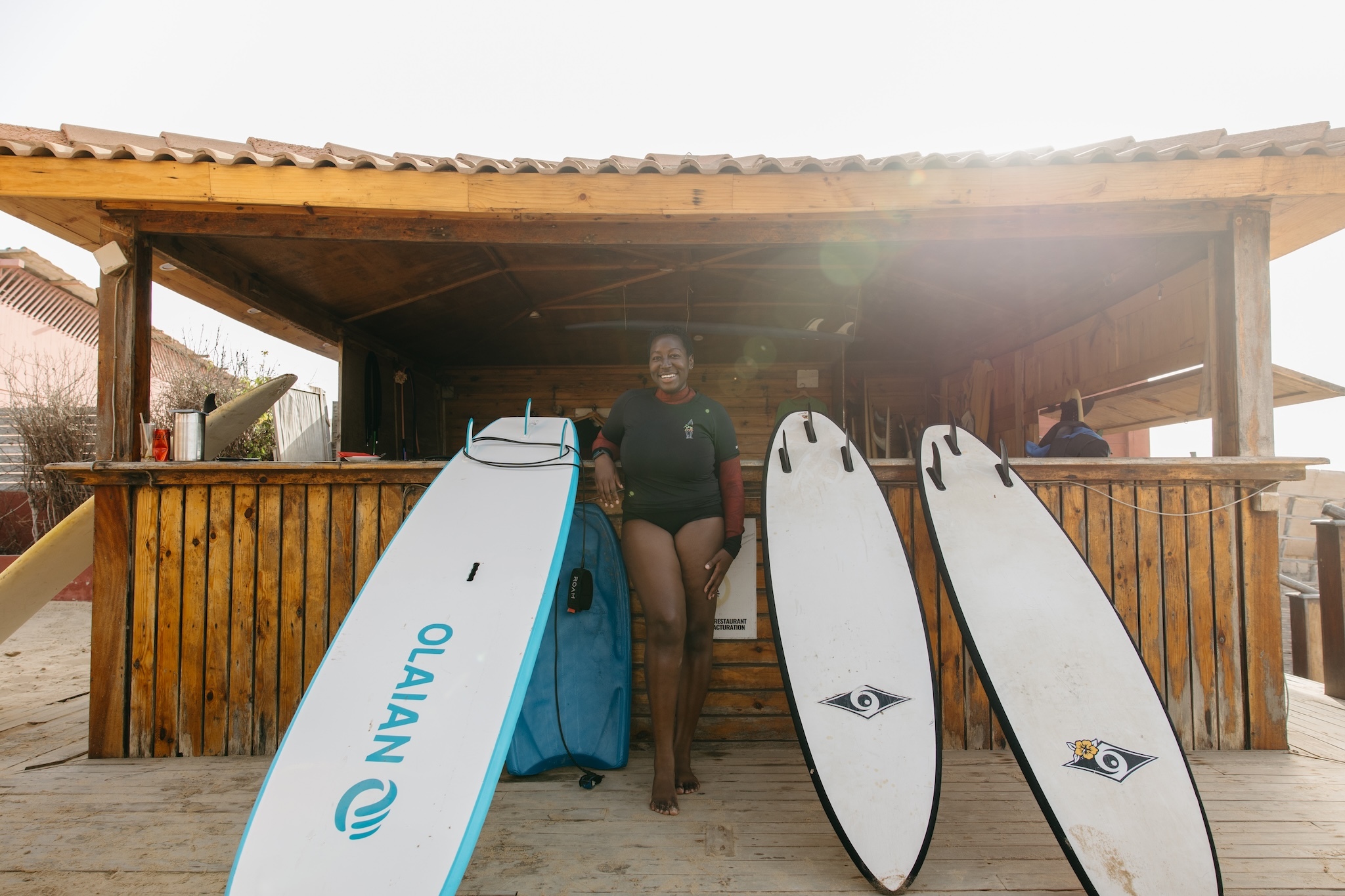
The waves are accessible and consistent, with no rocks on the beach and lots of room to spread out. I went to Kaay Surf for the first of three lessons with its founder, Mamadou Mbengue. Even on a crowded beach, he would have been easy to spot with his beaming smile and neon green and black wetsuit.

Mamadou began learning to surf at the age of six in nearby Ngor. He went from surfing near his home to competing in 2008, eventually becoming a three-time national surfing champion. He became a surf instructor in 2013 and launched his own surf school, Kaay Surf, in 2024.
‘You can surf all-year round and we know the breaks well, so we help new surfers progress safely. You’ll find only good vibes and cool people when surfing in Dakar,’ he says.

Arriving at the beach, I could smell the salt in the air as we walked across the sand, watching kids playing football and small restaurants lining the shore. On my first lesson, I couldn’t stand up and ride a wave – the pop-up technique felt so foreign to me. I spent most of the lesson gulping salt water and falling off my board instead.
You’ll find only good vibes and cool people when surfing in Dakar
Mamadou kept it fun and light, assessing my technique and reminding me to trust myself. By the end of my second 90-minute session, I managed to get up, only to fall off one second later from sheer disbelief and excitement. I left the water that day feeling proud. It was enough to send me home researching pop-up techniques on YouTube and trying them out on my yoga mat.

By my third lesson, I felt more confident walking onto the beach, realising this was the beginning of a new hobby that I could do all year round.
Over an hour into my third session, I still couldn’t get up on the board. Mamadou joked that the ocean was fighting me and I wasn’t fighting back. The perfectionist in me was feeling battered and frustrated, so I began to bargain with myself for some chocolate cake, while jokingly telling Mamadou that if I couldn’t stand up on the next wave, it must be because he was a bad instructor.

When I rode the next two waves and threw my hands in the air, the locals watching from the beach did the same. That moment unmasked what I couldn’t see in the midst of my frustration: the community in Yoff was genuinely invested in my success. While I was busy beating myself up, strangers in the water would switch to English to tell me to keep going.

Senegal is known as the ‘Land of Teranga’, a Wolof word loosely translating to hospitality that shapes Senegalese identity. Mamadou told me that when international surfers visit, the exchange goes both ways. Local surfers and visitors learn from each other, and surfers often leave their boards behind as a gesture of gratitude.
Whether it was strangers cheering from the shore or Mamadou’s patient smile across three sessions, I realised only I was in my way. Everyone else was happy to have me there.
I just wish I had explored this in Dakar sooner, and I hope the rest of the world continues to catch on too.
Surfing destinations in West Africa
Senegal
Beyond Yoff, there are many well-established surf spots, catering to all levels with year-round conditions: Virage, Ngor, Ouakam and Almadies. Many surf schools are English-speaking, so language is no barrier.
Liberia
Robertsport, about two and a half hours from the capital Monrovia, is the prime destination with consistent left-handers, warm water and uncrowded breaks. Best conditions run from April to August. The infrastructure is minimal but growing, and it suits all levels.
Ghana
Busua is Ghana’s surf capital, a laid-back fishing village about five hours from Accra with waves for all levels. Kokrobite is another surfing spot to know about, closer to the capital. The best season is April to August.
Sierra Leone
Bureh Beach, about an hour and a half from Freetown, is home to the country’s first surf club. The bigger swells arrive between March and October, but the water is warm throughout the whole year.
Stay in the loop: sign up to our free Travel newsletter for all the latest travel news and best stuff happening across the world.


