



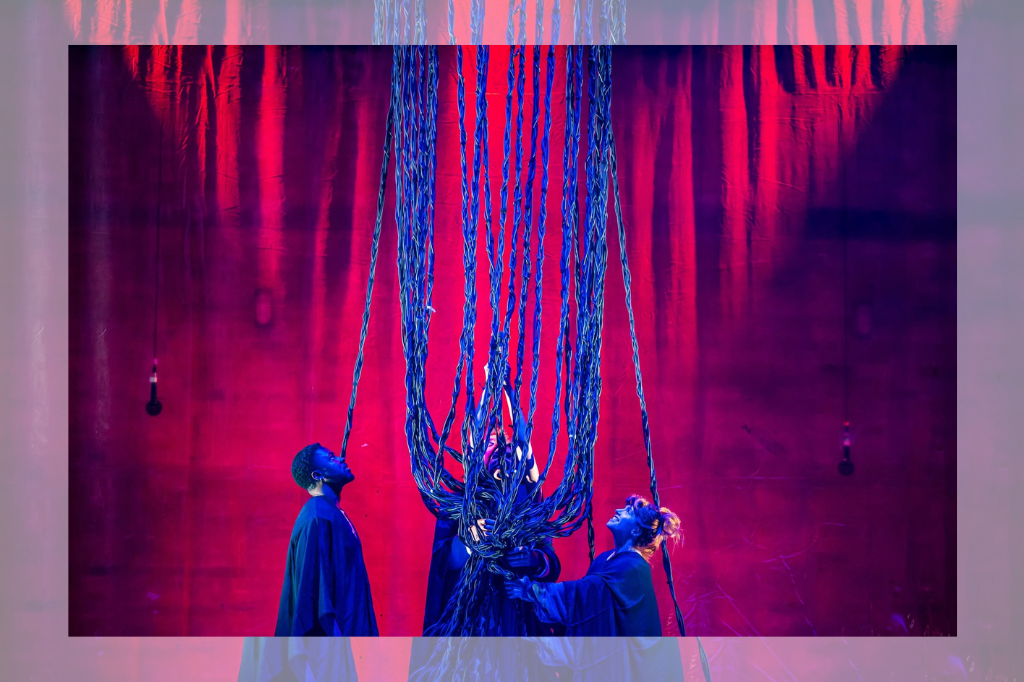
In Erin Shields’ latest play — her third world premiere this year — Medusa’s serpents represent seductively, sinisterly self-abasing thoughts. A co-production between Soulpepper Theatre and Outside the March, this contemporary reimagining of the Medusa myth plagues its eponymous character (Oyin Oladejo) with an unceasing cacophony of voices criticizing her every move. Speaking in sibilant murmurs via headsets wired into each seat of the Baillie Theatre, a chorus of intimate voices (Amy Keating, Sasha Khan, Michelle Monteith, Gord Rand, and Danté Prince) infiltrates the audience experience as well, drowning out dialogue and weaving an overstimulating soundscape.
Medusa is the sole mortal employee at Athena’s Temple and a household breadwinner responsible for two sisters: Stheno (Keating) and Euryale (Khan). Her obsessive thoughts, the Mitchell Cushman-directed production suggests, are just another barrier to equity that more privileged characters don’t face: the Sheryl Sandberg-ian Athena (Monteith) and wealthily bohemian Poseidon (Rand), for instance, operate with privileged self-assuredness.
Like much of Shields’ work, the device offers a smart and engaging transformation of its source material while maintaining an ironclad hold over audience interpretation. Layering an interior monologue over a scene is an exciting theatrical experiment that could, theoretically, offer deeper insight into a character. In Medusa, while these voices create an affective experience of overwhelm that immerses the audience in the play world, they also flatten Oladejo’s opportunities for performance. Members of the ensemble cast trade off microphones, producing a stream of narration that reminds Medusa of her many obligations, chastises her for social missteps, and comments on the action of each scene. The narration stops and starts, offering a reprieve during part of a scene before picking up again, overpowering dialogue. With thoughts and emotions being so often labelled (“shame, shame,” the serpents hiss throughout a crucially climactic moment, indicating Medusa’s feelings of shame), illusions of depth shatter.
Of course, Shields was never aiming for psychological realism. Medusa’s characters are more conceptual, producing a mythologically tinged allegory for the difficulty of civilians wresting power from elites. In the myth she’s reworking, sourced from Ovid’s Metamorphosis and other Greco-Roman stories, Poseidon rapes the mortal votary Medusa in Athena’s temple, and the virgin deity Athena transforms her into a Gorgon for the transgression. The first half of Shields’ play drives its earnestly beleaguered heroine toward a painful realization: gender coalition across class lines is a lie. Power will always protect power. In the final scene of the first act, Medusa’s internal voices speak in the dark, the device at its most powerful and agonizing. Patriarchy wins, violently.
We return from intermission to an entirely new world. The lights stay up through most of the second act, allowing audience members to see one another. Years after Athena’s curse, Medusa is the proprietor of a Rage Room — a place where women act out their frustrations with husbands and bosses by smashing personal items with a baseball bat. No this is not a substitution for political action! (the play insists). The Rage Room motivates women to act: they lay down their bats and promptly leave abusive husbands, abandon children, threaten predatory bosses. Rage is a feminist emotion.
Here, the messaging became a little muddy for me. What does it mean that Medusa is enacting her world view through a business venture? Are we meant to interpret Gorgon Rage Room as a large-scale cultural revolution? Or is this local business meant to seem like a trivial answer to Athena’s corporate empire? A subplot involving a real estate developer/chauvinist nemesis (played by Rand) further complicates the story’s meaning.
Anahita Dehbonehie’s set design employs striking visual iconography for each act. A tangle of braided cords hangs from the ceiling, microphones at their ends for use by Medusa’s snaking thoughts. The design suggests hair and serpents, while subverting the classical pedigree of the Medusa myth with a rough-hewn, industrial aesthetic. In the second act, a dingy vinyl curtain partially obscures Rage Room sequences. Our filmy vision of these scenes emphasizes the heightened unreality of the act’s meta-theatrics: Rage Room clients move through curated environments, their experiences structured by Medusa’s voice.
A developing friendship between Rage Room employees Annie (Keating) and Percy (Prince) is the emotional core of the second act. Medusa’s all but absent; instead, we watch Annie and Percy work through their own feelings about gender performance and emotional regulation. Something something manosphere — Percy doesn’t want to get sucked into that rage-baiting machine. Many ideas swirl around. Keating and Prince’s grounded presences and compelling chemistry keep this half of the show from spinning out into the cosmos.
I appreciated Medusa’s slippery logic and moments of satisfying revelation, despite a lack of clarity in its conclusion. This adaptation churns through its source material, creating a mess it refuses to tidy. Its structure, fittingly, resembles a tangle of serpentine bodies, each offering their own rich provocation.
Medusa runs at Soulpepper Theatre until July 12. More information is available here.
Intermission reviews are independent and unrelated to Intermission’s partnered content. Learn more about Intermission’s partnership model here.

WRITTEN BY
Ferron Delcy
Ferron Delcy is pursuing her PhD in early modern literature at the University of Toronto. In 2024, Ferron participated in the New Young Reviewers program facilitated by Toronto Fringe and Intermission. She is a big fan of ghost stories, fog machines, and weird metaphors.
LEARN MORE