



Director Janus Metz – Photo by Roy Rochlin/Getty Images for Netflix
Director Janus Metz Pedersen portrays Ted Kaczynski’s young life in Unabomber. It’s a story that requires, of course, a great deal of responsibility in portraying the domestic terrorist. Pedersen’s film doesn’t provide any answers, but asks how Ted became the deadly man he did.
Much of the film is set in the ’50s and ’60s, depicting Ted’s formative years at Harvard University. He’s experimented on by Professor Henry A. Murray (Russell Crowe), a role model turned ideological enemy for Ted. It’s a dangerous relationship that defines the film.
Recently, Pedersen spoke with What’s on Netflix about depicting their time together, as well as his own research into the Unabomber.
How does your documentary experience shape how you approach a figure like Ted?
Coming from a documentary background, it’s a very fundamental mechanism in me to try and learn from the real-life story. Truth, reality, is always fundamentally and endlessly exciting and interesting. Sometimes when you look hard enough and you look deep enough, that’s where you get the real answers. It’s informative to my filmmaking that way. If I’m in doubt, I go back to reality and I take a second look.
What were the main questions that you really needed to answer for the Unabomber before directing it?
There were many questions, and some of them are not necessarily something that you think of before you go into a project, but something that transpires as you’re working with it. I was certainly deeply interested in what were the elements that made a young Ted Kaczynski become the Unabomber on a basic level. Did the Murray experiments somehow contribute to breaking this kid and putting him on that track? Those are very fundamental questions for me that I was asking myself.
What was your takeaway? The movie doesn’t give you an easy answer to that question, but where do you fall?
When we are looking at the Ted Kaczynski story, it’s not a one-plus-one-equals-two. There’s so much nuance and complexity there, but we’re looking at something that’s a little bit of a black box because this experiment is still classified. The Ted Kaczynski file at Harvard is still classified. We don’t know exactly what happened. We have a lot of research from other people that took part in this experiment, and Ted’s also spoken about it himself.
But I think the way that these experiments were designed to break down someone’s personality was obviously something that was potentially very harmful. I like to think that we are maybe providing a piece of the puzzle in our efforts to try and understand who this man was and why he did what he did.
Cr. Philippe Bosse/Netflix ©2026
Was it a complete non-starter trying to talk to Harvard and be like, “Hey, can we see that file? This could be helpful information”?
Yeah, I don’t know that there was anyone who ever reached out. I think it’s locked off. Even for the court case, it was locked off. I don’t think a couple of filmmakers approaching Harvard was in the cards for us.
When you look at those scenes and those tests, it’s really cinematic for just two people sitting across a desk. For you, what was inherently filmic about those tests that you wanted to craft in the editing, picture and sound?
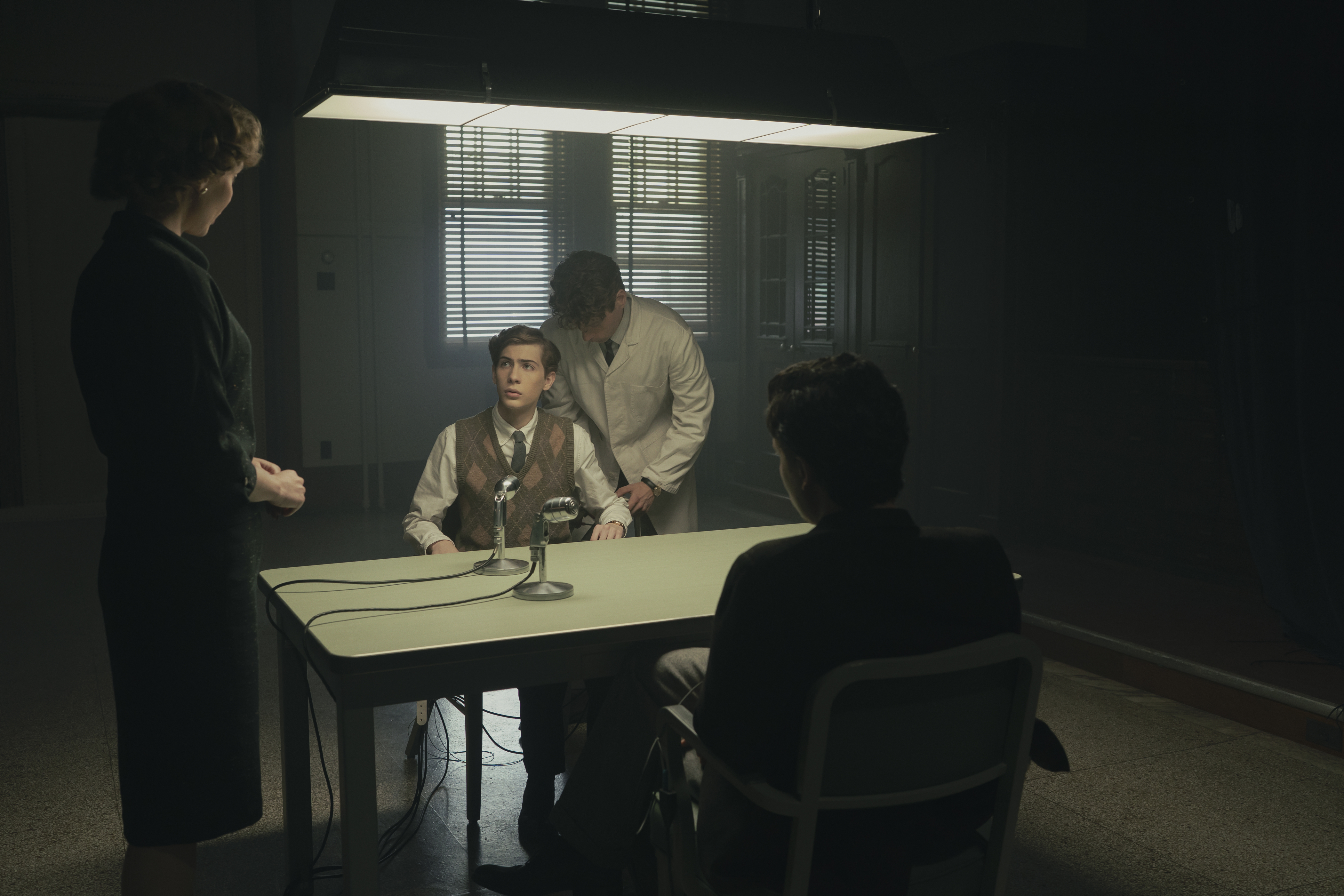
I think the drama is there just by the fact that these are two formidable opponents who are trying to break one another and outsmart one another. That is the drama, in many ways, in the storyline that takes place in the past, late ’50s, early ’60s.
Interestingly, my previous feature, All the Old Knives, is a spy movie, and 50% of that film takes place around a dinner table, also in a sort of interrogation situation. I would say I had a pretty good practice run at how you amp that stuff up cinematically to serve the story.
For me, it was important that we didn’t get too smart. The camerawork is not smart in that section. There is a moment when Ted finds out that these experiments were not what he thought they would be, and the world spins and the angle changes. You’re crossing the line on the cameras, et cetera, and he goes into this whirlpool of, “What the fuck’s going on?”
I think that’s when you break these more static images, which were chosen for: How do we mine a person’s state of being, a psychological state? Every single shot is directed at that. How do we get into the head of Ted and into the head of Murray?
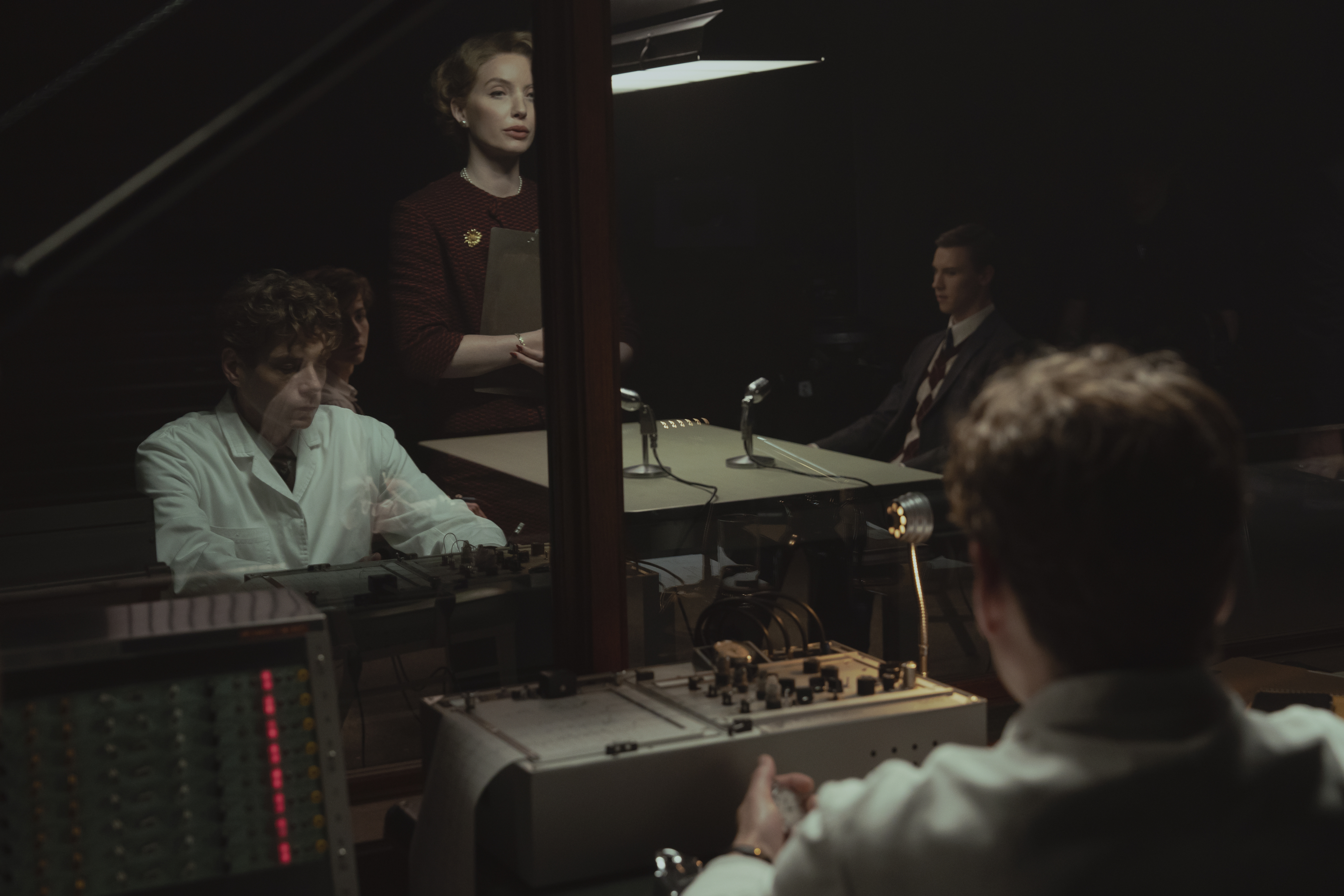
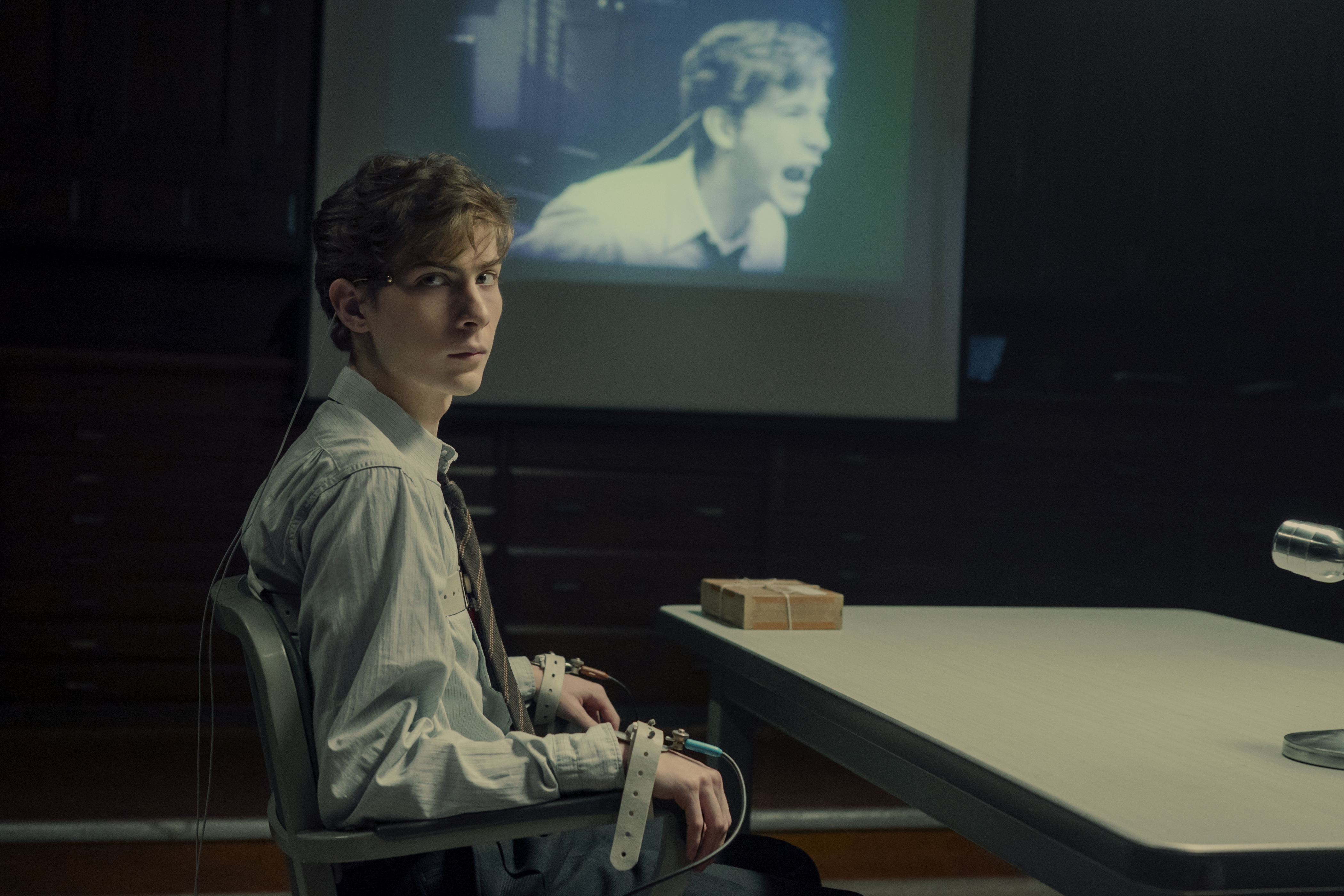
Ted Kaczynski is constantly monitored and observed. There are people behind a glass, like a one-way mirror, and he’s got his own reflection. So, that cinematically also speaks to: Is he being pushed into developing a sense of schizophrenia? You’re seeing his reflection in the mirror; the people behind the mirror are looking out at him. All these things were very exciting to work with cinematically.
I was also going to say, cinematically, it’s really good casting with Jacob Tremblay because he has such an innocent face. Was that part of the reason you cast him?
Jacob was at such an interesting place in his career. This is really his first adult-role performance, and it was such an honor to get to give an actor that moment. When I first met Jacob, I knew him as a child actor. I had the privilege to see some work of his that hadn’t come out yet, and that really got me excited because I felt he’s a guy who’s really looking for truth and authenticity in his performances. He’s about the art and craft of filmmaking and acting. He’s so curious.
At the same time, particularly when we shot the movie two years ago, he was so fresh-faced and wonderfully, “I’m coming out to the world, I’m curious.” We needed that from a young Ted Kaczynski, who’s 16 years old when we are plunging into his story.
When you work with someone like Russell Crowe, who has decades of experience, what do you notice about an actor of his caliber and experience?
Well, first of all, Russell Crowe is a living legend in my book. I was so excited to be able to work with him, and he’s so good. He brings so much gravity to his performance, to the screen, and he’s an ocean of experience, obviously.
What is important, for someone like Russell, and what’s exciting, is he loves to work. He loves acting, he loves the cameras, he loves being on screen, he loves to explore. You want that vitality, that fire from your actors.
He’s not just leaning into his experience. He’s trying to make it every bit as good as it can be and every bit as exciting as it can be. As part of that, you want to push yourself to new places. Maybe you want to lose control. It was very exciting to work with Russell in that sense.
Unabomber. Jacob Tremblay as Ted Kaczynski in Unabomber. Cr. Philippe Bosse/Netflix ©2026
He also casts such a big shadow. That suits this role well.
Yeah. The Henry Murray character that Russell portrays is the head of the psychology department at Harvard. He becomes, in a sense, a father figure to a young Ted Kaczynski, and then he deceives him. So that’s kind of the heart of the story, and Russell portrays that beautifully. He is this larger-than-life presence, and that transpires in the movie. It’s exactly what we want from that character.
Growing up as a kid, you’d always hear about the Unabomber’s manifesto, Industrial Society and Its Future. I never read it, but did you have an experience of reading it, and what did you learn?
Well, it’s very interesting to read it because you’re reading something that I think could almost have been written today. It’s quite coherent. It’s written as a dissertation, and there’s a logical argument that’s being pursued from A to B.
So if you took out the violence of Ted Kaczynski and the violence of the Unabomber story, you could read it and you could think, “Well, the guy, he’s not wrong. There’s something going on here that we need to think about.” And there are a lot of things in the manuscript that I don’t agree with at all as well.
First and foremost, I think when I read behind the immediacy of the argument, there’s a deep structure in the argument. It’s about this idea that the world has fallen apart, that there’s not any sort of connection between what we call things and what they are, and that we should be able to get back to a sense of a more natural being as human beings, where we’re more in tune with what we naturally are.
I think those kinds of paradise ideas or myths about the truth of the human constitution are inherently dangerous, because we just don’t know. We can’t be God in that sense. If you really do a deep dive into Ted Kaczynski’s manifesto, those kinds of ideas are underpinning his argument.
It’s also part of what the story is about. He’s envisioning a sense of paradise, and he’s trying to throw bombs at us in order to come into his boat so we can all outlive that idea. That’s fanaticism. That’s part of the radicalization that he is championing, and I don’t think we as human beings can ever succumb to those types of ideas.
Even though the film mostly focuses on his younger years, after he was jailed, were there many medical studies, tests or documents that you had access to that influenced how you portrayed his younger years?
There’s been a lot of writing and research about Ted Kaczynski. You could certainly argue that maybe he had some personality disorders, maybe schizophrenia. I don’t know that there is a widespread consensus about his mental constitution in his younger years or in his later years, but it’s debatable.
Trying to understand who he was, it would be so nice if we could say, “Well, this is why he did what he did.” I don’t think it’s possible to find that sort of simple answer to that question, but there are certainly many aspects to Ted’s life that contributed to him becoming the Unabomber.
Rather than giving straight-up answers, it’s interesting to explore that history and think about what isolation means to a human being. Think about how he was hospitalized as a kid and left without — he wasn’t allowed any visits from his mom — and what did that do to a child?
He was bumped up two years in school because his IQ was so high that he would outsmart everyone, but that also meant that he didn’t have any friends. He was socially isolated. There are all these factors to Ted Kaczynski’s life that I think contributed to him becoming what he became.
We can look at that and we can try and learn from that, but at the same time, there’s also just this junction and a rupture where: What is it that makes someone violent as opposed to other people who would’ve chosen differently? We can never answer that question fully, I think.
Unabomber. (L to R) Annabelle Wallis as Christiana Morgan and Jacob Tremblay as Ted Kaczynski in Unabomber. Cr. Philippe Bosse/Netflix ©2026
It’s always important to ask the question. For you, what was really pertinent about the Unabomber story today, in 2026, that made you really want to make it?
Well, I think we’re living in a moment where there’s radicalization, political radicalization, people living in echo chambers, and the manosphere. All these things are, unfortunately and sadly, something that we have to deal with and have to look at and have to try and understand. I think the story shines a light on that. I think that’s why it is a story that speaks to the present and that is relevant now, even if it took place from the ’50s up until the mid-’90s, when he was caught.