



Cristina Modreanu in conversation with Zsuzsánna Magdó at City of Asylum
Theatre researcher and author Cristina Modreanu toured the United States in September for a series of events dedicated to her latest book, Performing Womanhood in Eastern Europe: The Other White Woman, published by leading academic press Routledge. The book served as the starting point for events in a range of academic and cultural settings, from the Davis Center for Russian and Eurasian Studies at Harvard University to City of Asylum in Pittsburgh, Ithaca College and the David Geffen School of Drama at Yale University. At City of Asylum, Cristina Modreanu had a conversation about the book with Dr. Zsuzsánna Magdó, the Interim Director at the University of Pittsburgh’s Center for Russian, East European, and Eurasian Studies, which continues here in writing.
Zsuzsánna Magdó: Let’s start with the end of your book’s title: The Other White Woman. In white settler societies, most of us are used to feminism being framed as a conversation about race (white vs. Black, Brown, Asian feminism) and geographically about Global North versus Global South. You argue that Eastern European women fall into a gap that none of those framings notice. Can you describe for us what that gap is? In other words, who is this Other White Woman, why does her lived experience deserve a separate category at all, and what makes her relationship with Western feminism fraught?
Cristina Modreanu: Imagine a girl who has never owned a Barbie doll, who has not even heard of Barbie until she is in her twenties. A girl who was raised in an allegedly egalitarian society, where everyone had a home and a job; there were no homeless people, and there was little access to a variety of clothes, cars, or other goods that signify wealth. Information from outside the socialist “bubble” was limited, the right to travel was restricted, and, of course, there was no internet, only a limited television program and state-controlled newspapers. Literature, film, and theatre were heavily censored.
Meanwhile, prejudices against women inherited from the previous regime persisted, even though the official discourse consistently emphasized that men and women were equal. Mentalities are very hard to change. Imagine this girl growing up in a world where people were more or less equal, where most people were white. Yes, there were Roma people, but they were supposed to be uplifted by and incorporated into the socialist project, rather than exploited, at least not openly, so race was not perceived as a problem.
Very few people knew what feminism was; there were no public discussions about it—or about anything controversial, for that matter—because this was a closed, censored society in which ideas were not meant to circulate freely. In other words, the conceptual frameworks underpinning contemporary feminist debates simply did not exist.
The Other White Woman I am talking about in my book has virtually no relationship with the Western white woman whose experience is so deeply entangled with the history of feminism. Yet, theoretical discussions of feminism still tend not to distinguish between these two different positions. I do not recognize myself in the figure of the Western White Woman, taken as a point of reference in the arguments made by Rafia Zakaria, for example, in Against White Feminism.
ZS.M.: So, whiteness has shades “with all its heavy burden of meanings and responsibilities in the post-colonial world,” to quote from your book. And, evoking Rafia Zakaria, you argue that it is precisely because of this marginal positionality that the Eastern European woman stands against Western feminism along with the Black, Brown, and the Asian woman. This argument is so rich, let’s unpack the ideas here a bit more.
C.M.: As I said, we only learned about the different waves and nuances of feminism after 1989, when the fall of the Berlin Wall marked a turning point for all the countries of the former Soviet bloc. Then all the waves of feminism washed over us, folded into one. We encountered them as a theoretical problem rather than as a lived experience.
Of course, there were differences between socialist countries. The former Yugoslavia, for example, was more open to the Western world, and Slavenka Drakulić writes in her book How We Survived Communism and Even Laughed that she took part in the beginnings of a feminist movement in her country in the 1980s. And yet, as I said, I still do not recognize myself in the figure of the Western White Woman who serves as a point of reference—and a target of critique—in Rafia Zakaria’s arguments.
When I read her book, I agreed with most of the points she made, but in terms of lived experience, I felt closer to the position of Brown and Black women. We have not colonized other peoples; we were culturally colonized by the Soviet Union. We have not patronized other women or told them how to live their lives; we were barely able to live our own, with so few freedoms and rights. Ours was not a world driven by capital and profit. This is another important distinction, because capital and money can radically alter the course of things, often for the worse in the long run.
This does not mean, however, that we have no responsibilities. We must also acknowledge our failure to stand up to power: we were too submissive, both within the family and in society. We did not do enough to raise young people with a sense of themselves as independent individuals, capable of thinking freely. Our mothers and grandmothers had limited opportunities and their motivation was often to keep everything FINE than to teach us to rebel. And this was one of the challenges the new generation of women had to confront.
ZS.M.: This Eastern European white womanhood operates in a variety of ways in your book: it registers historical and social trauma, marginality, and silencing both within the region and in broader feminist discourse, but it also bears the mark of (post)colonial legacies. Help us see how this white womanhood is complex, fluid and situational. Socialist systems were diverse and gender’s intersection with a variety of identity markers (ethnicity, class, religion, race, sexual orientation, and ability) shape(d) lived experiences deeply. Also, do you understand this white womanhood as both a position of marginality and as a power/privilege mobilized to exclude an “Other,” two positions often negotiated in tandem?
C.M.: It is important to clarify that my book is written from the perspective of theatre: it is a book about womanhood as represented on Eastern European stages, not a historical or anthropological study. I am not a specialist in either of these two fields. I do archival research, and I have written two books about Romanian artists as seen through the archives of the Securitate, Romania’s former secret police, as well as personal and institutional archives. I have also watched theatre productions from countries across this part of the world for more than thirty years of writing about theatre.
I analyze the representations of womanhood I encounter in these productions because theatre is a powerful mirror of society, offering a multifaceted perspective on how people see themselves at different historical moments. So, yes, the lived experiences of women in socialist countries differ, but there is one point at which they converge: in all these countries, women have very often been written out of official history. I can see this, for example, in the history of theatre. In my book, I work with and quote fellow theatre critics from other countries in the region who have reached similar conclusions through their own archival research.
There is something else we have in common: over the past three decades, women researchers and artists across this part of the world have been working to make visible the legacy of their predecessors, in all its complexity. It is beautiful work, and I am happy to be part of it. Perhaps this is something that brings us closer to women artists and researchers in the Western world. As the American poet Adrienne Rich wrote in her essay When We Dead Awaken: “Re-vision is for us more than a chapter in cultural history: it is an act of survival.” By “us,” she meant women. She was writing this in 1971, at what she described as a time of awakening for women in the Western world. We have experienced this kind of awakening only over the past three decades, and this historical delay is essential to understanding the particular character of our feminist thinking.
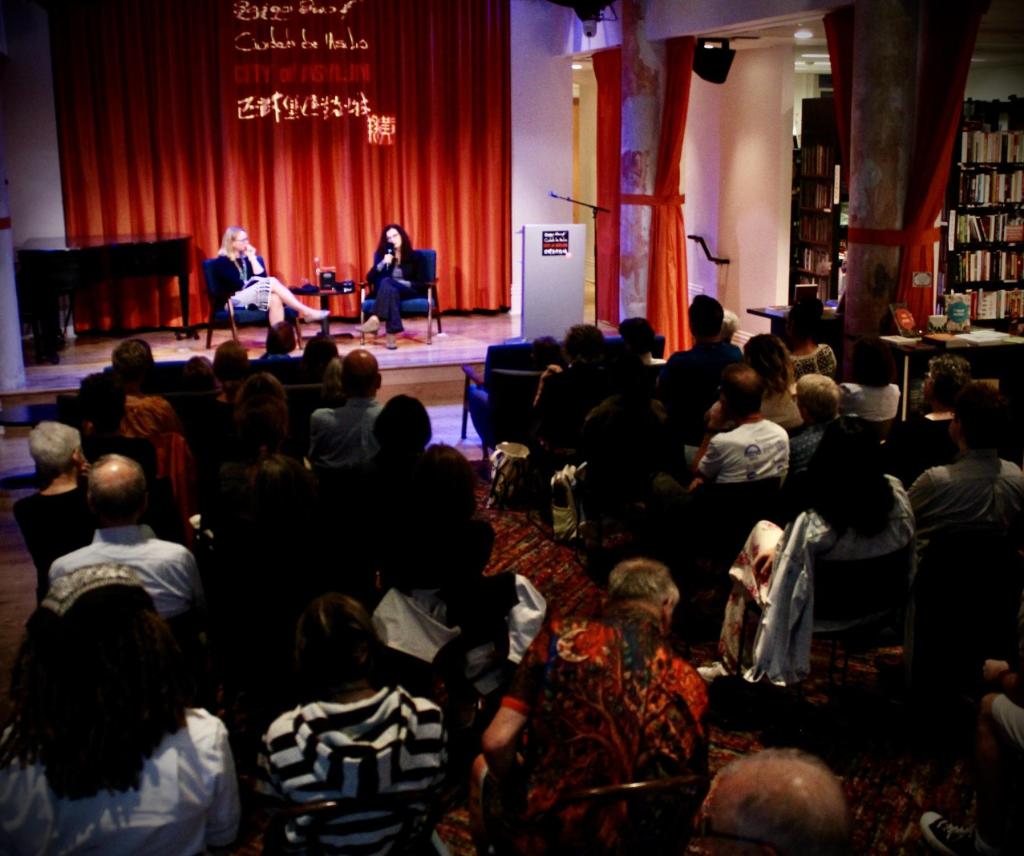
Zsuzsánna Magdó and Cristina Modreanu at City of Asylum in Pittsburgh, 2026.
ZS.M.: You started this book with your own family photos: your grandmother in 1950, your mother pregnant with you in a park in 1974. Why open a scholarly book on theatre with your own family album and personal narratives front and center?
C.M.: Good question. I didn’t want to write a memoir, obviously, but I was wondering how I could help readers who don’t know much about Eastern Europe understand its socio-historical context without becoming too didactic. So, I decided to start with my own family archive in order to make the theoretical arguments more vivid for the reader. I also wanted to offer, from the very beginning, a brief introduction to how womanhood evolved over 50 years in communist society (the photographs date from the 1930s to the 1980s).
At the same time, scholarly writing has changed considerably over the past decades, with a significant shift towards forms that interweave analysis with personal narrative, especially in feminist scholarship, cultural studies, anthropology, performance studies, and autoethnography. I learned about these developments while auditing classes taught by the amazing professors in New York University’s Department of Performance Studies, where I was a Visiting Scholar. This experience helped me enormously in shaping this book and my previous one, A History of Romanian Theatre from Communism to Capitalism, which also has a very personal introduction. I was also encouraged to take this direction by my editors at Routledge and by the peer reviewers of my book proposal.
ZS.M.: You argue that stereotypes about women that communism cemented into culture did not vanish in 1989. They are still visible on stage today, and a new generation of women directors are actively working to dismantle these. What does that dismantling look like when you are sitting in an audience that grapples with several waves of feminism hitting (post)communist societies almost simultaneously? Paint us a picture.
C.M.: I remember a moment when, at the opening night of a new production of Shakespeare’s The Taming of the Shrew, in the 2010s, a few scenes into the performance, a woman with her two teenage daughters stood up and very obviously walked out of the theatre, creating quite a moment. I knew her, so I wrote to her afterwards and asked what had happened. She replied: “I am sick and tired of the misogyny of this society. I don’t want my daughters to witness it in the theatre too and to believe it’s all right just because Shakespeare said so!”
But she was only one of eight hundred people in the room. Of course, there were probably many others wondering why this production—which misread Shakespeare, who is much more nuanced—reinforced misogynistic stereotypes, but the majority of the spectators were not even considering this. The same is true of many other productions that perpetuate stereotypes about women on stage in public theatres in this part of the world.
One of the chapters of my book follows the meandering path of a comic play first staged in 1948, just as the communists were coming to power in Romania, through to 2013, when a new version opened at the National Theatre in Bucharest. Its comic core is built around stereotypes about women’s roles in society, and these remained the same for almost eighty years, across two very different political regimes.
Mentalities are very hard to change, and doing so requires a cocktail of laws, public discussions, and ways of changing people’s imaginaries. This is where theatre can play an important role. Yes, some women directors have been trying in recent years to dismantle these stereotypes. I would say that they are decolonizing themselves from the patriarchal culture in which they grew up and were trained as theatre-makers. But this, too, takes time; it is a long, strenuous process. With the new generations, however, the audience is changing as well. In Poland, there is a feminist company, Teraz Poliz, doing exactly this kind of work. In Romania, there is a Roma feminist company, Giuvlipen, taking on the task of dismantling patriarchal tropes. These are just two of the companies I write about in my book.
ZS.M.: One of your chapter titles is “divorcing Stanislavski to marry Brecht.” Can you translate that for us: what’s the difference between those two approaches to theatre, and why did women directors in this region reach for the second one before and after 1989?
C.M.: In theatre tropes, Stanislavski represents the dominant culture: the standard hierarchy of the pyramid, with the director at its top standing on the shoulders of the other creators – playwrights, set-designers, actors/actresses – who “serve” his vision. Brecht’s is the more horizontal, collaborative model, taking distance from the standard and advancing into unknown territories. They are the highbrow versus the lowbrow, the elite/art theatre for the members of the bourgeoise and intellectuals versus the popular theatre with educational intentions for the benefit of the masses. This opposition is one of the reasons why Brecht was coopted by feminist critics and valued by them for the “radical potential’ of his political critique” (Diamond 1988). Without knowing about the feminist reasoning in regards to Brecht, women directors from Eastern European countries intuitively chose Brecht texts or Brechtian strategies for their productions, which in that context translated as resistance against the regime which actually enforced Stanislavski as the only method to be studied and applied in schools and on stages in Eastern Europe. Brecht encourages critical thinking, a degree of distance that allows for reflection, and more collaborative ways of working, rather than hierarchies imposed on people. In my book, I write about specific examples of women theatre directors in this part of the world who sought greater freedom of expression by staging Brecht’s plays or incorporating Brechtian strategies into their productions.
ZS.M.: You’ve spent two decades as a curator deciding what gets a stage in Romania — bringing in international artists, but also building platforms specifically for women’s work, like the 2014 Bucharest festival themed “The Future Is Feminine,” or your project Hedda’s Sisters funded by an Ibsen Scholarship from the Norwegian state. Tell us how this curatorial work was received at the time. What were some of the hard challenges you remember and how did those inform your thinking after?
C.M.: I have been doing curatorial work in theatre for more than 15 years (up until 2020), with a particular focus on women artists, because I knew there were not enough opportunities for them within the deeply patriarchal tradition of Romanian theatre. This was why it was difficult to convince people, especially theatre managers, to co-produce or host productions authored by women artists. It was also difficult to engage with a very conservative audience. It was not the audience’s fault that people had not been exposed to feminist discourse or new aesthetics, but this made it much harder for us to persuade them to come and experience these productions.
Luckily, the media was very supportive, with a few exceptions, as was part of the Romanian theatre milieu, particularly artists from younger generations. I don’t want to sound immodest, but I think these projects were quite pioneering in the field. They also fed my desire to reflect on the transformations I had witnessed over the years, particularly in terms of responses to new aesthetics and changes in spectatorship in this part of the world—both of which are closely connected to broader societal changes.
I curated the National Theatre Festival in Bucharest and later founded the Bucharest International Theatre Platform, which had seven editions, the last one in 2020. I stepped back from my curatorial work for a while in order to advance my research in an academic context.
Last year, however, I returned to curating, working with Cricoteka, the Centre for the Documentation of Tadeusz Kantor’s Art in Kraków, Poland. I curated a festival of Romanian arts in dialogue with Kantor’s vision, Playing with Kantor, and I am very proud of the work we did together with the researchers from Cricoteka.
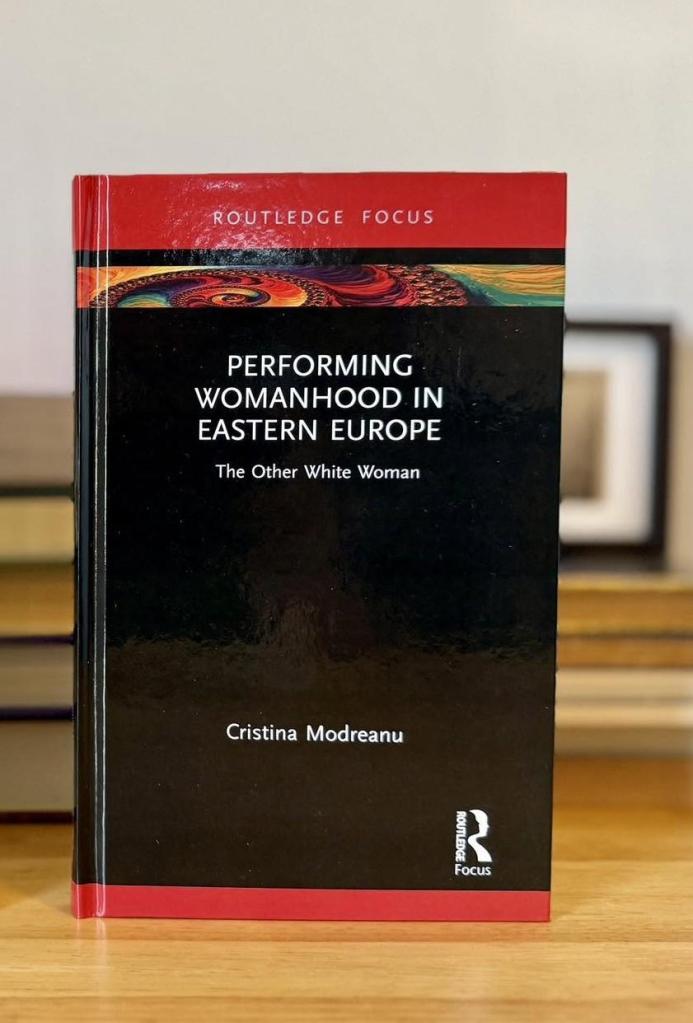
Cover of Performing Womanhood in Eastern Europe, by Cristina Modreanu.
Why this matters right now
ZS.M.: The book’s final chapter is blunt about the moment we’re in. You write about history “closing in on women again” as far-right politics rise globally. I’ll add a number to that: Romania lost about 55,000 people to emigration in 2025, more than in any year since 1990. Women have made up a substantial and often majority share of migration from Romania since the early 2000s. For someone who does not think about Eastern Europe on a regular basis, how does migration, gender, and feminist politics show up on stage? What is there and what is missing in terms of engagement with the displacement of people to Romania?
C.M.: Exile, exile, exile—it is a chorus we hear very often in Eastern Europe, both before and after 1989. For various reasons—political ones before 1989, economic ones afterwards, and now again for a variety of reasons—people have had to leave their homes and start new lives in different cultures. There are currently 5 million Romanians living outside Romania. A sense of dislocation defines their lived experiences. Hurtful as this is, it is rich material for the stage! And yet, for years, this issue was not discussed on stage. At most, there were small initiatives in independent theatre, without any real visibility.
When a production titled Exile, authored by Alexandra Badea (a French playwright and director of Romanian origin), finally reached the main stage of the National Theatre in Bucharest in 2022, it was a huge success. It was so obvious that people needed this conversation—almost everybody in Romania has someone in their family or circle of friends who left at some point in history! And this is also true of Poland and other countries in the region. But we are not very good at talking about what hurts us; we tend to bury it deep inside and simply muddle through.
I decided to dedicate almost an entire chapter to this production, Exile, precisely because it addresses everything: migration, gender, and feminist politics, under the guise of an epic story about three generations of a Romanian family, with a focus on its women, extending up to the current political situation. Which is not, as you underlined, so great for women—AGAIN! As you said, emigration is rising again, and far-right parties are gaining more traction all over Europe, including Eastern Europe. The only good thing in our case is that we still remember the times when we lived under Russian influence, but this memory is fading away among younger people too. There are many things to be discussed at this particular moment in history, and I believe theatre is a great platform for these kinds of conversations.
ZS.M.: You’ve published several books and articles, run a magazine you co-founded, Scena.ro, lead ongoing archival projects, and still curate festivals – all of this while living between two continents. What keeps you returning to the desk, or the archive, or a play?
C.M.: Curiosity. There is always a restlessness in me. Even before I finish an ongoing project, a new idea for the next one takes shape and becomes powerful. If it won’t let go of me, it means I have to pursue it, one way or another. It may lead to archival research, generate a book, or develop into curatorial work. All I know when I start is that this is my fuel; I cannot go on without it. I am curious to see where the new idea will take me next.
This post was written by the author in their personal capacity.The opinions expressed in this article are the author’s own and do not reflect the view of The Theatre Times, their staff or collaborators.