




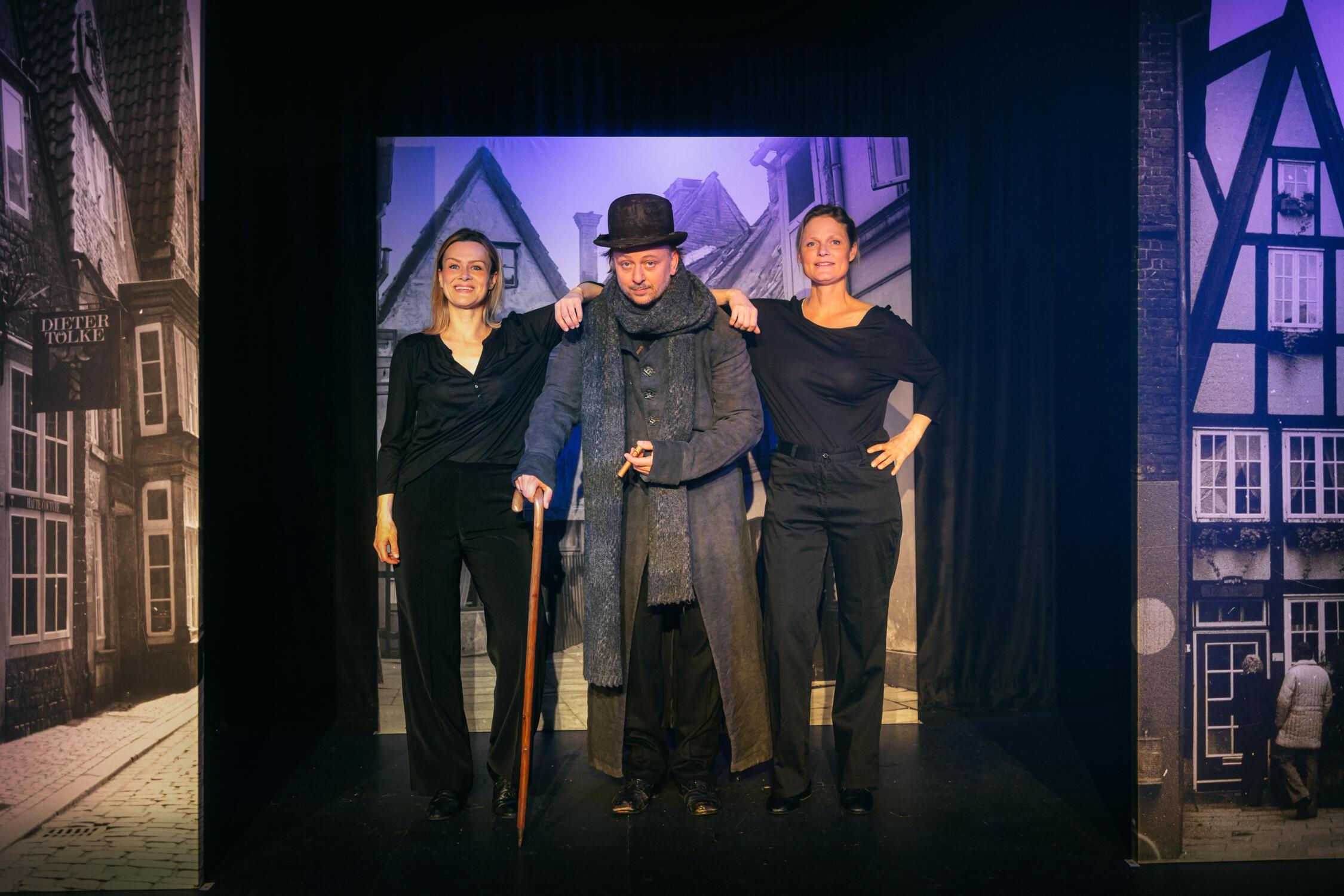
For the last full production of his first season as artistic director of Packhaustheater in Bremen, Dirk Böhling had written and directed a revue-style, 90-minute, fast-paced accumulation of quirky, short scenes about Bremen – covering some of the city’s history (for example, when and why the district in which the theatre is located received the name Schnoor), and some idiosyncrasies of the city and its people (including modes of greeting each other, habits, and ways of talking).
There was no plot, and the episodes were loosely connected to the character depicted by the bronze statue outside the theatre, Heini Holtenbeen. His real name was Jürgen Heinrich Keberle, a Bremen citizen (1835-1909). While an apprentice, he fell through a roof hatch, suffering brain damage and a lame leg, which led to him being given the name “Holtenbeen”, local dialect for “wooden leg”. “Heini” is short and colloquial for “Heinrich”. He became a celebrity of sorts in Bremen due to his old heavy coat and for politely taking partly smoked cigars off the merchants as they were entering the stock exchange building on Bremen’s central marketplace: smoking was not allowed inside.
Martin Olding had composed a few catchy songs, with exuberant lyrics by Böhling, which were interspersed with the scenes, expanding further on the stories told. Bianca Vespermann’s costumes were appropriately period, Bianca Oostendorp’s set, with the Schnoor environment of the Packhaustheater painted onto flats, created the visual context for the episodes efficiently.

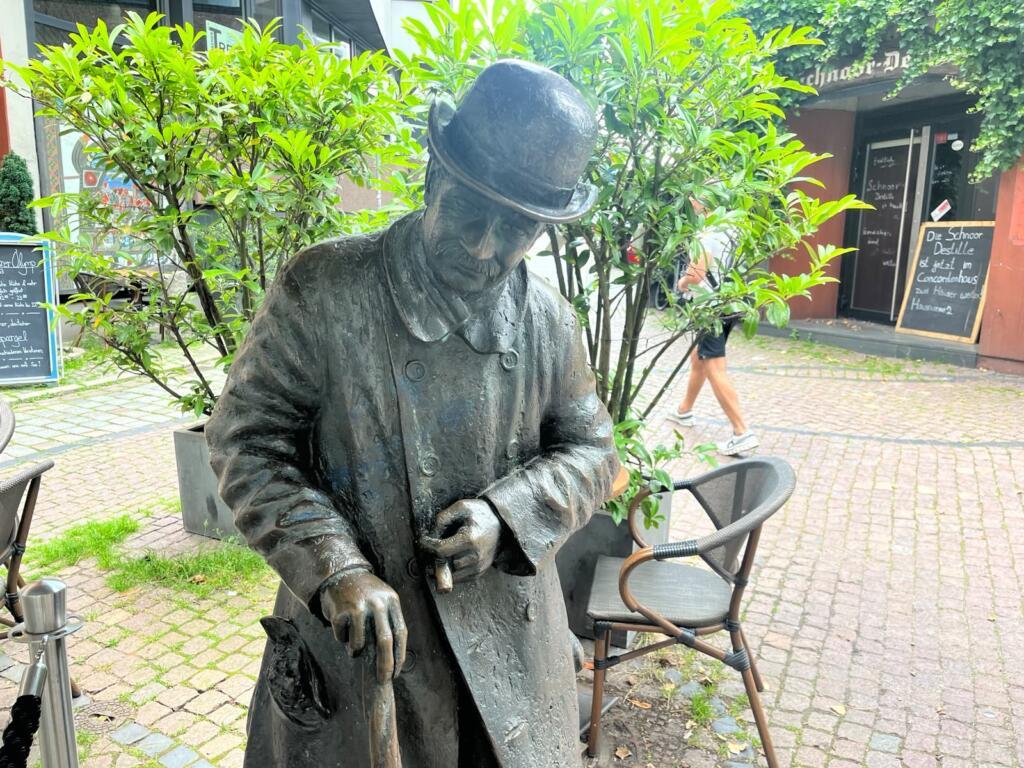
The statue of Holtenbeeen outside the Packhaustheater. Photo credits: Brendel.
The cast of three, Franziska Schubert, Katrin Zierof and Andreas Brendel, engaged fully with the production’s overall spirit of carefree, witty and entertaining, never-critical celebration of local history, people and events. They shifted swiftly and smoothly between guiding the audience through the evening as narrators, engaging in songs a cappella or accompanied by live instruments or playback music, and playing the range of characters of the contents-driven scenes.
Overall, Böhling’s first season at the Packhaustheater has offered well-made, fast-paced, diverse major productions, interspersed with one-off presentations. The audiences will have much in common with audiences for the small and cozy boulevard comedy theatres across Germany. The 2026/27 season will see more performances of the current season’s productions, and new productions about the Bremen-based legendary TV show Beat-Club (1965-1972), a comedy set in circles of Bremen politics, and a play about the notorious Bremen Gesche Gottfried (1785-1831), who killed fifteen people with Arsenic. The municipal theatre in Bremen will, coincidentally, premiere its own production based on this case, with the subtitle “A music theatre chamber of horrors.” The Packhaustheater 2026/27 season also includes more one-offs, which may in some cases attract new audiences to the theatre, and from further afield: for example, psychologist, dancer, actress and singer Aranea Peel, who, as lead singer of her band Grausame Töchter (Cruel Daughters), is an icon of the Electro-punk scene, will play Zarah Leander in a play about the famous singer, and Klaus Kinski in a production commemorating that actor’s 100th birthday.
This post was written by the author in their personal capacity.The opinions expressed in this article are the author’s own and do not reflect the view of The Theatre Times, their staff or collaborators.