




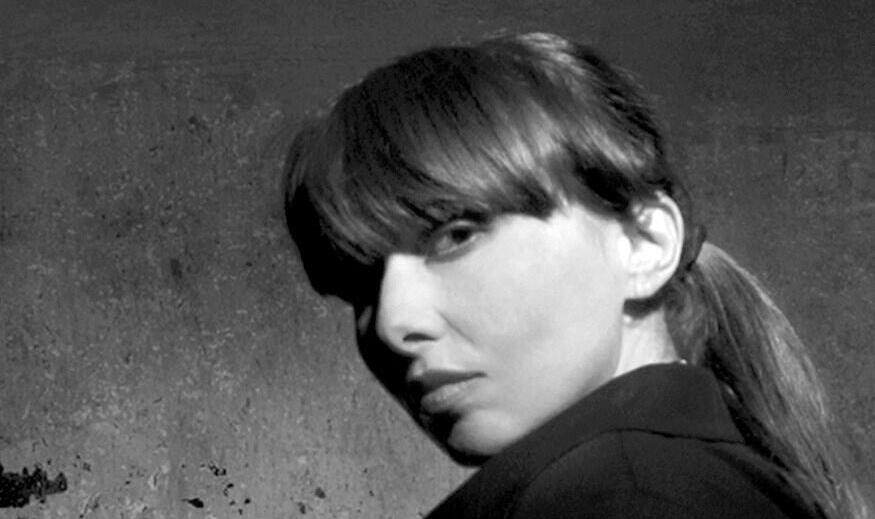
An Interview with Žaneta Vangeli, visual artist, professor, and set designer for the theatre performances of the late theatre director Oliver Micevski (Lolita, Hands Around, Norway.today, The Glass Menagerie, Vernissage, Edmond, Hitler and Hitler, Ant Street, Winter Solstice, 4.48 Psychosis – 2025/2007)
Žaneta Vangeli (b. 1963, Bitola, North Macedonia) is a multimedia artist whose work explores themes of identity, memory, and socio-political realities. She graduated from the State Academy of Fine Arts – Städelschule in Frankfurt am Main in 1988. Since 2008, she has been a Professor at the Faculty of Fine Arts at Ss. Cyril and Methodius University in Skopje, where she teaches painting and transmedia practices. Vangeli’s artistic practice spans a wide range of media, including painting, photography, installation, video art, sound art, theatre set/costume design and film. Her work often reflects on the complexities of national identity in the Balkan context, addressing issues of violence, vulnerability, and historical and contemporary socio-political conditions. Combining elements of realism and conceptual art, she creates works that challenge viewers to critically engage with layered narratives of memory and place. She has exhibited extensively both nationally and internationally. Notable presentations include the 50th International Art Exhibition – La Biennale di Venezia (2003), the Istanbul Biennial (1995, 2003), exhibitions at the Museum of Modern and Contemporary Art in Rijeka (2012), and Gender Check at the Museum für Moderne Kunst in Vienna (2009). Her works are part of major public collections, including the Museum of Contemporary Art in Skopje and the National Gallery of North Macedonia.
Ivanka Apostolova Baskar: Your work moves across painting, video, sound, and film. When an idea arises, how do you sense which medium will carry it, and how did such choices shape your collaborations with Oliver Micevski in shaping sets, costumes, and posters that inhabit the performance’s narrative?
Žaneta Vangeli: The world of ideas is a perfect world, where everything is possible. The idea itself is a deep inner necessity which is longing to be realized. Most ideas in my case already appear in a specific medium, sometimes in several; the final decisions are made during the working process. In the beginning I started with painting, which for me is a medium non plus ultra, all other practices derived later from it. Not only that all visual arts are interconnected, all arts in general interfere with each other in a most complex and unpredictable way. Beyond the artist of today, many artists of the past had the highest desire to accomplish a Gesamtkunstwerk, which in present circumstances morphed to a Gesamtdatenwerk; and that is so understandably in the ‘Age of a Post-Medium Condition’. My collaboration with the theater director Oliver Micevski, whom I still cannot comprehend as not existent in this dimension, was very much determined by my visual arts experiences. Each play, on which we worked was in some way closer and closer to my art works, and the culmination of this productive and very intense collaboration was 4.48 Psychosis, a very emotionally loaded theatre play, with a high degree of personal compassion with the author, Sarah Kane and all individuals who still suffer from the wide disseminated civilizational psychological states. It was a play realized without any compromises at all. Extreme. I have to stress that my engagement as a co-worker responsible for the visual aspects in theatre implies a drastic change in my attitude; being a video and film director myself, I can both rationally and intuitively understand the role of a director and his position, so I always try to put his ultimate aesthetic necessities in first place, after previously presenting my whole view of the possible. In February this year, we started to work on Micevski’s latest project, Martyr by Marius von Mayenburg. I just finished the poster, which Oliver Micevski chose from several designs, we discussed the stage design, the casting was already finalized. The next day he was not accessible any more. The premiere was scheduled for May 11th at Kings Head Theatre in London… An immense loss, both for European and for Macedonian theatre, so early, so shockingly.
IAB: Looking back at your retrospective Archive II, 1985–2025: Epiphany, which traces of your earlier works continue to echo within you, and what transformations have emerged in your vision as you moved from gallery walls to the living temporality of theatre?
ŽV: Time is a very strange category, a human one, actually. All our actions in all times, past, present and future (seem to) exist synchronically; retrospectives are a unique introspective experience for an artist, which you can never foresee in advance, they are always a surprise. My first retrospective exhibition in 2017 at the Museum of Contemporary Art in Skopje had the title Archive I, 1987-2017: Synchronicities, exactly for this very reason; in both archives I physically juxtaposed works which were 20 or 30 years apart; what resulted was a spontaneous, unpredictable insight, where I was visually confronted with my timeless focuses of interest. Of course, I have everything but transcended time and space, nonetheless some examples were new for me too, as a self-inflicted anamnestic process. On the other side, many later works have a completely new approach, technically and conceptually. So, to answer your question, the traces never disappear, not even those of our ancestors, existing in our ‘cultural gene’; they accumulate and advance into infinity. Each new process is a transformation. Each new aesthetic challenge and collaboration is a transfiguration and affects the work in my studio, where I am responsible only for myself. My previous experience with installation and video art very much supported the realization of various concepts for the theatre assignments; the impact of theatre on my work was so strong, that I even started to think about theatre myself, that is how much Oliver Micevski was inspiring with his dynamic, explosive and extremely enthusiastic way of working. If I would do theatre, I think it would rather be a filmed one, I don’t know if I could survive the unpredictability of a live performance. I have had and still have serious thoughts about this.
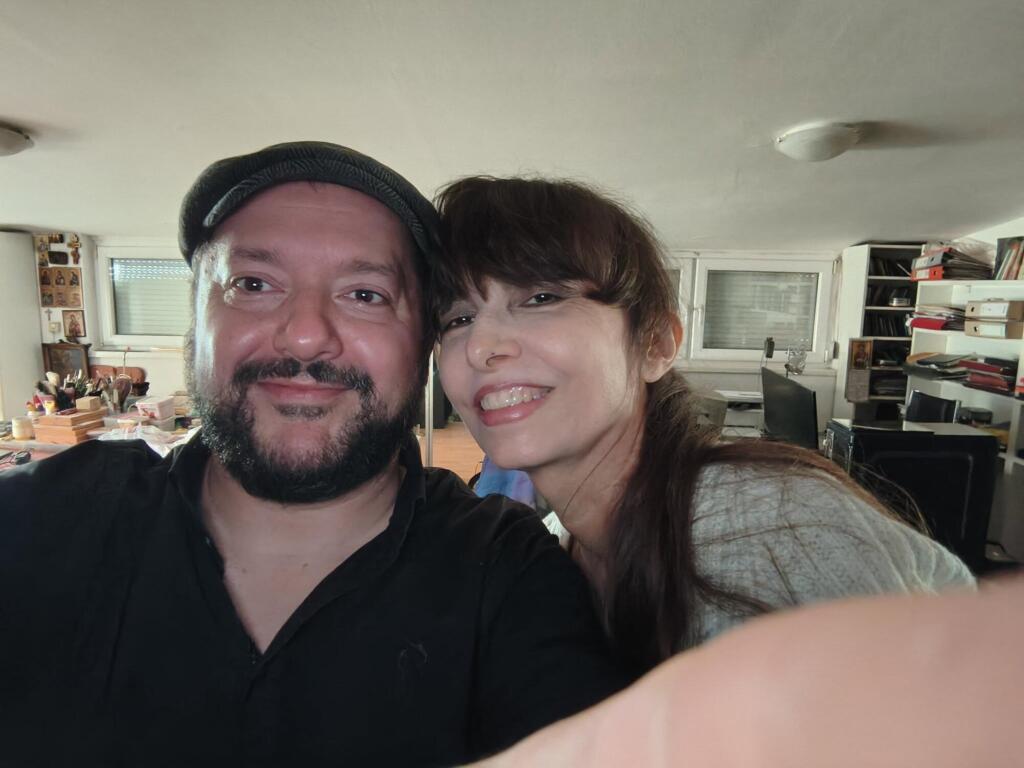
Žaneta Vangeli and Oliver Micevski. Photo credits: Oliver Micevski.
IAB: Representing Macedonia at the Venice Biennale was a crossroads. How did this encounter expand your perception of art as both intimate intuition and global dialogue, and how did it ripple into your approach to stage and multimedia design?
ŽV: The exhibition at the Macedonian Pavilion at the Venice Biennale in 2003 was a very unique experience, regarding the complex project Integralism, which I installed in three spaces, each with a subtitle, The War Room, The Show Room, and The Design Room, directly referring to the globally established process of integration through militarization. This idea derived from the necessity to juxtapose the local and the global processes, which are in a constant interaction and interdependence. It was an installation which could also function as a stage design, without doubt, as my installations per se are very much staged in most of the cases. In theatre they became much bolder and more extensive, conditioned by the given space and narrative itself. The most interesting moment was when I realized that both experiences are reversible and utmost inspiring. In theatre the installations became vivid, living and acting spaces, spaces of communication. Architecture itself could also be treated as a monumental sculpture or art installation, which to a high extent determines human communication, movement of people, masses and their behavior. The architects who I admire create colossal living sculptures as living or working spaces and this approach functions in the best way possible, it is ideal.
IAB: When collaborating with Oliver Micevski and other artists, can you recall a moment when your visual choices – projections, textures, or spatial configurations, directly redirected the actors’ gestures, the rhythm of the scene, or the dramaturgical flow itself?
ŽV: I think that my choices and suggestions to arrange the flow of the space, the projections and the whole idea of the additional dimension of the play, i.e. the visual aspect, have had an influence of the play itself, of course. The objects on stage or the video projections are something that the actor cannot ignore, they are frequently a referential point in acting, I would say I useful one. Of course, I had many times some extreme ideas, for the posters, for the stage and costume designs, but many of them stayed as ideas, which is not disadvantageous or wrong; I simply work like that… I have to search for the right idea, visually, not only mentally. I also have to see the choices for myself, not only the director.

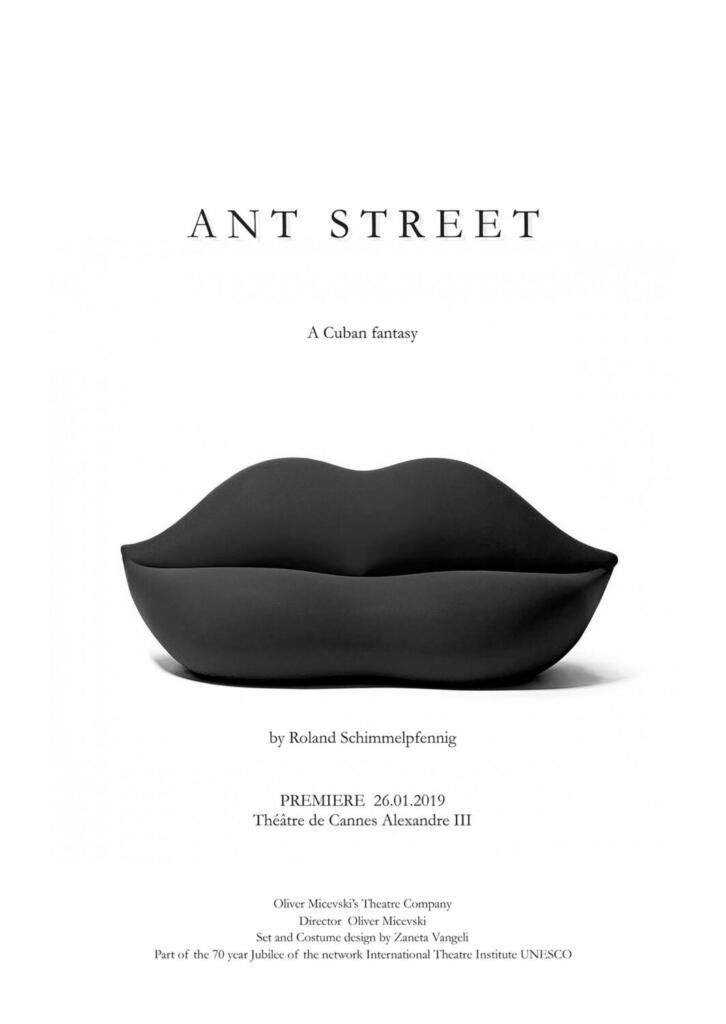
Poster by Žaneta Vangeli.
IAB: You often speak of the archive as a living, breathing space. How does this philosophy guide your theatre work, where time unfolds live and unpredictably, and how do you anticipate and shape the audience’s emotional journey through your interventions?
ŽV: I perceive a theatre play as performance art in the realm of fine arts; the stage, as a huge installation, where the interaction happens. If there is video and sound involved, as a multimedia performance, based on a play. The more dimensions involved, the more openings in opera aperta (as U. Eco would say), the more entries for interpretation of the recipient. And each interpretation is a new creation of the artwork. What is so immensely precious and marginalized, is the nature of visual arts, along with literature; they are the most radical, most subversive, most autarchic, most independent forms of art because of several reasons. One of them is the individual production of art in the studio, then the absence of a team with the autodynamics of huge groups and decision makers, the autonomy and irrelevance of the financial aspect to a high extent. The sole responsibility of the (visual) author or writer, for all his actions or lack of actions, for his knowledge or lack of knowledge is on him/her. So when you pair theatre with some of the named aspects of free, uncompromising, uncalculated fine art experiences, then one can produce a really drastic change in theatre generally, creating a living, dynamic, breathing installation, with performing artists, eventually with audio-visual interventions, a Gesamtkunstwerk incorporating literature, performance, painting (as an expanded notion), sculpture, installation, music, sound, moving pictures. This is my personal belief. The fear of failure, or non-acceptance or financial flop or a harsh critique is much higher expressed in performing arts generally, where huge teams are a prerequisite, serious financial constructions, very often a lucrative expectation of the result. Individual fine artists are determined by the nature of their medium, they are much more protected by the silence of the white cube gallery space, much more distant from direct, physical social interaction. Of course, they pay a price for that, too, which is a maximal financial insecurity and almost a total absence of career projections. One cannot shape and anticipate the audience’s emotional journey through interventions; one can only follow the inner necessity of the (art) work, regardless of the outcome. That is the only truthful way to make art. With other words, one should not shape the outcome of outer reactions.
IAB: Intuition, epiphany, the unconscious, they are threads in your creative fabric. How do these impulses steer decisions across media, and how have they supported you in navigating the demands of scenography while sustaining your own voice?
ŽV: Intuition, epiphany and the unconscious are the driving force of all creation. I sometimes just articulate them, since I am very well aware that all explanations and descriptions of an art process are done post festum, a kind of rationalization of the irrational. An artist can never give a fully rational and logic answer why and how he made some decisions, nor wants he to do that, even if he could, for the simple reason that no artist would like to deconstruct him/herself. I often talk about processes and contexts, but how can I describe something that is beyond logic. I navigate fully intuitively. Of course, I am also interested in conceptual art for a long time, but the idea itself is again – intuitive. When working on scenography or on the visual design of other elements of the theater play, I listen to the director very carefully and silently, then I ask him lots of questions; during our communication I see a movie in front of me. That is all. There is no enigma. I have to admit that a condition for such a direct communication is also a personal familiarity, a worldview which connects us, a spiritual closeness.

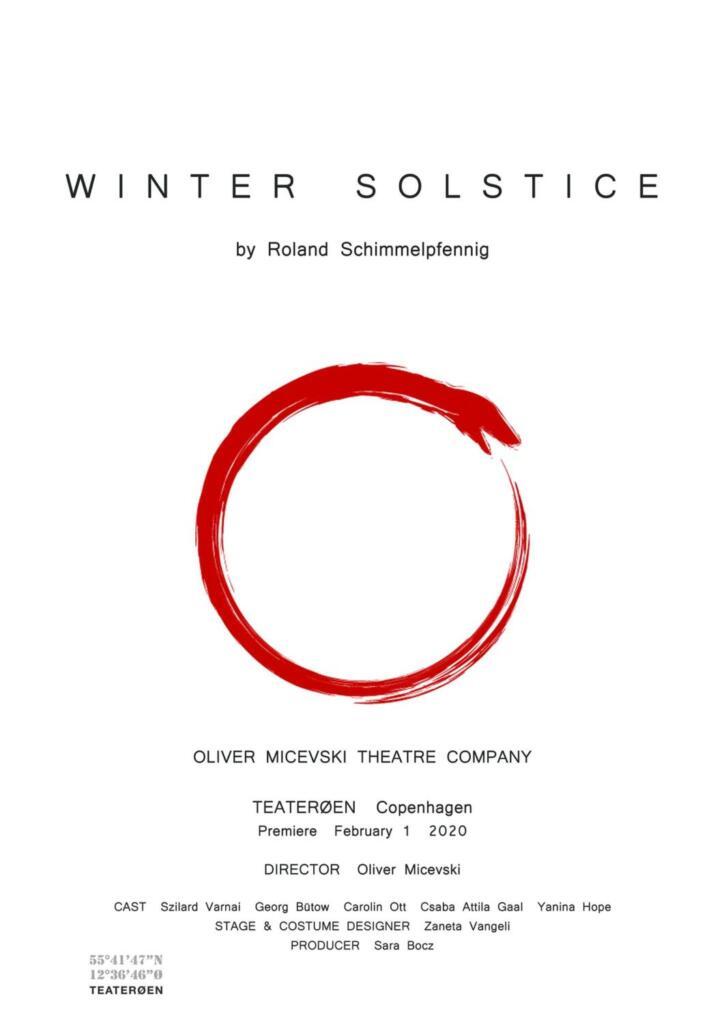
Poster by Žaneta Vangeli.
IAB: Video introduces a temporality, painting and photography cannot. How do you use experimental video and soundscapes to heighten narrative tension and emotional resonance in theatre, especially within performances charged by politics or society?
ŽV: Very carefully. I avoid all kinds of illustration, description or any sort of decoration of the action on stage. The experimental video and soundscapes in theatre should represent an additional dimension to the artwork of the actors and their interaction. Which is a very interesting task, conceptually, visually, technically. It feels like a synchronic nonverbal energy, a unique possibility to express the nonverbal, unspeakable aspect of our existence, which should be synchronized with the verbal parts of the play in a very precise and symbolic manner.
IAB: As a professor at FLU Skopje, what do you hope emerging artists encounter when they engage with contemporary art, and how do theatre, scenography, and multimedia practice inform your teaching of video and transmedia arts?
ŽV: The emerging artists at the Faculty of Fine Arts in Skopje are by definition, from the very start already multimedia artists, since the use of video and sound are very familiar to them from an early age. Not seldom there are students already involved in classical or experimental music from middle school, which is a great advantage. Regarding installation, scenography or transmedia arts, the most important part is the affinity of the student itself, i.e. young artist can be inspired or taught or informed, but the crucial moment is the magnetism they feel towards a specific form of expression. Since the ‘new media’ are not new anymore in a literal sense, it is of utmost importance to stress the need of realizing authentic, internalized ideas and focus on one’s inner world, instead of hunting approval of professionals and institutions by adjusting themselves to actual local and global trends, politically correct objectives, already radicalized practices from history… The inner source is infinite and always surprising. With other words, since the use of diverse media is not an obstacle any more on a global level, the most important method of teaching is to clarify, that art and life should be one. That the most precious approach is the introspective one. That the fascination of the ‘new media’ does not produce art, but the idea.

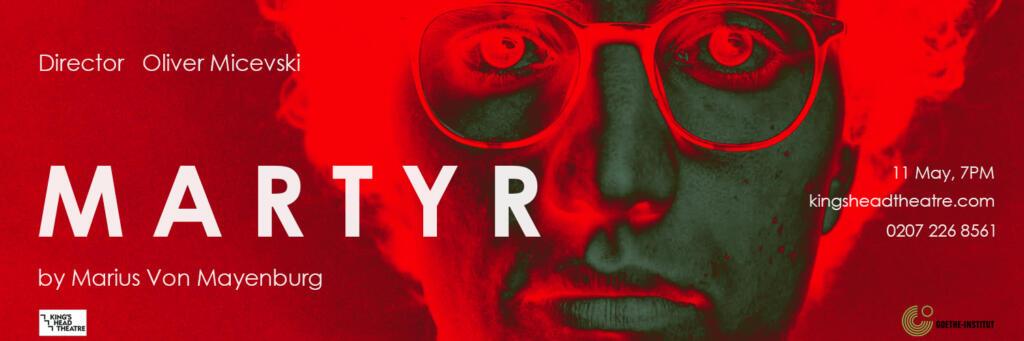
Poster by Žaneta Vangeli.
IAB: Your work balances inner intuition with outer reality. In your collaborations with Micevski, how did you negotiate personal vision with collective dramaturgical aims, and how do these tensions resonate in your multimedia and stage designs?
ŽV: As already mentioned, I always developed several options for any of the required visual elements and through the progress of rehearsals of Micevski with the actors, step by step we mutually chose the final designs. Some of my personal visions were too experimental, of course. But respecting the collective objectives, I created new ones, also very free and unbound which did not destroy the general ideal of the director, in contrary, my utmost wish was to support him realize his/our dream. The most significant inspiration for our collaboration were our synergistic aesthetic values, our spiritual bond.
IAB: In a world dominated by digital and multimedia practices, how does painting survive, evolve, or transform in your practice, and how do these painterly sensibilities permeate your theatre designs sets, costumes, and posters alike?
ŽV: The global art scene is dominated by the ‘not so new media’, you are definitely right; that is a fact and our reality generally, where the analogue creation, execution, working processes of any kind is preconditioned by electrical power and digital performances. And in such a world, the most radical action is to paint! In a world with fast production means, fast data transfers, fast expectations, fast processes, fast wars, a slow and patient, meditative process as painting is least popular (at least in the political West). Painting is one of the oldest arts in history of mankind and it will survive until the end. The end of painting was proclaimed more than once, but it was just another attempt to smash the tradition again and again, the big narrations, to be radical, new, especially under the pressure of the fundamentalist capitalism, which could not survive without the self-curated neomania. Painting evolves and transforms naturally, without pressure of the social trends and expectations; under pressure of the new, it becomes a caricature. Regarding the connection between painting and theatre design, I personally see everything through the painting-glass: concept, composition, space, color, symbolism, material. It happens automatically; paining is an art of two dimensions, the other media are multidimensional. They can become a living painting in space.
IAB: Epiphany is the subtitle of your retrospective. When designing for stage or exhibition, how do you craft epiphanic moments that lift the audience beyond the material and into reflection on personal and collective experience?
ŽV: Visual artists need some matter to express their ideas, regardless how spiritual the art is, with exception of some fully etherical artists like, for instance Yves Klein or others, who sometimes exhibited the ‘nothing’ in an empty gallery space. Yet, the creation of a fine artist can freely be treated as a creatio ex nihilo, because of the ascetic use of matter. It is remarkable how artworks are the only ‘items’ which are not ‘functional’ in a society, they have no utilitarian use at all, except to exist as a spiritual emanation, nothing else. To lift the audience beyond the material, as you say, happens. It is not a skill in my opinion. It depends on the credibility of the artist, of his/hers idealism and personal spiritual experiences. Just like epiphany, you cannot project or expect it. It has to happen beyond your will and wish.
IAB: Looking forward, which materials, questions, or modes of visual exploration call to you, and how might they continue to shape the dialogue between experimental video, multimedia, and live performance?
ŽV: I always make spontaneous decisions regarding upcoming projects. My interests are extensive; therefore, I always have to channel them to reach the result which I would like to experience. For a longer period of time I have been working on two documentaries, I still collect some materials for them. My next exhibition will also include several media; I have been preparing it since 2022 and the main notion is Casus Belli / Uncontemporary Art, I cannot reveal more. I am not interested in conventional forms of expression, regardless of their convenient production and distribution; I simply see no path in executing something just mechanically without feeling an inner necessity for it. Film and video are relatively new art forms and not much is experimented in this regard. I just follow my inspiration. Multimedia arts and live performance in theatre became very challenging for me, especially the complexity of the work, the multilayered approach and the teamwork; the possibilities are really immense in this direction.
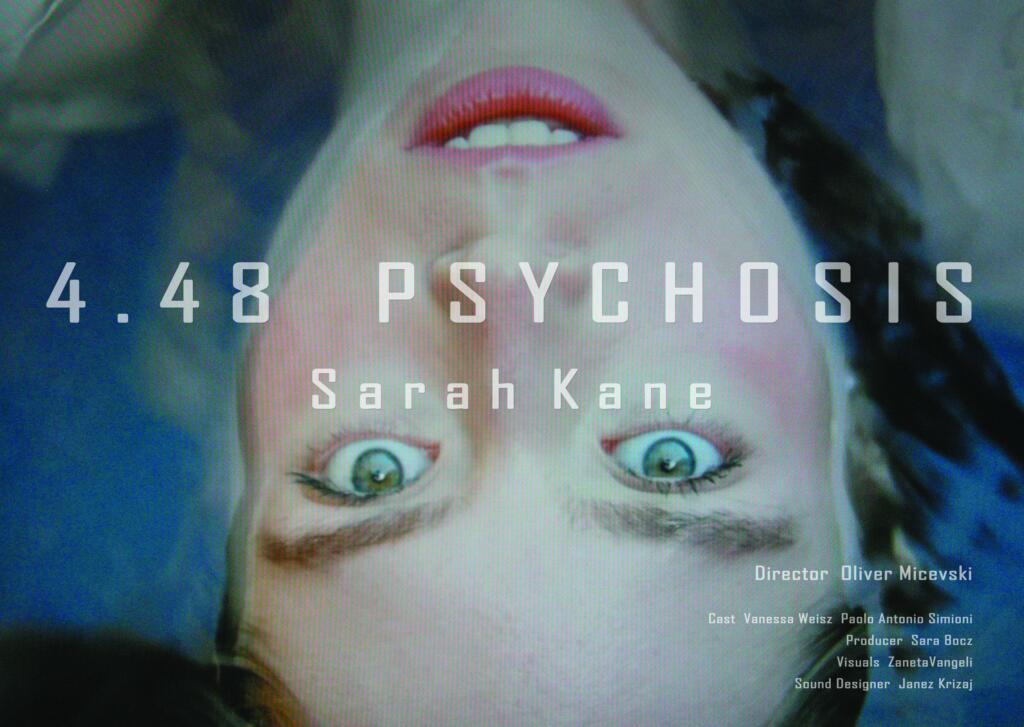
Poster by Žaneta Vangeli.
IAB: In designing posters, costumes, and stage elements for Micevski’s productions, how do you ensure these are active participants in storytelling rather than ornaments, and how do they resonate with performers and audience to create a living narrative?
ŽV: Posters, trailers, video projections, costumes, stage elements, they all are symbols. I have a huge affinity for the symbolism of signs, colors, shapes, movement, etymology. For my work, the most important method is to avoid any form of illustrating / describing the story. The symbol does not stand for something; it is the substance itself. That is why symbols are so powerful and affect our sub-consciousness so strongly, unmistakably. The most important thing is to transcend the Cartesian dualism which divides form and substance; the substance is always immanent to the form. The narrative will be living if the elements are truthful.
IAB: How do you bridge traditional visual media, like painting and photography, with immersive and interactive video art, and how does this transmedia approach allow you to connect diverse audiences across cultures, languages, and theatrical norms?
ŽV: Modernism was all about breaking the taboos, tradition, and that was in a big range successful; postmodernism’s maxim anything goes, although many times misused and reason for arbitrariness and unprincipled eclecticism, re-introduced traditional media in a strange, maybe unwanted way; when working, I do not analyze if I am connecting diverse audiences; I am focused on the needs of the work itself and hope somebody will perceive and be able to communicate with it. I experienced one thing, and that is that the intention to make art destroys art.
IAB: Finally, what do you hope students, audiences, and collaborators carry with them from your work, through theatre, experimental video, and transmedia, that might shift the way they perceive art, identity, or society itself?
ŽV: My hope is that they will have the opportunity to see something which I live and perceive through my prism, at least for a moment of time…
IAB: Dear Žaneta Vangeli, thank you very much.
ŽV: Dear Ivanka Apostolova Baskar, it was a pleasure to talk to you!
Skopje 2026
This post was written by the author in their personal capacity.The opinions expressed in this article are the author’s own and do not reflect the view of The Theatre Times, their staff or collaborators.
This post was written by Ivanka Apostolova Baskar.
The views expressed here belong to the author and do not necessarily reflect our views and opinions.