




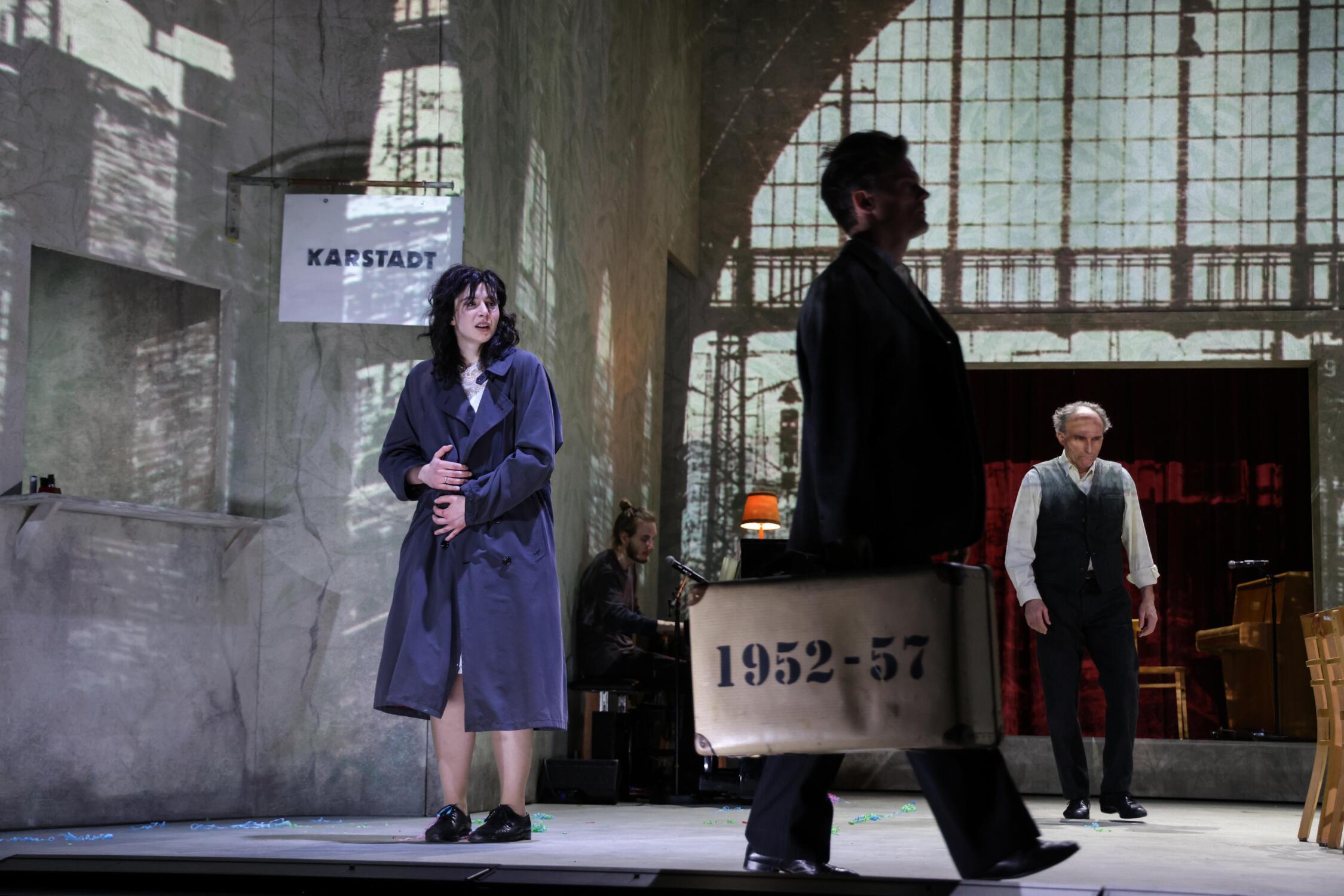
David Safier was born in Bremen in 1966. He trained as a journalist, worked as radio and TV presenter and script writer for TV before he turned his attention to writing novels. Those have become critically acknowledged best sellers. One of them is the autobiographical novel Solange wir leben (As long as we live / are alive), first published in 2023. In 2025, Theater Bremen staged the world premiere of the adaptation of the novel for the theatre, in an adaptation the theatre had commissioned from established dramaturg and dramatist renowned specifically for his adaptations, John von Düffel. The play covers the history of Safier’s mother Waltraut and his father Joschi, and their respective families, hers from the working-class Bremen suburb of Walle, and his in the Jewish community in Vienna, until they happen to meet in Bremen after the end of the Second World War in an ice cream parlor. Waltraut was by then widowed and a single parent to her daughter, Gabi, while Joschi, some twenty years older than Waltraut, had escaped from Nazi Austria and spent several years in Palestine, had a wife there and two extramarital children. Their life together was marked by further ups and downs, such as Gabi’s death, and Joschi’s several businesses, which were short-lived and ended in financial losses, fueled by his alcoholism. The narrative thus revolved around the key theme of impressive survival of the central characters in the face of massive blows of fate – survival in which those characters still manage to appreciate life.
The text combined prose narration in the third person for each character, as well as first person reflections and dialogue. The year(s) in question for each of the separate scenes, and the locations, were signified by signs on or projections onto the walls or signs on suitcases. The juxtaposition of intimate scenes, which focused on two or three characters in a narrowly demarcated space on the stage, with scenes with more characters, making use of the entire stage space, worked well in shifting attention back and forth between nuanced detail and broad-brush strokes. Live music composed and performed by Matti Weber supported the production considerably. Director Alize Zandwijk led the large cast through the complex and multi-layered narrative with conviction, making sure key motivations and emotions were foregrounded clearly throughout, allowing the production’s three hours thirty minutes to pass quickly.
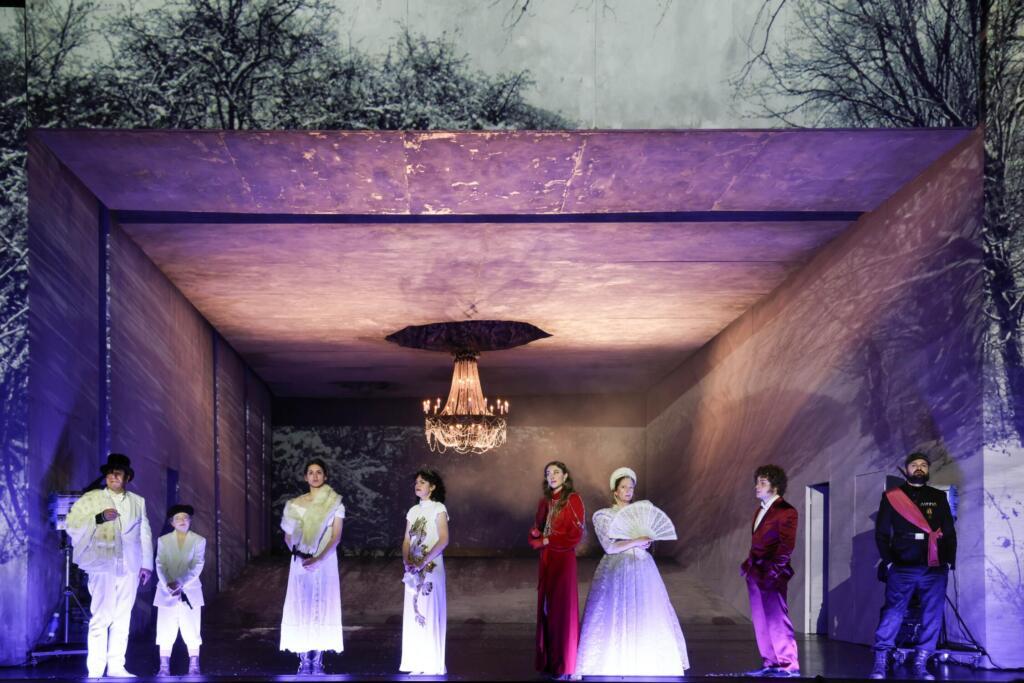
Krieg und Frieden: Ronald Kukulies, Caline Weber, Sofia Iordanskaya, Stephanie Schadeweg, Lieke Hoppe, Susanne Schrader, Ferdinand Lehmann, Manolo Bertling. © Jörg Landsberg.
The three-hour-45-minute stage version of Tolstoi’s novel War and Peace premiered at Theater Bremen on 7th March 2026. Armin Petras (b. 1964) served both as adapter and director. He has had a noted career in Germany as director, artistic director and dramatist. Petras had worked in Bremen before. On 19th February 2026, the Bremen authorities had announced that Petras would become the next artistic director of Theater Bremen with the start of the 2027/28 season. The storytelling, combining textual adaptation from Tolstoi’s novel and production decisions, flowed smoothly. Both as adapter and as director, Petras did justice to the broad scope of the original, efficiently interweaving the three strands of the plot, each focusing on a specific aristocratic family, and ensuring the audience could follow and always associate each character with the appropriate strand. The actors had developed their character(s) fully within their own contexts, and where an actor played several characters, confusion never arose. The production was well-paced, allowing time where needed, in particular for movingly emotional moments, condensing the development of the plot with a few clear words on other occasions, and shifting as needed between intimate moments with only a few characters involved, and crowd scenes. This frequent shifting of pacing, constellations and emotional intensity allowed for sufficient distance to develop between spectator and staged events to allow the audience to be able to comfortably bear the extent of the human suffering on display in the novel and its adaptation.
As with Safier / von Düffel’s Solange wir leben, human survival in the face of repeated, near-constant blows of fate, was prominent in Tolstoi / Petras’s War and Peace. Both adaptations successfully foregrounded different levels of individual responsibility for events taking place, and resulting different levels of personal feelings of guilt, which were shown to be just as crippling as the blows of fate themselves.
This post was written by the author in their personal capacity.The opinions expressed in this article are the author’s own and do not reflect the view of The Theatre Times, their staff or collaborators.