



Cheng-Chun Lee was an underperforming student in his high school composition classes. It was strenuous for him to express his ideas on pages while following the structure of introducing a topic, presenting arguments, and reaching a conclusion. Therefore, he “never imagined that [he] would win the Taipei Literature Award one day,” as he later wrote in an Instagram post. Apparently, he had mistaken a lack of academic skills for incompetence in creative writing.
It turned out that he is actually very good at writing. In 2024, he won second place in the Taipei Literature Award for Between Classes, and first place in the Playwriting Award for Children’s Theatre for The King of Happiness. Since then, he has been active in both Taiwanese theatre and on the world stage—The Way Back has toured to Edinburgh, Marseille, Geochang, and Stuttgart, and the award-winning Between Classes was translated into Korean and staged in Cheongju and Seoul. As Lee’s residency came to an end, Kuan-Ting Lin, Literary Manager at the Prologue Center, sat down with him to trace the beautiful detours that have shaped his playwriting.
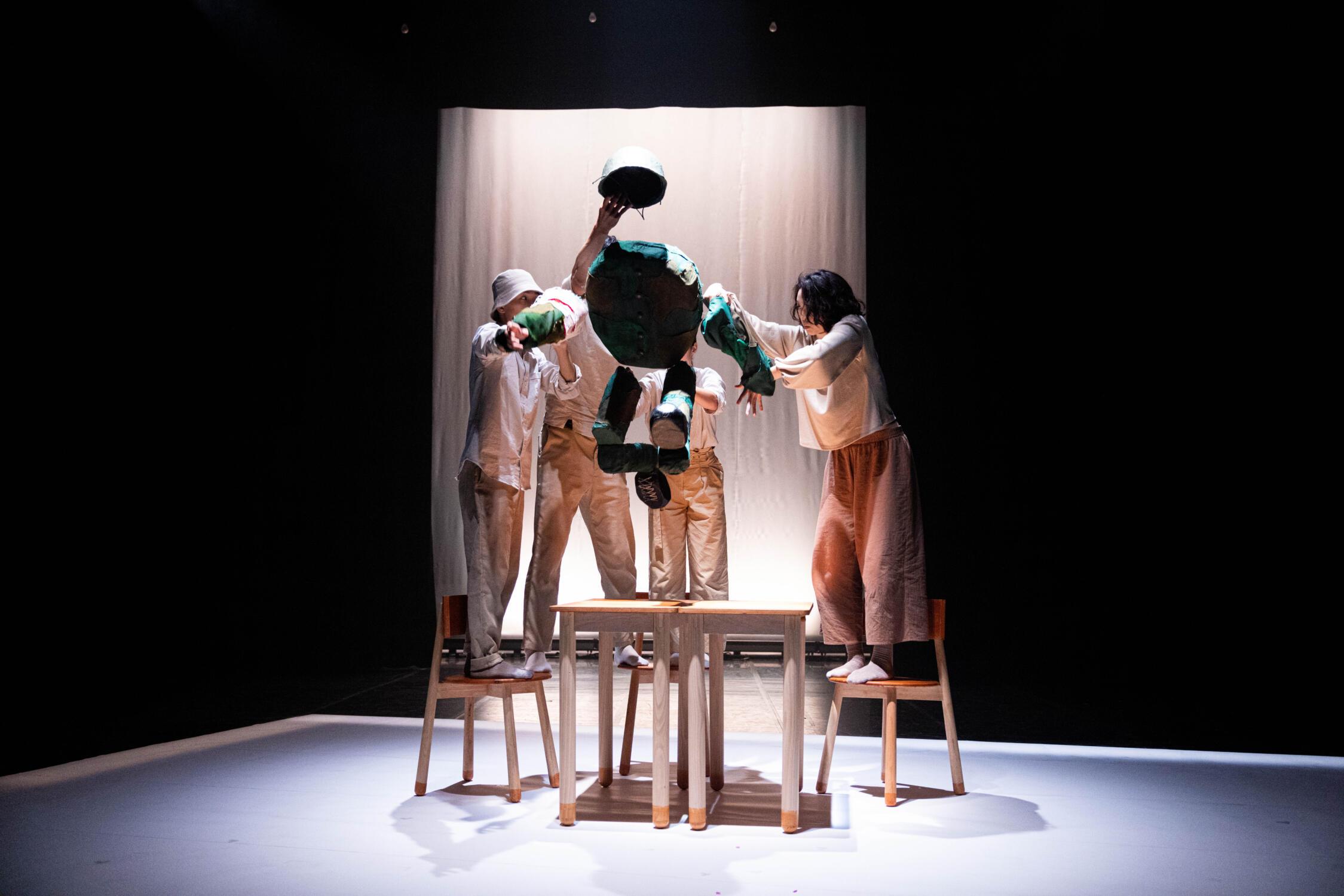
Cheng-Chun Lee’s The Way Back. Photo by Annabelle Chih.
Lin: How did you become a playwright?
Lee: I started a theatre company called The Double Theatre with Cheng-Jui Lee, my twin brother, and Heng Wang, our mutual friend, after we graduated from college. We thought about translating and staging Western plays, but the licensing fees weren’t affordable for a newly founded company. We came to the conclusion that someone had to write plays, and that person turned out to be me. So, to be honest, I didn’t know I’d have a writing career. It was a fun and beautiful detour.
Lin: Sounds like you were born to write plays. Your work is characterized by a unique feature—you love to make your characters tell stories onstage. Where does this trait come from?
Lee: A few specific incidents come to mind. I remember participating in a workshop led by a contemporary French troubadour during my undergraduate years. He didn’t do much, simply telling stories with the students sitting in a circle. The trick was simple, but I couldn’t forget how deeply my imagination was engaged. Around the same time, Needcompany’s Isabella’s Room toured to Taiwan, and I was amazed by how stories could grow out of the physical objects onstage. Also, I’m a big fan of history, especially how the history of Taiwan is constantly being formed and overthrown from different perspectives. These are likely the reasons why my characters love telling stories.
Lin: The Way Back, a work for young audiences about war, also grows out of storytelling, but it does so through puppetry, shadow play, and physical theatre. Could you share with us how this work came about, and why you decided to show children the dark side of life?
Lee: The Double Theatre was fortunate enough to be selected for the Taipei Performing Arts Center’s (TPAC’s) developmental program for children’s theatre in 2019. Yi-Chin Chen, one of the touring members of The Way Back, had always been interested in combining storytelling with physical theatre. In the early stages, we workshopped by making up stories of a body part in a certain setting. Say, an arm in a cemetery. It became clear through this process that the play was going to be about war.
Soon, the director Cheng-Jui and I began thinking about who soldiers are before they’re forced to join a war. War has the ruthless power of dehumanizing people. Soldiers are seen only as service numbers, or worse, scattered body parts on the battlefield. However, before the war, they were human beings who lived every day with their own experiences, identities, and memories. That’s why the story is told through the different body parts of a fallen guitarist-soldier. Their attempt to reunite is not only about becoming whole and going home as an intact body; it’s also a resilient gesture to combat violence and regain humanity.
The Way Back is not just the work that put me and the theatre company on the map. With support from TPAC, we were able to experience a healthy and wholesome developmental cycle. Since then, we have made it a rule not to rush into a production without three years of research and development. Also, we met our long-term dramaturg, Chun-Yen Wang, while working on this project. So, looking back now, it was another beautiful detour in many ways.
Lin: In contrast with the weight of life and death in The Way Back, The King of Happiness seems gentler on the surface, though it also raises questions about happiness, governance, and individual freedom. What was the inspiration for the play?
Lee: The King of Happiness may appear to be a fairy tale, but its inspiration was drawn from a real societal context. The news in Taiwan is always flooded with complaints about the government. We can go on a rant about anything, from the cost of living to the political climate, and this pervading discontentment with life gives me the feeling that the country is becoming less happy.
With the general mood so low, the seed of a question dropped into my mind: is being happy really the ultimate goal of life? Then, I began to reflect on how Taiwanese people react to these issues. When we blame the most trivial matters on the government, does it indicate that we are still stuck in a mindset where everything should be solved by a political strongman, much like during the martial law era?
These two questions laid the foundation for the play, from which the Kingdom of Happiness grew. The only law there is that everyone must be happy. All walks of life must serve this purpose, and those who become unhappy are quarantined in a specialized center. If read below the surface, The King of Happiness is actually an allusion to how Taiwan transformed from a dictatorship to a democracy.
Lin: Would it be a challenge for younger audiences to make the connections between what is on the surface and what lies below? Does your writing differ when you’re writing for different audiences?
Lee: Younger audiences are smarter than adults imagine. The Double Theatre staged a play called Beyond the Distance in 2018, and it was another piece that dealt with life and death. After one show, a child and a parent were having a conversation, just like adult theatregoers do after walking out of a theatre. Oftentimes, adults project their own expectations when they assume that children’s theatre is nothing serious. They would rather their children not see the brutal realities of life too early.
When writing for a younger audience, technically speaking, I make the writing more straightforward and colorful. So, whether the tone is light or transitioning into something heavier, my writing remains very clear. But, thematically speaking, there’s no difference.

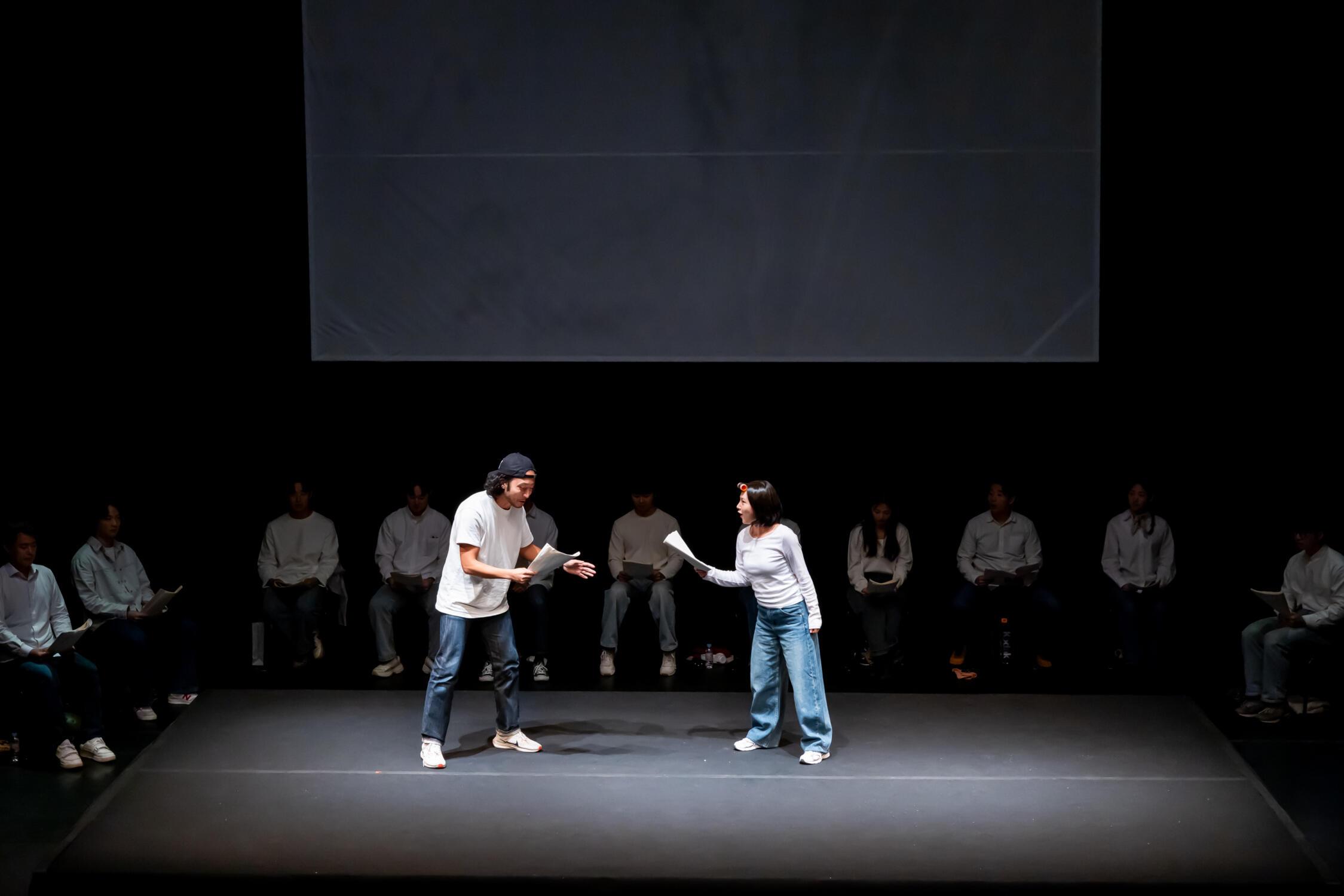
Korean Staged Reading of Between Classes at Seoul Arts Center. Courtesy of Chungbuk Theatre Company.
Lin: Seems like a great chance to move onto the award-winning Between Classes, a play that centers on a harassment/bullying incident in a high school. A male student is rumored to have touched the swimsuit of a female student, and her boyfriend retaliates. The play then unfolds 38 snappy dialogues before ending with a monologue. How did you arrive at this structure?
Lee: High schoolers, in my opinion, are still finding their own ways of expressing themselves through language. Even though they’re often considered cognitively developed, they don’t always have a strong grasp of language. Yet, like all young people, they have the desire to be treated as adults. Mimicking how grown people speak is their way of reaching that stage.
In my high school, boys would gather during breaks, and more often than not, the conversations centered around girls. Who was seeing who, who was dating who, who was breaking up … Boys tended to exaggerate their real feelings in those conversations. If they liked someone, it was expressed as total infatuation; if they had no feelings, it was expressed as absolute nonchalance. They were trying so hard to act like men through their language, but their perception of masculinity was actually quite stereotypical, absorbed from Taiwanese TV series or Japanese manga.
Looking back now as an adult, I see that their use of language and modes of reaction were a reflection of a heteronormative society. More importantly, it was a distorted reflection. The real world doesn’t work that way. Unlike high schoolers performing a roleplay, adults can articulate themselves better and form deeper, more meaningful connections. That’s why, following the 38 rapid-fire dialogues, a final monologue closes the play. Monologues are often an articulation of rich and intricate inner thoughts, and the ability to textualize and express those feelings is something more common in adulthood.
The monologue comes from Jason’s diary. Jason is the character who is, to an extent, the victim of the bullying incident. He is left out of the play until the end because those at the center of high school drama often lack the ability to understand and articulate what has happened to them in the moment. Often, by the time they find their voice, time has already moved on.
Another reason for this writing choice is that this state of being deprived of a voice mirrors my impression of Taiwan across different historical narratives. Taiwan often seems like a supporting character on the world stage. In reality, it sits at a position where it has the power to change everything, for better or for worse.
Lin: Taiwan’s position is a recurring theme in your latest writing. How I Learned to Dance is an example. It is an unapologetically political play that explores what it means to inhabit a Taiwanese body. Would you like to tell us more about it?
Lee: How I Learned to Dance is a solo performance centered on Yen Wang, a Taiwanese dancer whose national identity is constantly shifting under her mother’s manipulation. One moment, she’s American; the next, she’s Chinese. It isn’t until the end that she realizes being Taiwanese actually means something.
I created the play in collaboration with Heng Wang and Cheng-Jui Lee, and the play is based largely on Heng’s own experiences learning contemporary dance. We transformed her personal history into a political allegory, with the dancer’s body serving as a vehicle for various political ideologies.
National identity is normally assumed to follow from where a person is born, but that’s not the case in Taiwan. No single, coherent form of nationalism has ever taken firm hold on the island, nor has any one national narrative achieved a broad consensus. Since 1945, competing stories have been told about who we are. Some say we are Taiwanese; others say we are Chinese; still others believe that who we are remains undecided. How I Learned to Dance is our attempt to capture how this uncertainty has stayed with us through decades of political volatility.
Lin: Son of the Yankees also deals with ambiguous identities, but from a different angle: a Black baseball player in the 1980s Taiwan. Since Black communities have not been a large demographic presence in Taiwan, what prompted you to inspect Taiwan through a racial lens?
Lee: Originally, I was going to make a stage adaptation of Hideki Irabu’s life story. Irabu was an NPB and MLB player from the 1990s to the 2000s. He was born in Okinawa to a Japanese mother and an American father during the Cold War, so he must have had a hard time figuring out who he was and where he belonged. His splendid career ended tragically when he, the first Japanese player to win a World Series, committed suicide in 2011. His life was so dramatic that the adaptation did not go smoothly.
Chun-Yen, our dramaturg, reminded me one day that Taiwan was also a US ally during the Cold War, so stories of children born to Taiwanese women and American soldiers might be a new direction. Also, I’m a big fan of baseball, and I knew the sport was first introduced to Japan by Americans after the Kanagawa Treaty, and then to Taiwan under Japanese rule. This triangle of semi-colonial relations seemed like the perfect starting point for a play. That was the genesis of Michael, a half-Taiwanese, half-American who later goes on a search for his Black father outside Yankee Stadium.
The play gave me a lot of firsts. Michael might be the first Black character in a Taiwanese play. The Double Theatre is scheduled to stage the play at the end of the year, so we’re currently figuring out whether we should cast an actor as Michael. If the answer is yes, where do we find him? It was also my first time writing a play with so many languages. To be historically accurate, Michael should be bilingual, speaking both English and Taiwanese. However, I don’t speak Taiwanese, so I wrote it in Mandarin Chinese and worked with Shu-Kai Yang, our Taiwanese-language translator, to produce a multilingual version. This collaboration also made me wonder if theatre is essentially untranslatable.
Lin: Since you brought up translation, Between Classes has been translated and performed in Korean. What was it like to see your own play in another language?
Lee: It’s such a pity that I don’t understand Korean. Otherwise, I’d love to compare student slang in both languages and see how actors from different cultural backgrounds interpret the play.
I’d say that the Korean actors paid more attention to creating distinct qualities for their characters, even when the classmates were written as everyday faces of Taiwanese high schoolers. When I walked into the rehearsal room in Korea, some actors were even writing journals for their roles. In contrast, the staged reading in Taiwan focused heavily on the high schoolers’ language. The two versions were sharply different, and it was such a privilege to observe that difference.
Lin: I’d like to end with a light-hearted question. What do you do when you’re not working as a playwright?
Lee: I still write, but purely for self-entertainment. To this day, I still find immense satisfaction in immersing myself in writing a funny story or a touching romance. These stories I write in my free time may have little production value, but they’re my getaway from the intense writing periods that keep a theatre company running.
(Kuan-Ting Lin is a playwright, translator, and dramaturg from Taiwan. Currently, he serves as the literary manager at the Prologue Center for New Plays.)

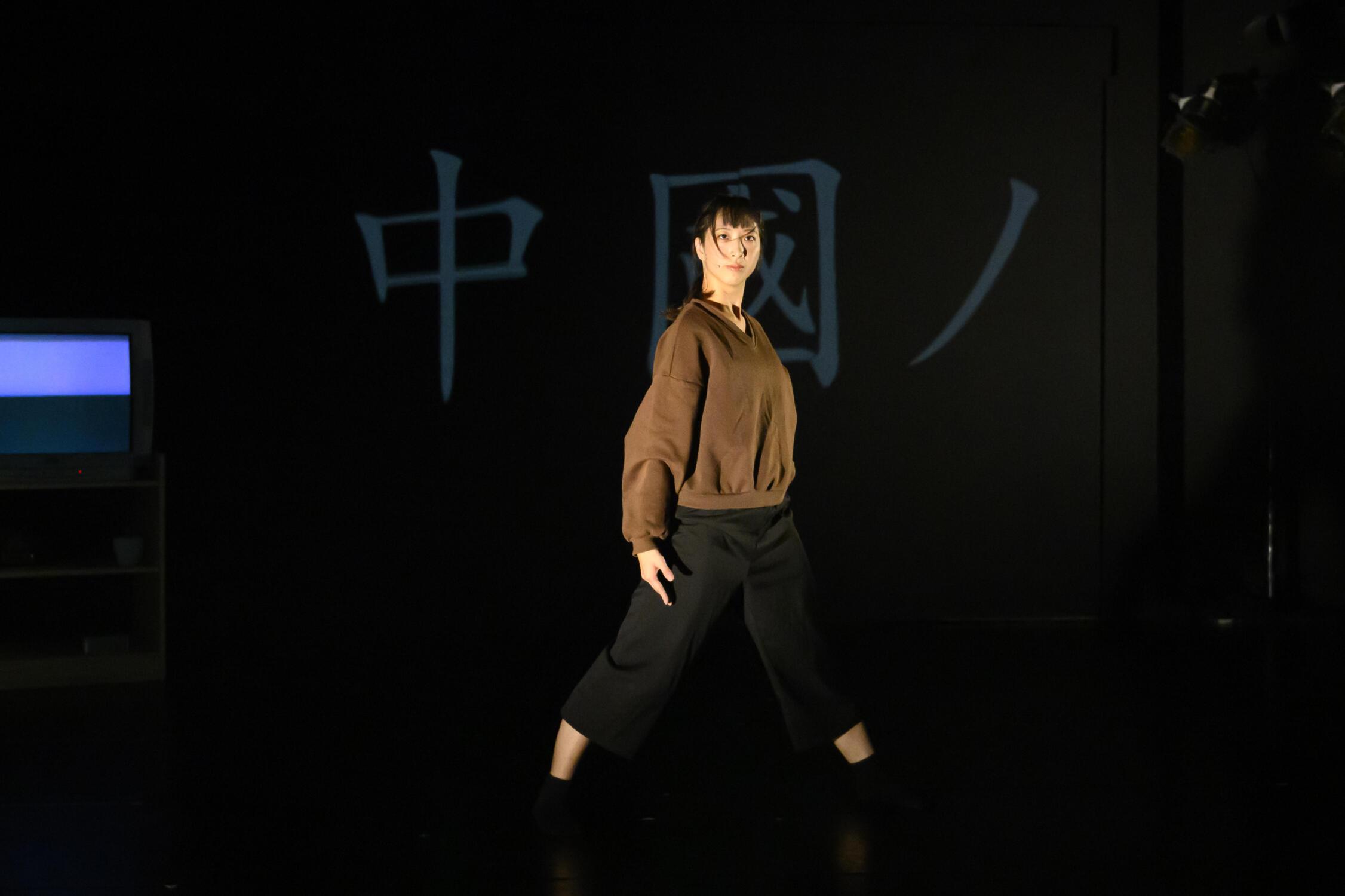
Cheng-Chun Lee’s How I Learned to Dance. Photo by Lo Boo-Him.
This post was written by the author in their personal capacity.The opinions expressed in this article are the author’s own and do not reflect the view of The Theatre Times, their staff or collaborators.
This post was written by Kuan-Ting Lin.
The views expressed here belong to the author and do not necessarily reflect our views and opinions.