

![1st Aug: Better Late Than Single: After Service (2026), 6 Episodes [TV-PG] (6/10)](https://occ-0-273-999.1.nflxso.net/dnm/api/v6/0Qzqdxw-HG1AiOKLWWPsFOUDA2E/AAAABa3i_78iRC2fNybhflJHu-IhWXhIsL0p1FqiQFRi0sGjREfrpE_qPtdXDaJCZa2fnfzHGJZP7ydaMKqFFlUcx_IAadClltT7zWN19eeaYytcRalw0Jr0yjbFiipCCYCB6XK00S7JmZHrZY_hLUY9IdIxl8mRE0xtprxhlA_Ea8ZUe5ugd_7F07KaGxGiORrd0N99CBNgPMXfljxJMcYDaN0XkhrNDCPUhnpslX_81KzcmoBQz6Pjzatx84U_uh_lsa_UvioeXh0_74o6jZeFhFqh_7hoZ3HkZ699v22WPVLDy9mblrYg7inaqM38HQ.jpg?r=41d "1st Aug: Better Late Than Single: After Service (2026), 6 Episodes [TV-PG] (6/10)")



![1st Aug: Blackwater Lane (2024), 1hr 48m [PG-13] (5.3/10)](https://occ-0-858-92.1.nflxso.net/dnm/api/v6/0Qzqdxw-HG1AiOKLWWPsFOUDA2E/AAAABed9lIc3T1FgjeDty-Uy5vz83bNaFvJPmRPpiHlbMn0l6OXvEuqLOhQRT2tMFyZ4gm1Fp8yoqdDuXPURpKk8dbmCInUtR6k74-CW2sHLyaVm_rRdAPwjo1GoRWdWM7EPNvtelDGbEil1BjpO5WaNjX-OUcx0CkoJIJN_oKkkFbludQ.jpg?r=40b "1st Aug: Blackwater Lane (2024), 1hr 48m [PG-13] (5.3/10)")



Note: This article is based on a personal blog I wrote 10 years ago to entertain nobody but myself. So if you’re one of the 10 people who read it, that’s why parts of it seem familiar.
Steven Spielberg’s 1977 UFO epic Close Encounters of the Third Kind is one of the most influential and beloved sci-fi movies of all time. Its presence is still felt today — not least in Spielberg’s new film Disclosure Day. And yet it’s also kind of an evolutionary dead end for sci-fi, thanks to a little film Spielberg’s friend George Lucas released six months earlier: Star Wars.
Famously, Lucas thought Spielberg’s movie would do better at the box office, so they made a bet by swapping profit points on each other’s movies. Both films were massive hits, but still, I think we know who won that bet. Spielberg already sensed his vision of sci-fi as a kind of ecstatic thriller was no match for Lucas’ space fable. Close Encounters‘ true blockbuster legacy was in how it guided what Spielberg did next: Raiders of the Lost Ark (with Lucas), eventually Jurassic Park, and especially E.T. They’re all parts of Close Encounters, but not the whole.
Maybe that’s why Close Encounters can still seem so arrestingly weird. It shouldn’t be. Its imagery is scored into the popular imagination, and it’s been exhaustively documented and picked apart. Not least by Spielberg himself, who has performed very public surgery on it in three edits over the span of 20 years, and offered up reams of lucid commentary on everything to do with its making, from his close identification with Richard Dreyfuss’ character to the freewheeling technical improvisation behind its still-dazzling FX.
Close Encounters is the definition of a known quantity, but it still has the power to unsettle and surprise. It’s typical of Spielberg, yet completely unique. Outside of The Fabelmans, it still stands as Spielberg’s most personal film: the culmination of the impulse that drove him to make homebrew sci-fi movies as a teen, and rightfully one of few for which he retains the sole screenwriting credit, no matter how many other writers had a hand in the script.
As a director, Spielberg is famed for his open emotional communion with the audience, and Close Encounters finds him at his least calculating, his least guarded. The movie focuses on Dreyfuss’ Roy, a power company worker who has a close encounter with what appears to be a UFO and becomes obsessed. But Roy’s story is washed along in a tide of other events as mysterious happenings and alien sightings become more and more common. At the same time, a mother (Melinda Dillon) seeks her abducted child, while French scientist Claude Lacombe (François Truffaut) attempts to marshal a global response to a historic event.
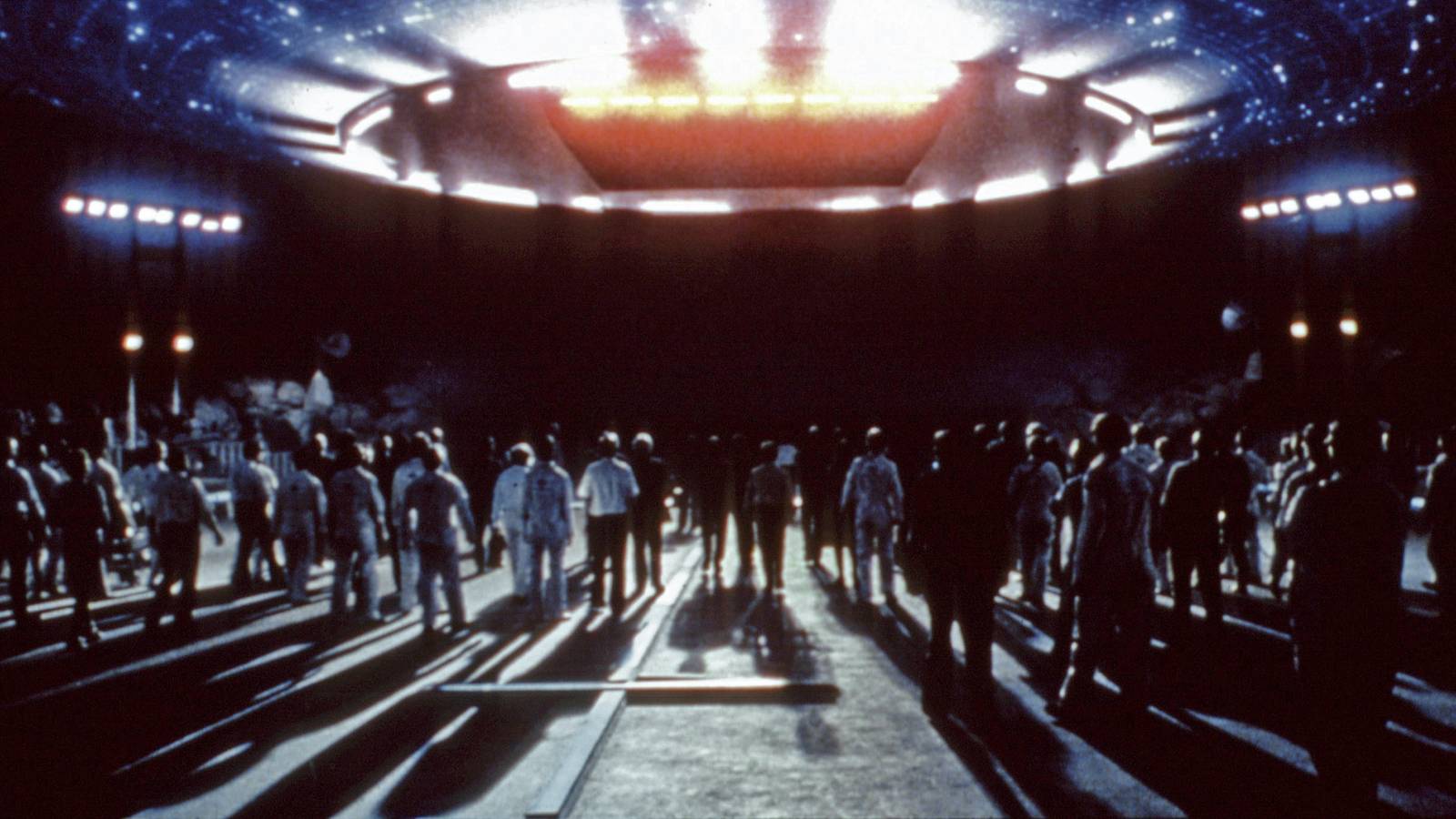
Conventional plot structure goes out the window. The film does have three acts, but they’re wildly unbalanced: a portmanteau compilation of mysterious happenings is followed by a paranoid psychological thriller and then a rapturous lightshow, which doesn’t resolve the film’s storylines so much as obliterate them. This is still one of the most striking things about it. While Hollywood storytelling generally seeks to process any event in terms of the characters’ personal lives, Close Encounters goes to the trouble of setting these stories up before ultimately treating them as irrelevant in the face of the transcendent force of its own spectacle. (Which, I suppose, they would be.)

And then there’s the tone. Spielberg made a career out of his ability to elicit fear and wonder by treating them as inseparable, but I don’t think he has ever done it as unsettlingly as in Close Encounters. The film is at once nakedly optimistic and absolutely terrifying. It frames the international effort to make contact with the aliens as an ominous conspiracy, yet portrays it from within as a peaceful convocation of curious, well-meaning scientists. It never really questions Drefyuss’ unthinking quest to see more (which stands in for Spielberg’s, and ours) nor does it turn away from his disturbing mental collapse and the havoc it wreaks on his family. The UFOs are playful things — tumbling, darting splashes of hazy neon colour — but they’re introduced with alarming scenes of boiling clouds and inanimate objects shaking themselves apart. The blunt peak of Devils Tower looms darkly over the film, refusing to appear beautiful or meaningful.
If anything, the soundtrack is more disquieting than the visuals. Dialogue is layered over dialogue in a cacophonous gabble, giving a sense of breathless excitement but also meaningless confusion. John Williams’ score seesaws between romantic swells and atonal chaos; the masterful musical conversation he orchestrates between humans and aliens, the most memorable moment in the film, is allowed to pass through joyful harmony into a frenzied delirium that’s too much to bear. Too much information.
For a film in which nothing very bad happens, Close Encounters is often nightmarish. It’s built on emotional clashes: hope and terror, joy and madness, suspicion and awe. But none of these is really a contradiction. And I think that’s what gives Close Encounters an elemental power that hasn’t faded. Spielberg is always so placid and controlled in public, but the manic Roy is his most truthful avatar. Made by a man allowed to act out his personal fantasy at ridiculous expense, Close Encounters of the Third Kind is about the fear we feel when we get exactly what we want.