




The communications started arriving soon after my article “The Climate Cartel” was published.
As predicted.
Not a flood. A trickling dozen. Each one carried some form of the crushing weight of silence. “I’ve thought this for years,” one wrote, “but I’ve never said it publicly.”
One commenter went to great lengths to publish some ad hominem “investigation” on me on a platform elsewhere. It remains without engagement months later.
Some were 30-year climate scientists, some risk modellers whose firms sell projections as gospel, and one sustainability consultant conceding in encrypted prose that the carbon offsets they broker are lucrative corporate theatre. This is the silent majority within the profession – whispering in private inboxes because faculty meetings, grant committees, and conference stages have made public honesty professional suicide.
We have reached the end of this series.
We exposed Yorkshire vineyards that the models could not explain, the Antarctic freezer with its pinhole leak, and the Phantom Trees fugazi that haunts corporate balance sheets.
Here is the reckoning.
The crisis in climate science has nothing to with the physics; it is about the institutions that turned necessary scientific uncertainty into sufficient ideological certainty.
What the cartels revealed: incentive engineering at scale
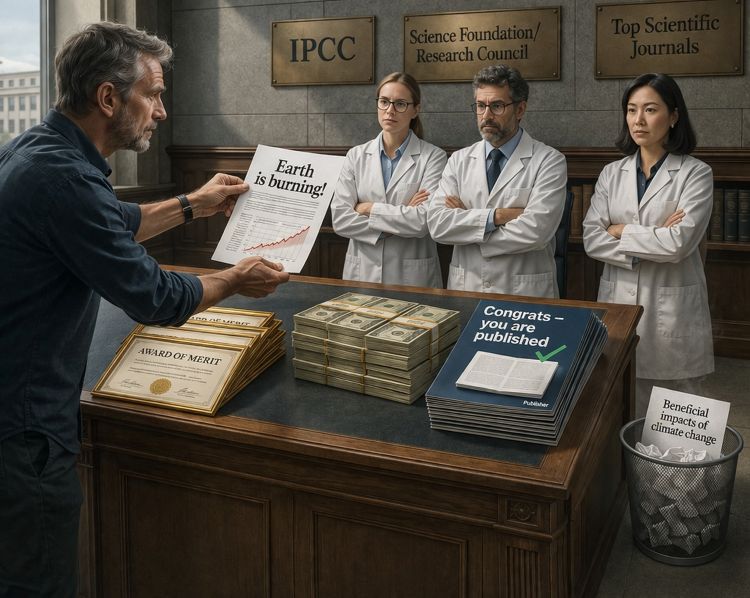
The Climate Cartel is not a conspiracy; it is incentive engineering perfected.
About 95% of funding flows to anthropogenic attribution, while natural variability and model validation are starved. Early-career researchers learn the math of survival quickly: ask the funded question or die on the vine. I have encountered this directly in academia. As Daniel Sarewitz argued in Environmental Science & Policy, the “excess of objectivity” allows science to be used to support nearly any political position, leading to a system in which research is funded not for discovery, but for policy ammunition.
The Medieval Warm Period did not vanish because the data changed; it vanished because its existence complicated the grant narrative required for institutional survival. The Cartel never needed censors – self-censorship through rational career calculation does the job with perfect plausible deniability.
What the cult enforced – the certainty porn of the ‘settled’
Institutional capture built the machine; the “Cult of Certainty” supplied the fervour.
Error bars—the heartbeat of honest science — vanished from presentations while confidence statements ballooned. As Judith Curry noted time and again that the drive to simplify climate complexity for policymakers has led to a “consensus” that systematically marginalizes legitimate uncertainty.
Science supplied this “certainty” because institutional survival demanded it. Policymakers needed marching orders, and activists needed moral certainty. Moral crusades are a dubious undertaking, and crusaders are more dubious than the crusade.
This has led to what Jerry Ravetz describes as the “maturing of post-normal science,” where the pressure for a unified narrative overrides the messy, necessary skepticism of the scientific method. The penalty for voicing normal scientific caution becomes professional exile.
You are not debated; you are labelled a “climate denier” to ensure you are never invited to the room again.
Cults are not inclusive; they are exclusive. And ruthless.
What the converts discovered – the fugazi on the balance sheet
My conversion was not ideological.
It was a data-driven reckoning born from professional nausea and bearing witness to peers imbibing the poison lock, stock, and barrel. And certification instructors too often stating “let’s not go there” when uncomfortable questions arose. I could no longer reconcile the “phantom trees” that I was tracing for clients – credits for forests never under threat, profiteering from a system claiming to be saving the planet.
A 2023 landmark study in PNAS by West et al. confirmed the “fugazi”, revealing that more than 90% of rainforest carbon offsets from major certifiers were essentially worthless. The pattern is the same across every pillar of this series: technical papers contain caveats, public narratives delete them. None of this is fringe; it lives in the specialist literature, and works like Donna Laframboise’s investigations into the IPCC process.
It only vanishes the moment it approaches a press release or an ESG fund brochure.
The manifesto – what honest climate science requires
To rebuild evaporating credibility, we must burn the current playbook. Sheesh, I am no Unabomber, but we really need to blow it up. Mike Hulme suggests in Why We Disagree About Climate Change that we must acknowledge that climate change is an “untidy” problem that cannot be solved by a single, manufactured consensus.
Here is my stab at a manifesto.
Honest science demands:
- Comprehensive funding reform: Grants awarded on methodological rigour, not “policy relevance”. We must fund natural variability and model validation with the same intensity as attribution. Financial gerrymandering must end.
- Symmetric evidence standards: Heterodox findings must be judged by the same bar as orthodox ones. Replication and null results must be published, not buried.
- IPCC structural reform: Separate technical findings from the “Summary for Policymakers.” Government representatives must be banned from rewriting scientific language to suit political agendas, a concern highlighted some time ago by the sociology of Sheila Jasanoff.
- Model validation via genuine prediction: End the era of tuned “hindcasting”. Judge models on future forecasts, and deprecate those that chronically over-predict instead of averaging them into ensembles that hide failure. Ensembles are obfuscation.
- Elimination of the carbon shell game: Prohibit offset markets as systematic fraud. Corporations must report absolute emission reductions, not “purchased indulgences” for phantom assets. No carbontithes for thee. That is my neologism for “pay for penance” in this space.
- Educational honesty: Curricula must teach natural variability alongside greenhouse physics. Students must learn probabilistic thinking, not ideological certainty. I was not sufficiently forceful on ethics in my ESG Measurement, Reporting and Ethics course that I designed. A guilty conscience is my penance.
The personal calculus
I ran the numbers.
My academic career in the climate space did not end because I refused to teach projections as gospel. My consulting clients were deselected when I started calling the carbon markets a “fugazi on the balance sheet”. I have a former friend in the offsets scheme.
Professional costs are real. But as Roger Pielke Jr. argued in The Honest Broker, when scientists cross the line into advocacy, they lose the very thing that makes them valuable: their objectivity.
I cannot unknow the data. I cannot teach a certainty that is not there.
The choice is not career versus suicide. It is integrity versus comfortable self-deception.
The path forward
To every colleague who communicated with me: I know why you stay silent.
Speaking up can cost you a mortgage and your reputation. But every self-censored paper reinforces a consensus that does not exist. Silence is the glue holding together this corrupted system.
The credibility crisis is not driven by skeptics. It is driven by the public discovering the gap between our stated confidence and our demonstrated accuracy. The public deserves more. We are robbing them as we hide in fear, writing propaganda, collecting cheques we do not deserve.
When that gap becomes common knowledge, the backlash will be total. Accountability is a word that many I know dare not speak. It is verboten.
I choose to speak up because I would rather lose a fraudulent pursuit to the truth than keep it alive through lies. The communications I mentioned at the outset tell me that many are ready to make the same choice.
The question that shall not be asked has become the only question that matters.
Stop protecting the narrative and start defending fundamental facts and data.
Editor’s note – here are the other six articles in Richard’s series, beginning with most recent:
(Richard LeBlanc – BIG Media Ltd., 2026)