





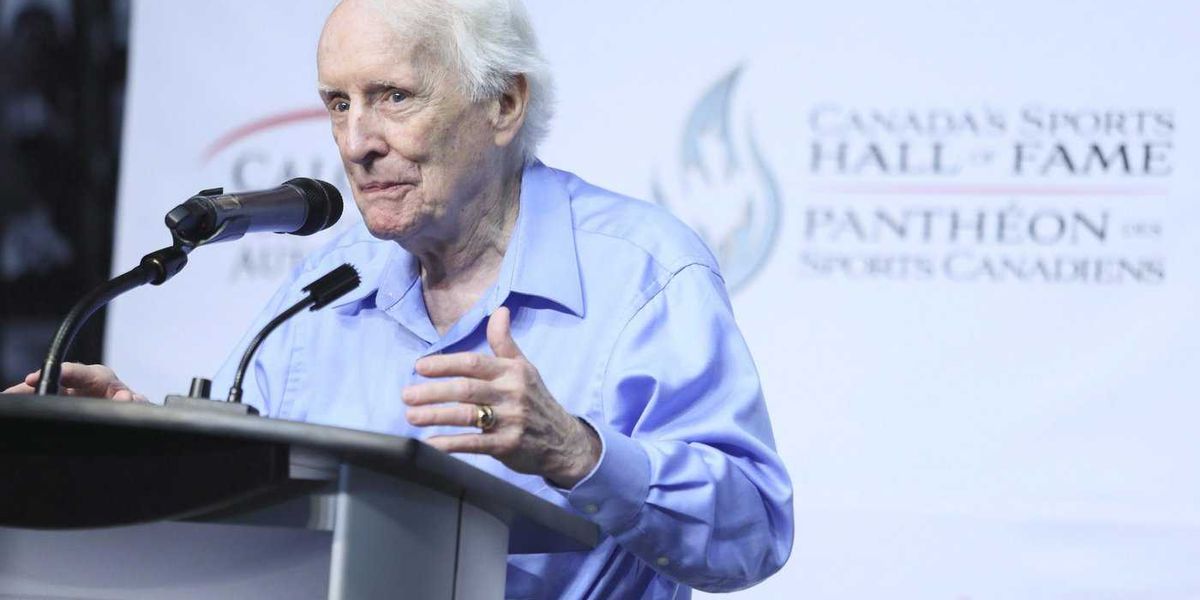
For many Canadians who have an intellectual disability or know someone who does, Frank Hayden is a treasure.
“His advocacy changed the lives for thousands of intellectually disabled people across the world, including my own brother,” said Chris Lewis, a former Ontario Provincial Police commissioner and retiree, in an interview from his home in Burlington, Ont.
“My brother (has autism) and wouldn’t even talk to a stranger. When they said, ‘Hi,’ he would turn the other way. Now he has interpersonal skills. Had Frank not done the work that he did, none of this would have ever happened.”
Hayden, who sparked the idea to create Special Olympics Canada and later spearheaded the organization, died Saturday.
He was 96, the organization said in a statement.
Hayden was born in Windsor, Ont., and grew up further east in St. Catharines.
His groundbreaking research in the 1960s found that exercise could transform people with an intellectual or developmental disability, such as autism or Down syndrome.
“It was assumed that their low fitness levels were directly connected to their disabilities,” Special Olympics Canada’s statement said.
“Hayden’s body of work challenged that mindset – one that claimed it was the disability itself that prevented people from fully participating in play and recreation.”
Hayden’s research caught the attention of Eunice Kennedy Shriver, the sister of former U.S. president John F. Kennedy.
In 1965, the Kennedy Foundation gave Hayden a call.
Shriver and Hayden’s collaboration led to the inaugural Special Olympics Games in 1968 in Chicago, where athletes from 25 states and a Canadian floor hockey team participated. He then established roughly 50 additional Special Olympics organizations worldwide.
He has also been inducted into Canada’s Sports Hall of Fame, appointed a companion of the Order of Canada and had a school in Burlington, Ont., where he lived, named after him.
Amy Van Impe said Sunday she was feeling sad about Hayden’s death but grateful that she got to let him know that he was her superhero the last time she saw him at an Special Olympics event a few years ago.
“I got to tell him how important he was,” said Van Impe, a 44-year-old Special Olympics athlete in an interview from Burlington.
“I have an intellectual disability, and I’m on the autism spectrum…He gave me the confidence to help other people and understand everybody’s different.”
Darlene Halchuk, a community coordinator for Special Olympics in Burlington, said Hayden regularly attended local sporting events.
“He had an unbelievable memory for our athletes,” she said in a phone interview.
“Special Olympics has changed their lives.”
Lewis, 69, said he crossed paths with Hayden several times in the last two decades, including when Lewis worked as a police commissioner.
“Him and his wife, every time they saw me to this day, would ask me about my brother,” Lewis said.
“What Frank did and continued to do all through the years, his advocacy, has changed the world for so many people.”
Gail Hamamoto, CEO of Special Olympics Canada, said in a statement his work opened doors for people.
“Frank Hayden changed the lives of millions of people because he believed something long before many others did — that individuals with intellectual and developmental disabilities deserved the same opportunities to participate, compete, belong and discover their full potential through sport.”
Hayden is survived by four children, seven grandchildren and five great-grandchildren.
This report by The Canadian Press was first published May 18, 2026.
By Fakiha Baig and Aaron Sousa | Copyright 2026, The Canadian Press. All rights reserved.