![10th Jul: Captain Underpants: The First Epic Movie (2017), 1hr 28m [PG] – Streaming Again (6.1/10)](https://occ-0-2433-2430.1.nflxso.net/dnm/api/v6/0Qzqdxw-HG1AiOKLWWPsFOUDA2E/AAAABb68rDyaBJEL7RbqGf3Gc_l-46FtW47ONdU4U6Kkq9QtmxEzSZnQzzhje8n573JHIf54DVCrBOOkMiC8CYDReVH6RoOShiTRf_YE.jpg?r=77f "10th Jul: Captain Underpants: The First Epic Movie (2017), 1hr 28m [PG] – Streaming Again (6.1/10)")




MITEM (Madách International Theatre Meeting), held annually at the National Theatre in Budapest, is one of Central Europe’s major international theatre festivals. Since its founding in 2014, it has brought together companies from across Europe and beyond, positioning itself as a platform for dialogue between theatrical traditions, languages, and aesthetic approaches. Rather than functioning as a conventional showcase, MITEM has developed a reputation for carefully curated programs that reflect broader cultural and political questions shaping the region.
The thirteenth edition of MITEM begins with William Shakespeare and ends with Shakespeare. There is something at once rigorous, elegant, and faintly mischievous in that decision, especially for a festival marked by the number 13. Usually, 13 is tamed by superstition, defused by humor, or neutralized by rational explanation. MITEM does something more deliberate: it turns the number into a dramaturgical principle. This year’s festival does not look away from anxiety. On the contrary, it incorporates anxiety into its very structure. That is why the frame “from Richard to Richard” is not merely a graceful curatorial gesture, but a genuine reflection on the historical moment.
MITEM 2026 opens with Richard III, directed by István Albu and presented by the Satu Mare Northern Theatre’s György Harag Company in Romania, and closes with III. Richard, directed by Itay Tiran and performed by the Gesher Theatre of Tel Aviv-Jaffa. The entire festival unfolds between these two Shakespearean mirrors. This is not a movement from comedy to tragedy, nor from experiment to canon, but from one configuration of power to another. Richard III is, after all, a play about power as performance—seduction, manipulation, theatrical illusion, self-advertisement, and destruction. To frame an international festival in 2026 with two Richards is to acknowledge that theater today cannot speak about the human being without speaking about power, cannot speak about culture without speaking about violence, and cannot speak about Europe without confronting the persistence of its historical legacies.
Yet the strength of MITEM 2026 lies in the fact that this frame does not exhaust the festival—it organizes it. What emerges is not a simple list of productions or a neutral showcase of international partnerships, but a carefully composed dramaturgy. This is a festival that thinks not in isolated events but in relations between them. It works like a novel in performances, like a musical score, like a political and poetic map of Europe in which classical texts, new stage languages, minority theaters, major institutions, and borderland artistic territories are drawn into a single conversation.
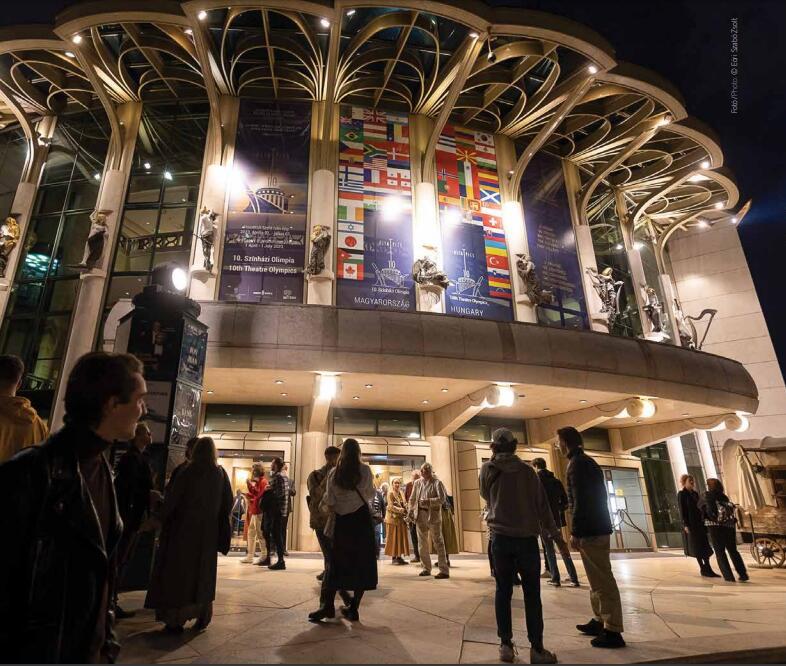
Photo: Eöri Szabó Zsolt
Canon As Nerve, Not Museum
The first striking feature of the program is the density of the European canon. Shakespeare, Sophocles, Molière, Voltaire, Friedrich Schiller, Nikolai Gogol, and Anton Chekhov all appear here, alongside works that directly argue with the canon itself. MITEM does not feel like an academic festival or a museum of masterpieces. Here the canon exists as a living zone of conflict: these texts are reopened and made to answer difficult questions again.
That becomes evident in the distribution of emphasis across the program. Many of the productions are about power, the breakdown of historical orders, and the collision between the individual and forces larger than the self. Richard III and III. Richard form the festival’s central political nerve. Beside them stand Oedipus and the Prophets by the Plovdiv Drama Theatre in Bulgaria, directed by Diana Dobreva, and Mary Stuart, directed by Andrei Şerban from Robert Icke’s adaptation after Schiller. Sophocles and Schiller cease here to be monuments of school culture and become acutely contemporary authors, because both Oedipus and Mary Stuart are figures of power, responsibility, and doom. Their tragedies are dramas of political space, where knowledge, law, fate, and publicity can no longer be separated.
To this line belongs, in another register, The Government Inspector – Ревізор, directed by Attila Vidnyánszky Jr. and presented as a co-production of the National Theatre in Budapest and the Transcarpathian Regional Hungarian Drama Theatre in Berehove, Ukraine. The choice of Gogol in a festival so clearly preoccupied with power and its grotesque mutations cannot be accidental. The Government Inspector is not simply a satire on officialdom; it is a play about a system exposing itself through panic and self-delusion. Within the context of MITEM, this production reads as part of a larger conversation about the political nervousness of Eastern Europe.
Another crucial cluster is made up of productions about the end of eras, the destruction of illusions, and the fragility of cultural constructions. Here one must first name The Cherry Orchard, presented by the Witkacy Theatre in Poland and directed by Nikolai Kolyada, and Candide, or Radical Optimism, staged by the National Theatre in Budapest and directed by Aleksandar Popovski. Chekhov and Voltaire, placed side by side, offer a precise way of reading the present. The Cherry Orchard is about parting from a world that can no longer be saved. Candide is about the impossibility of simple optimism. Together, they suggest a Europe compelled to look again at its own intellectual, social, and moral ruins.
Into this same line naturally falls Amadeus, presented by the N. I. Turkish Theatre in Skopje, North Macedonia, in a production directed by Andrej Cvetanovski. Within the festival’s larger dramaturgy, this is not merely a play about Mozart and Salieri. It is another story about genius and institution, gift and cultural machinery, and the ways talent and mediocrity are shaped by the system itself. Read alongside Candide, The Cherry Orchard, and Mary Stuart, Amadeus becomes part of the same overarching theme: great culture offers no guarantee of moral order and no protection against decay.

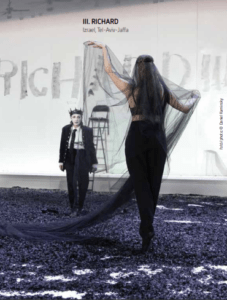
Photo: Daniel Kaminsky
From Text To Body, From Plot To State
MITEM 2026 would, however, be too predictable if it limited itself to the grand European repertory. The force of the program lies in the way it repeatedly moves the viewer out of literary certainty and into another theatrical sensibility, one in which body, rhythm, visuality, and language come to the foreground.
Especially important here are The Characters of Thought by Union des Contraires in Paris, with text, painting, and direction by Valère Novarina, who passed away earlier this year, and I’m Sorry by Troubleyn/Jan Fabre Company in Antwerp, directed by Jan Fabre. Novarina and Fabre are artists of very different kinds, yet within the festival they work in the same direction: they weaken the traditional dominance of plot and move theater into the realm of thought through performance itself. In Novarina, language becomes an independent, almost corporeal substance. In Fabre, the body becomes the site where guilt, shame, memory, and confession are expressed before words. Both productions are vital to MITEM because they remind us that contemporary theater thinks not only through texts, but through gesture, voice, and bodily presence.
The same zone includes Tarsius, a co-production of the National Theatre of Catalonia and Teatres en Xarxa in Barcelona, directed by Ferran Carvajal, and Birds by Pier 21 in Leeuwarden, directed by Theo Smedes. These are essential points on the festival map, where theater becomes an investigation of condition, environment, language, and both human and nonhuman vulnerability. Placed beside Pinocchio. What Is a Person?, presented by Teatro di Napoli and Interno5 in Naples and directed by Davide Iodice, they make one of the festival’s recurring questions unmistakable: not only “Who rules?” or “Who is guilty?” but “What counts as a person at all?” That is not a peripheral question at MITEM. It is a central one.
In this sense, the festival is built along an unusually intelligent trajectory: from classical stories about power, history, and guilt, it gradually leads the audience toward the anthropological question. What is a human being after the catastrophes of the twentieth and twenty-first centuries? What remains of the European subject once political stability, language, and the humanist consensus itself have all been shaken? It is here that Shakespeare, Chekhov, Novarina, Fabre, Iodice, and the more intimate works in the program converge.

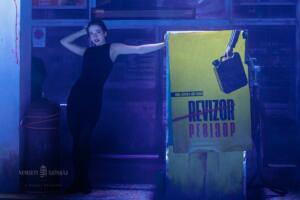
Fotó: Eöri Szabó Zsolt
Europe Without a Center
Another of MITEM 2026’s greatest strengths is its geography. This is not the kind of internationalism built from the predictable roster of prestigious capitals. On the contrary, the program is convincing precisely because its map is deliberately decentralized. Paris, Barcelona, and Naples are here, but they do not dictate the tone. Much more important is the fact that they stand beside Satu Mare, Plovdiv, Subotica, Berehove, Kazan, Almetyevsk, Skopje, and Leeuwarden. This is Europe seen not from the center, but as a network of tense cultural nodes, historical breaks, and linguistic borders. Europe appears here not as a single cultural voice, but as a polyphony in which borderland, minoritarian, and insufficiently represented cultures matter most.
This line functions structurally, not decoratively. Frisian, Tatar, Neapolitan, Turkish, Catalan, Hungarian, Serbian, Georgian, Romanian, Polish, and Hebrew make the program feel like an invitation to hear Europe as a space of many timbres. At a moment when the idea of Europe is continually suspended between uniformity and fragmentation, a festival that takes linguistic difference seriously performs important political work. It reminds us that culture does not live in abstract universalism, but in concrete voices.
Russia And Ukraine: Not a Head-On Statement, But a Curatorial Strategy
One of the most interesting features of the festival is the way it handles Russian and Ukrainian presence. It does so not polemically, but curatorially.
The Ukrainian trace in the program is significant: The Government Inspector – Ревізор is a co-production involving the theater in Berehove. Ukraine appears here not as abstraction, but as a concrete cultural territory with its own multilingual reality.
Russian presence is also there, but in a revealing form. Through Tatar institutions and through directors associated with the Russian theatrical school but working outside a simple model of national representation. Viktor Ryzhakov directs Queen of My Heart in Budapest, while the late Nikolai Kolyada, who passed away earlier this year, is represented by The Cherry Orchard in Poland. Russia appears not as state power, but as artistic tradition.
This is a highly intelligent choice. The festival avoids blunt rhetoric, yet conceals nothing. It shows the region as a field of transitions, minorities, and overlapping influences.

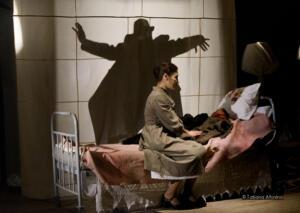
Photo: Tatiana Afonina
The Dramaturgical Breath of the Festival
Look closely at the program, and each title occupies a precise place. István Albu’s Richard III opens a space where politics is inseparable from theatricality. Valère Novarina’s The Characters of Thought reminds us that thought in theater can be an event of language. Avtandil Varsimashvili’s Stalker reads as a work of anxiety and memory. Jan Fabre’s I’m Sorry shifts the conversation toward the body. Ilja Bocharnikovs’s Our Town returns attention to community and time. Attila Vidnyánszky’s Marx’s Capital introduces philosophical critique. Oedipus and the Prophets concentrates knowledge and fate. Play With Me! reflects on theatrical transmission. Candide adds irony. Viktor Ryzhakov’s Queen of My Heart introduces a contrasting tone. Molière’s The Imaginary Invalid (by Nikola Zavišić, National Theatre Belgrade), János Feledi’s The Rooster Stew (by János Feledi, Feledi Project – Asterion Project), Mary Stuart, Birds, Tarsius, The Government Inspector, Amadeus, The Corn of My Soul (by Farid Bikchantaev, Galiasgar Kamal Tatar State Academic Theatre), Pinocchio. What Is a Person?, Nina Plavanjac’s The Aquarium, and Broken Melody all contribute to a carefully balanced structure. The Cherry Orchard becomes a poignant farewell shaped by the memory of Nikolai Kolyada. Finally, Itay Tiran’s III. Richard closes the composition, returning to Shakespeare and reaffirming the central question: power, history, and the human.
Many international festivals try to prove their importance through the sheer number of countries, names, and formats, and end up resembling a beautifully designed catalog. MITEM 2026 chooses a different path. It is not afraid of consistency. It does not hide its seriousness. It does not try to please at any cost. This is a festival that believes in the meaning of curation. It shows that a program can be not merely a set of events, but a way of thinking. That the classics can function not as tribute to tradition, but as a language for contemporary unease.

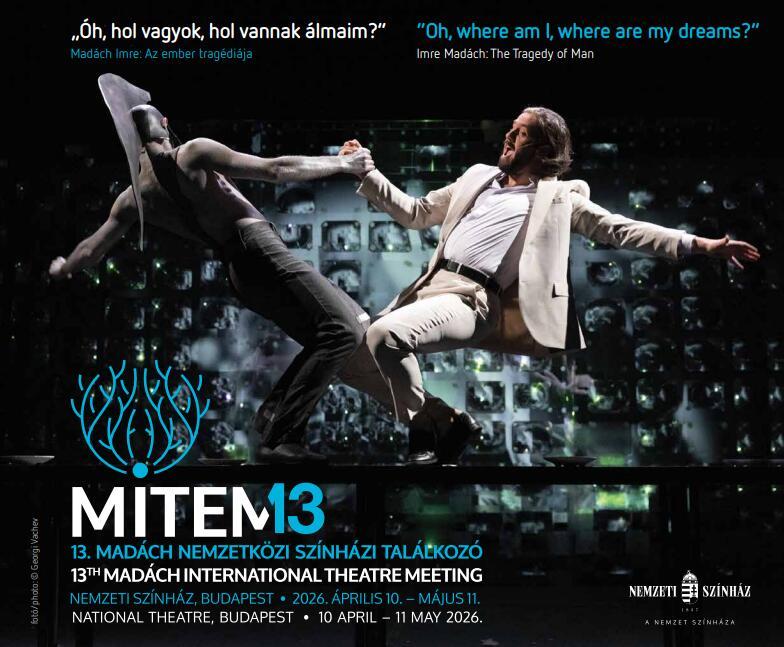
MITEM 13 official visual. Courtesy of the National Theatre, Budapest.
That minority theaters can be not an appendix to the main program, but one of its moral and aesthetic centers. That Europe can be seen not as a map of prestigious capitals, but as a field of tense cultural neighborhoods. That theater is still capable not merely of servicing a conversation about the world, but of leading it. MITEM 2026 does not simplify. It does not pretend seriousness must be justified by entertainment. It is not afraid of large themes—power, language, fate, collapse, identity, the human. The thirteenth edition seems to say: yes, these are anxious times; yes, Europe is not in a state of inner comfort; yes, theater is not obliged to console. But it is obliged to look closely. And if one is to play with the number 13, then perhaps one should do so in this way: MITEM is not afraid to be an “unlucky” festival in the superficial sense. It chooses something else—to be an honest festival. And honesty in theater, as we know, has a longer life than superstition.
On the pages of The Theatre Times, we will certainly return in greater detail to several productions in the program—those that formulate today’s theatrical unease with particular sharpness and reveal especially clearly how MITEM imagines Europe in 2026. But even now one thing is clear: this is a festival that deserves not a passing overview, but a close reading, like a difficult, intelligent, and timely text.
This post was written by the author in their personal capacity.The opinions expressed in this article are the author’s own and do not reflect the view of The Theatre Times, their staff or collaborators.
This post was written by Emiliia Dementsova.
The views expressed here belong to the author and do not necessarily reflect our views and opinions.