


![24th May: Bad Thoughts (2026), 2 Seasons [TV-MA] – New Episodes (6.1/10)](https://occ-0-503-2705.1.nflxso.net/dnm/api/v6/0Qzqdxw-HG1AiOKLWWPsFOUDA2E/AAAABTWZBqM4kZwLDEjOhThqN7kbrwgZ-ULslOBeTcg9NsBWtZJXNRyRBFwCXmEvHaLkvRcnwcFzCIs9ZBnZNArkhx3XznV0ib56_OwhXr_tCKeq2DGPbJoe7oKP5IaTW7c3YDkamWrxpDV44O5Z3jACd9Y7sBF0cg18XVXCFndQ.jpg?r=251 "24th May: Bad Thoughts (2026), 2 Seasons [TV-MA] – New Episodes (6.1/10)")


While the Canary Islands’ reputation as an epicentre for winter sun seekers precedes it, there’s another side to the Spanish archipelago: a world of glorious hiking trails, criss-crossing through volcanic landscapes and subtropical cloud forests.
The master of all these trails is the GR-131. The Gran Recorrido (‘great journey’) is a 560-kilometre route that spans all seven islands, and I’m tackling part of it on La Gomera, one of the archipelago’s least-visited (and criminally underrated) islands.
Recommended: I visited the world’s highest Irish pub – where Guinness comes in cans and yaks transport the barstools
We’ve only got five days, so the itinerary is jam-packed. We’ll hike 25km from the port town of San Sebastián to Chipude on one day, then 15km from Chipude to Vallehermoso on another. On our last full day, we’ll hike from the town of Vallehermoso to the beach, covering some of the GR-132 route, which goes around the island instead of across it. The other two days will be travel days.
Recommended: The best Canary Islands to visit in 2026, according to an expert
But there’s a slight spanner. In the early hours, not long before we’re due to set off, I wake up with a vomiting bug. I manage to sleep for a few hours and get over the worst of it, but by now, it’s too late to start hiking. So, much to my disappointment, we take the bus to Chipude instead.

There’s ample distraction from my disappointment, though, watching our surroundings change as we drive up through the hills. And the 45-minute journey allows me to recoup some energy, so, after arriving and dropping our bags off at Hotel Sonia – the town’s only hotel – we head straight out.
We choose a 15km circular route, which goes through parts of Garajonay National Park and reaches Alto de Garajonay, the island’s highest point.

The houses and roads quickly give way to undulating landscapes: mountains and valleys that create microclimates, so within minutes, you’re taken from bright sunshine and blue skies to thick mist enveloping the path ahead. Our only companion is a little ginger cat, who sticks by us for a solid 20 minutes, leaping nimbly over rocks and waiting for us as we pick out our route with more care and less grace.
After four hours of walking and a hot shower, we head to the hotel’s restaurant for an early dinner. Sonia, who runs the hotel, is a small woman with a big smile who whizzes around the tables without breaking a sweat. We eat soup and bread, Canarian potatoes with mojo (sauces made from herbs, oil and spices), and a heaping plate of pasta. Our leftovers are stowed away in Tupperware for tomorrow’s lunch, and we fall into a carb-induced sleep.

The next day, we tackle the stretch from Chipude to Vallehermoso. Despite the Canaries’ subtropical climate usually providing year-round pleasant hiking weather, on this day, the weather Gods aren’t on our side. It’s very wet and surprisingly cold – but this turns out to be a blessing in disguise. The steep ups and downs of the route, coupled with the slippery wet stones, force us to slow down and properly take in our surroundings. In fact, the drizzle only makes things more vibrant. The greens appear greener, and the damp air refreshes my warm cheeks.


A large part of the hike goes through laurel forests: humid, subtropical rainforests filled with moss and lichen. The canopy of the tree cover here shields us from the rain, and we stop for a well-deserved snack.
The trail is very well marked; red and white symbols, painted on trees or rocks every 100 metres or so, mark the way, while weather-beaten signposts every 1km tell us how much ground we have left to cover.

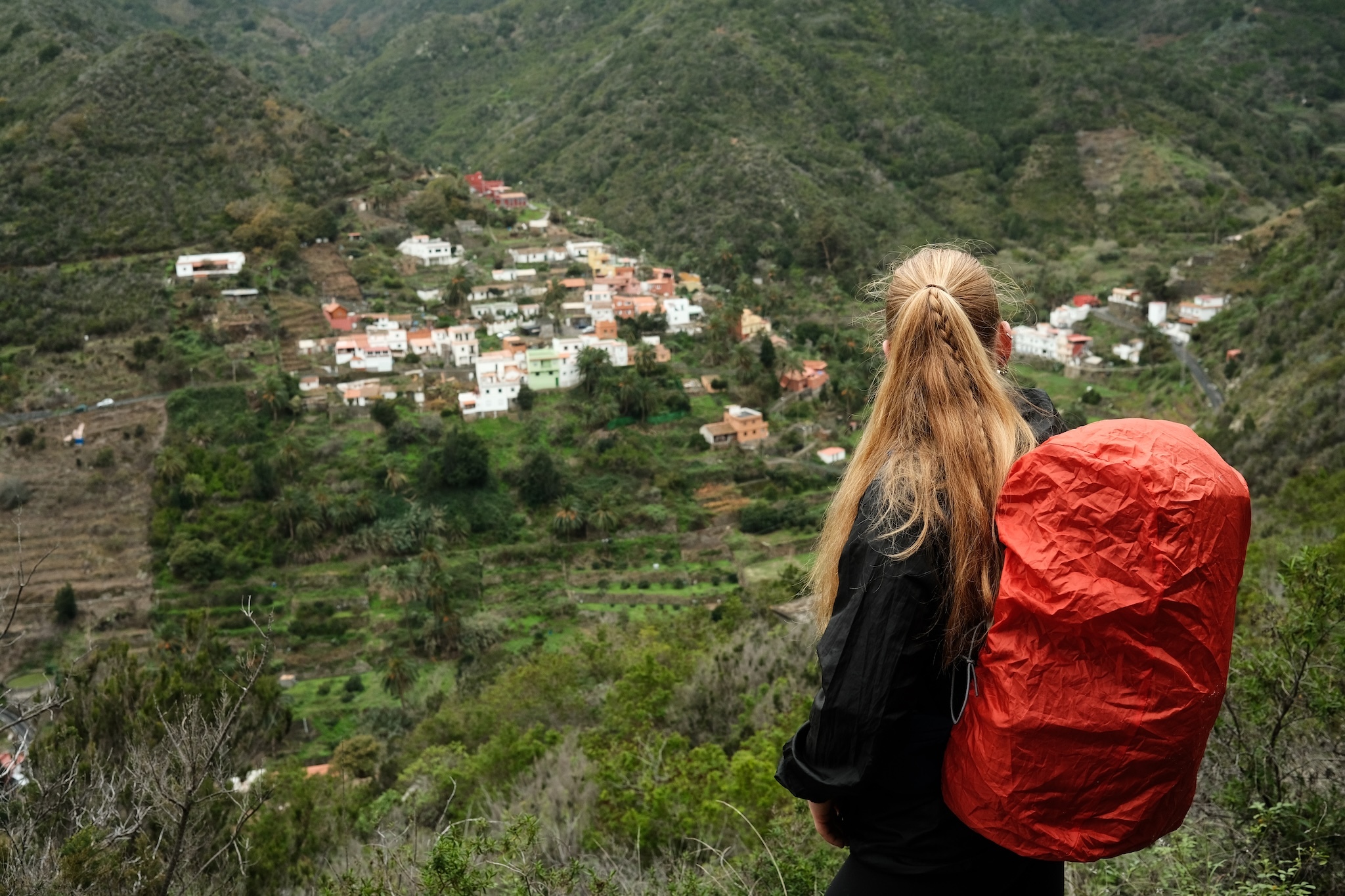
Before beginning the descent into Vallehermoso, we see where the town gets its name (‘beautiful valley’). Colourful houses cluster together amongst huge, green mountains, scattered with trees.

On our last full hiking day, the 17km circular route we’ve planned overlaps with part of the GR-132 trail, taking us down to the beach and then up into the mountains, leaving the sea behind us.

After a sweaty uphill climb which, at times, felt never-ending, we’re in the clouds. The air is heavy with moisture, creating an all-encompassing fog. This, combined with the red clay ground, makes it feel like another planet. We find a church and house with a small garden of animals: hens and a rooster clucking around a family of cats.

Our final night is spent feasting on local delicacies. Despite our plant-based requirements, there’s no shortage of options – we eat padron peppers, two types of mushrooms and plenty of fries. We have ‘escaldón de gofio’ (toasted corn soup) and ‘berenjeras con miel’ (roasted aubergines with palm syrup) – all washed down with plenty of red wine.

La Gomera, dubbed ‘La Isla Magica’ or the ‘Green Island’, is one of the three small, overlooked Canaries, along with La Graciosa and the tiny El Hierro. Despite being only a ferry ride away from Tenerife, the largest and most popular island in the archipelago, it retains its quiet, rugged beauty thanks to a lack of direct international flights.
As such, you won’t find the same towerblock hotels and tourist-choked beaches just over the channel. Instead, you’ll find a hiker’s paradise: deep volcanic ravines, rugged peaks, and accommodation options that range from colonial-style boutiques to bungalows.
Hebe’s tips for hiking the GR-131 on La Gomera
- Book flights to Tenerife Sur. Flights are reasonably priced throughout the year – usually £40-80 return from the UK.
- Take the ferry to San Sebastián via one of two ferry companies (Fred Olsen Express and Armas). It’s cheaper to book in advance. Note that you’ll need to buy non-Canarian-resident tickets.
- Accommodation options are limited as the area isn’t very touristy. As well as Hotel Sonia in Chipude, we used Booking.com to find apartments in both San Sebastián and Vallehermoso.
- Make sure to pack layers – including waterproofs – because the weather can change quite drastically, quite quickly. But do also try and pack light; you’ll regret every surplus pair of socks when you’re fighting to catch your breath!
Read ’s full guide to the world’s best hikes.
Stay in the loop: sign up to our free Travel newsletter for all the latest travel news and best stuff happening across the world.