



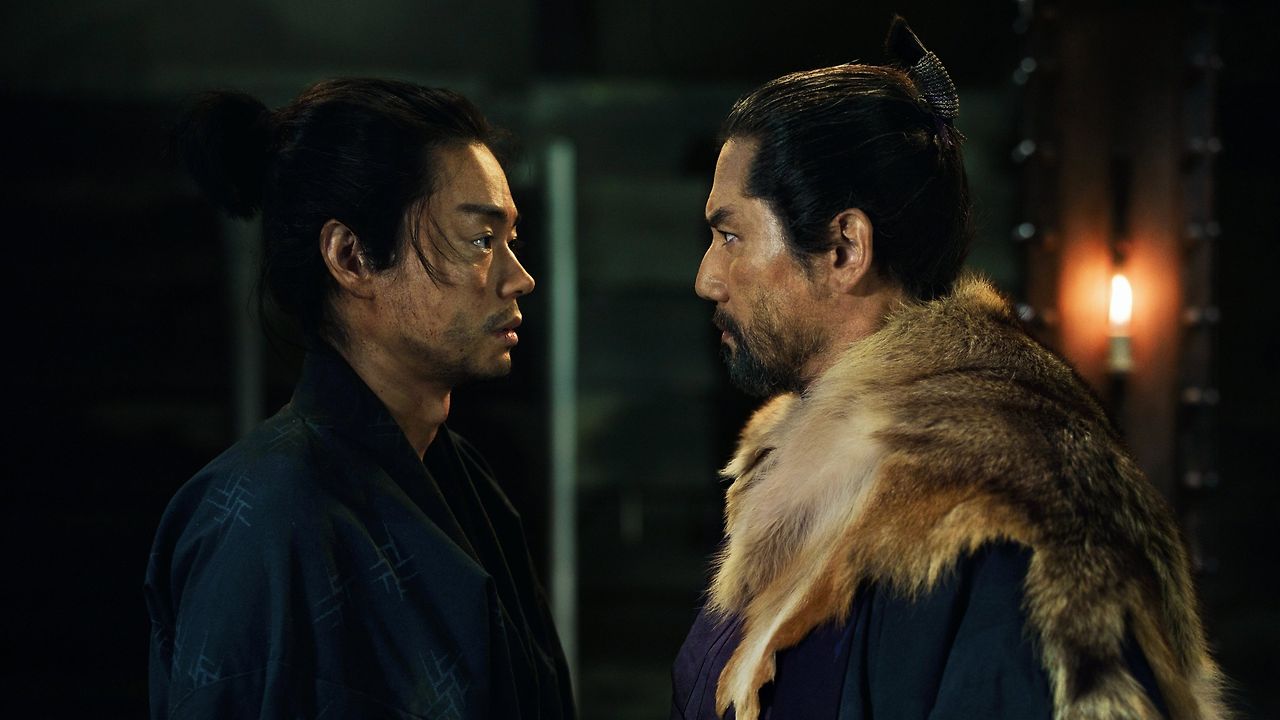
It is true—this time, I filmed in locations that have existed for hundreds of years before our lifetime and probably will exist for hundreds of years after. These are very important, protected cultural artifacts that I was allowed to film in, so I don’t take it lightly that I was able to create a film inside of them. I found them to be more special than the warehouses in Tokyo that I’m typically filming in. However, I found there to be surprising synergy [between] these castles and temples [and those warehouses,] more than one might have initially considered.
When you place characters in a castle or temple, these environments—back then—had a kind of depth. There’s this world that extends beyond the characters in a way that is very multi-layered and exudes a sense of history; there are traces and evidence of things that have happened before, just beyond the characters and where they’re standing. That’s not dissimilar to the warehouse spaces I film in my urban dramas, which also had histories long before they were demolished. Of course, it is different from these new pieces of architecture where it’s just a flat concrete wall, but there are layers of history even in these warehouse spaces. I would hope my films capture not just their age, but also the evidence of life lived beyond the walls we see through the screen.
You’re no stranger to adaptation, having adapted the work of Kazumi Yumoto for Journey to the Shore. Before We Vanish was based on the play by Tomohiro Maekawa. I’m curious if you can speak more about the process of adaptation, as it pertains to this project.
Kokurōjō is a fascinating novel. I would say that 80% of the narrative contained within the film is drawn directly from it. I don’t think that working on this film has made me rethink the process of adaptation; instead, it has made me recognize how important it is to stay faithful to the source material when it is very good. [Laughs]
This may veer slightly away from the idea of adaptation, but this film is not only an adaptation of a novel; it is important to remember it is also based on historical truths. The ten-month siege of Arioka Castle was an actual historical event, and Araki Murashige was an actual historical figure. I always wanted to keep that element of realism in mind, no matter how much I may have fictionalized for the sake of adaptation. At the end of the siege, we see Murashige flee the castle, leaving behind his retainers and his family. That is the central drama of the film, and I think that the fact that the film and book were both based on this historical truth is very important in my mind.
I do consider my responsibility as far as what gets through to a viewer, especially given the fact that this history may not be as well-known for those outside of Japan. At the same time, I think plenty is going on, narratively, that most viewers—regardless of where they’re watching—won’t know about and will have the opportunity to be surprised by.
I don’t expect Japanese audiences to know the history behind these characters; conversely, there are probably many people abroad who might know a lot about the history. While I do feel a sense of responsibility towards what people might interpret from the film, what makes cinema lovely is that people can be swept up in the histories and concerns of protagonists they might not otherwise have any sort of connection with. For example, I don’t know a tremendous amount about American history, but I’ll watch a film about the American Civil War and be swept up by the life of the protagonist and what they’re going through.