









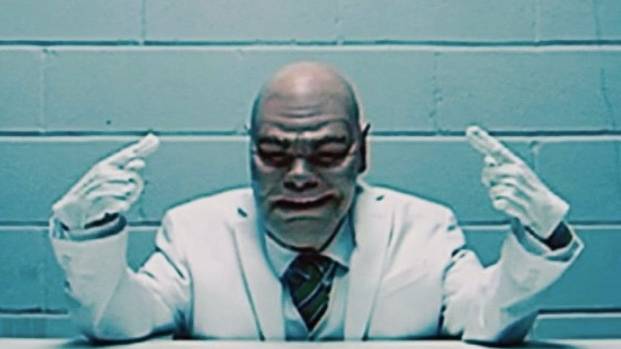
In Daredevil: Born Again season 2, the Man Without Fear isn’t the only one getting under the skin of Wilson Fisk (Vincent D’Onofrio). In addition to all the other complications that come with being the mayor of New York City, Fisk is being plagued by a series of viral videos secretly put out by journalist BB Urich (Genneya Walton) where she wears a rubber mask of Fisk’s face and mocks him as a cutthroat gangster lying to his electorate.
The videos have a glitchy, underground quality to them, with flashing lights and jittery images. For those who weren’t watching TV in the late 1980s, the closest points of reference are likely the Cafe ‘80s scene in Back to the Future Part II or Eminem’s 2013 music video for “Rap God.” But Back to the Future and Eminem were both paying homage to the same bit of obscure 1980s pop culture that Daredevil now is: Max Headroom and the somewhat unrelated “Max Headroom Incident” of 1987.
Max Headroom is a fictional character played by American actor Matt Frewer on the British TV station Channel 4. In the mid 1980s, the network was looking for a format to present music videos and turned to British production house Cucumber Studios to create something. Rocky Morton and Anabel Jankel of Cucumber Studios dreamed up Max Headroom, “the first computer-generated TV presenter” designed as a parody of American TV hosts. Despite the name, there was no computer animation used for the character, just prosthetic hair and facial pieces, flat makeup, and harsh lights put onto Frewer, who sat in front of a blue screen.
While in development of The Max Headroom Show, Channel 4 decided to introduce the character in a TV movie, so it teamed up with HBO to create Max Headroom: 20 Minutes into the Future. In this story, Max Headroom begins as journalist Edison Carter (also Frewer) set to expose his own network’s use of subliminal advertising. However, while on the run from network goons, he crashes into a sign labeled “Max Headroom” resulting in a head injury. Worried that people will ask about Carter’s whereabouts, the network creates a brain scan of Carter in order to digitally recreate him, but there’s a glitch and Max Headroom is born. Then, seeing profitability in the funny, unusual personality, the network decides to turn Max into a host on their network. This leads directly into the TV show, which debuted just a day after the TV movie aired.
The Max Headroom Show debuted in April 1985, and there was only a loose narrative structure to it. As originally intended, it was just a way to present music videos, and the segments with Max bridged the gaps in between those videos. The character instantly became incredibly popular. Channel 4 eventually reran the episodes in America on Cinemax, and Max Headroom would become the spokesperson for New Coke, which debuted just a couple of weeks after The Max Headroom Show did.
Separately, the American ABC network created Max Headroom, an hour-long drama series that debuted in April 1987. This show kept Frewer in the role, but reshot the original TV movie as a pilot. Frewer’s journalist character Edison Carter was the lead of the series, while Max Headroom, despite being the titular character, was a minor element.
In between the ABC show’s first and second seasons, yet another series was made directly for Cinemax. In The Original Max Talking Headroom Show, Max interviewed guests, sang, and performed comedy.
If you’ve lost track, that’s one TV movie and three separate TV shows, all of which wrapped up in pretty quick succession. The original British series concluded after its third season in March 1987. Then the Cinemax show ran for just six episodes during the summer of 1987 as essentially the fourth season of the British show, even if it was only broadcast in America. The ABC show concluded after its second season in May 1988. As for why it all came crashing down so quickly, a three season run is pretty typical for a British series. With the ABC show, poor ratings doomed it, as it was competing with huge shows like NBC’s Miami Vice and CBS’s Dallas.
Separate from the official goings-on of Max Headroom, there was “The Max Headroom Incident,” which took place on Nov. 22, 1987 in Chicago. That night unknown television pirates hijacked the signals of two separate TV stations. First they took over the signal for WGN-TV during a local news broadcast. For 25 seconds around 9:00 pm, someone in a Max Headroom Mask silently swayed about on the screen before disappearing and returning the station to the news.
Two hours later, the pirates took over Chicago’s PBS affiliate, WTTW and broadcast 90 seconds of nonsense. This time with both video and audio, the same figure in a Max Headroom mask squeakily jibbered about New Coke, a cartoon show named Clutch Cargo and WGN sportscaster Chuck Swirsky. The person in the mask also pulled their pants down and was spanked by a woman with a flyswatter. Then the signal glitched out and the station returned to the episode of Dr. Who that was interrupted.
Granted, some of the built-in glitchiness of Channel 4’s original The Max Headroom Show is present in the viral videos in Daredevil: Born Again, but the series is drawing more from “The Max Headroom Incident” than it is the original TV shows with the character. While Frewer wore prosthetics to play Max Headroom, the Chicago incident utilized an oversized mask, just like the Kingpin mask used by Urich. Plus, the way the viral videos somewhat interrupt the narrative of the Disney Plus series is meant to emulate the pirate signal. The major difference is, the person behind the mask is exposed to the audience right at the beginning of episode 2 of this season, while those responsible for the 1987 Max Headroom Incident have yet to be found out.

