



To read PART I of this interview, go to this link.
IAB: Atmosphere as Performance – Your installations often operate through subtle relations between sound, light, technology, biological activity, space and the visitor’s body. How important is ambience in your work? Can atmosphere itself function as a performer something that acts upon the spectator before the spectator consciously understands what is happening?
SS: Atmosphere is essential because an encounter often begins in the body before it becomes an explanation. Sound, vibration, temperature, light, proximity and spatial orientation can change how we breathe, move and listen. They create the conditions in which a visitor becomes receptive or perhaps uncomfortable, curious or uncertain. I would not treat the atmosphere as an independent performer. It emerges between bodies, materials, organisms, technologies and the space they share. This relational quality is what interests me. The atmosphere is never simply something I produce and an audience consumes; it changes with those who enter it. I am especially drawn to the moment before recognition, when we sense something without immediately knowing what to call it. It is a fragile moment, but it can loosen our habitual ways of separating ourselves from our surroundings.
IAB: Art, Biotechnology and the Politics of the Stage – Biotechnological art inevitably touches questions of science, health, ecology and technological power. Can the installation and perhaps theatre become a political stage on which we make visible the systems of power governing bodies, organisms, environments and technologies?
SS: Biotechnology is never simply a neutral set of instruments. It is embedded in decisions about which lives are protected, measured, cultivated, exploited or rendered disposable. Art can make these arrangements perceptible without merely illustrating a political argument. In Inspiration, breathing opens onto questions of extraction, biotechnological mediation and the uneven distribution of conditions for life. A process we usually take for granted becomes a way of considering how bodies depend on infrastructures and environments that are neither equally accessible nor politically neutral. In Terra Xenobiotica, I approached soil as a living archive rather than a passive ground beneath human activity. The 86 soil chromatograms register material differences through patterns produced by chemical reactions; the sonification and Holding Patterns then approach those traces through other sensory and narrative registers. Rather than presenting soil as an untouched natural substance, the project asks how industrial histories, chemical transformations and ecological disturbance become inseparable from the environments and bodies that carry them. For me, the political potential of an installation lies in unsettling the fiction that we stand outside the systems we analyze. A sensory encounter cannot replace political action or scientific knowledge, but it may complicate what we consider worthy of attention, care and responsibility.
IAB: From Interdisciplinary Collaboration to Collective Performance – You have collaborated with microbiologists, ecologists, programmers, sound artists and theorists. What makes an art–science collaboration genuinely productive? Can such collaboration be understood as a collective performance in which different disciplines, forms of knowledge and temporalities negotiate the same space?

Radiotrophic Fungarium by Saša Spačal and Kaitlin Bryson. Photo credit: Miha Godec.
SS: Productive collaboration begins when disciplines move beyond merely providing services to one another and become willing to challenge and transform each other’s perspectives. I value encounters in which a scientific method unsettles an artistic assumption, or an artistic question opens an unexpected way of approaching scientific material, sometimes even leading to scientific publications. The most generative moments often emerge precisely where our languages, methods and ways of understanding the world do not quite coincide. In Terra Xenobiotica, my collaboration with soil researchers at the Rillig Lab – Plant Ecologies, Institute of Biology, Freie Universität Berlin, and with Dmitry Morozov on computational sonification brought different ways of sensing, interpreting and translating the same material into dialogue. Working with literary scholar and cultural theorist Alison Sperling on Holding Patterns opened yet another dimension, allowing scientific observations to resonate with ecological, philosophical and cultural questions. In earlier bioart installations, exchanges with microbiologists were equally formative, as biological cultivation, sensing and maintenance were inseparable from the artistic concepts themselves. Across my practice, collaborations with microbiologists, soil researchers, technologists, sound artists and theorists have shaped not only how works are produced, but also the very questions they explore. Yet I do not wish to romanticize interdisciplinarity as a seamless exchange of knowledge. Collaboration involves translation, disagreement, practical limitations and sometimes fundamentally different understandings of what constitutes evidence or meaningful inquiry. These frictions are not necessarily obstacles to overcome; they can become productive forces that open possibilities none of the disciplines could have reached independently. Perhaps this is why the metaphor of collective performance resonates with me. No single participant possesses the entire script, and no one can fully anticipate how the encounter will unfold. Each brings particular forms of knowledge, imagination, curiosity and constraints. The work emerges through this ongoing negotiation, often becoming something that none of us could have imagined alone.
IAB: The Spectator as Participant – Your installations often place visitors inside microbial, technological or ecological systems. What do you want the spectator to physically sense, rather than simply observe? At what point does a visitor stop being an audience member and become a participant, performer or even a component of the work’s living system?
SS: I want the encounter to begin in the body, before it becomes an interpretation. Through sound, vibration, light, proximity or biological feedback, the visitor can physically sense that they are not standing outside a system observing it, but are already entangled within it. In Myconnect, the participant enters a biofeedback loop with fungal mycelium, experiencing through their own body a connection with another form of life that would otherwise remain largely imperceptible. In Symbiome – Economy of Symbiosis, the visitor’s breath becomes part of the installation’s metabolic exchanges, as the carbon dioxide they exhale influences the conditions in which plants grow. In both works, the human body is not simply an observer but an active participant in a system of reciprocal influences. Yet participation does not imply control. The visitor affects the system while remaining dependent on processes that unfold beyond their perception and intentions. In The Library of Fallen Tears, participation takes a more intimate and vulnerable form. Visitors are invited to donate their tears to a collective archive of tear microbiomes, transforming an intensely personal bodily fluid into a gesture of exchange. In The Sanctuary of Living Tears, sensors register this offering and respond with sound, acknowledging the act of giving. The collected tears become part of an archive that brings together personal histories, microbial lives and the material traces of human emotions. Through this work, I wanted to explore the possibility that we never truly cry alone. Even our tears, which we so often associate with the most private moments of our lives, carry traces of our entanglement with other forms of life. Our bodies are not self-contained entities, but porous, watery environments, continuously exchanging matter with the world around us. The work also opens towards a larger hydrological imagination, in which the waters of our bodies participate in planetary cycles that connect us across species, environments and temporalities. What interests me across these works is that participation is not necessarily about interaction in the conventional sense of pressing a button or triggering an effect. It can also mean offering something of oneself, becoming vulnerable, or recognizing that our bodies are constantly affecting and being affected by other bodies, organisms and environments. The boundaries between spectator, performer and the living system become increasingly difficult to maintain. Perhaps the spectator becomes a participant not at the moment they begin to act upon the work, but at the moment they recognize that they have never been entirely outside it.
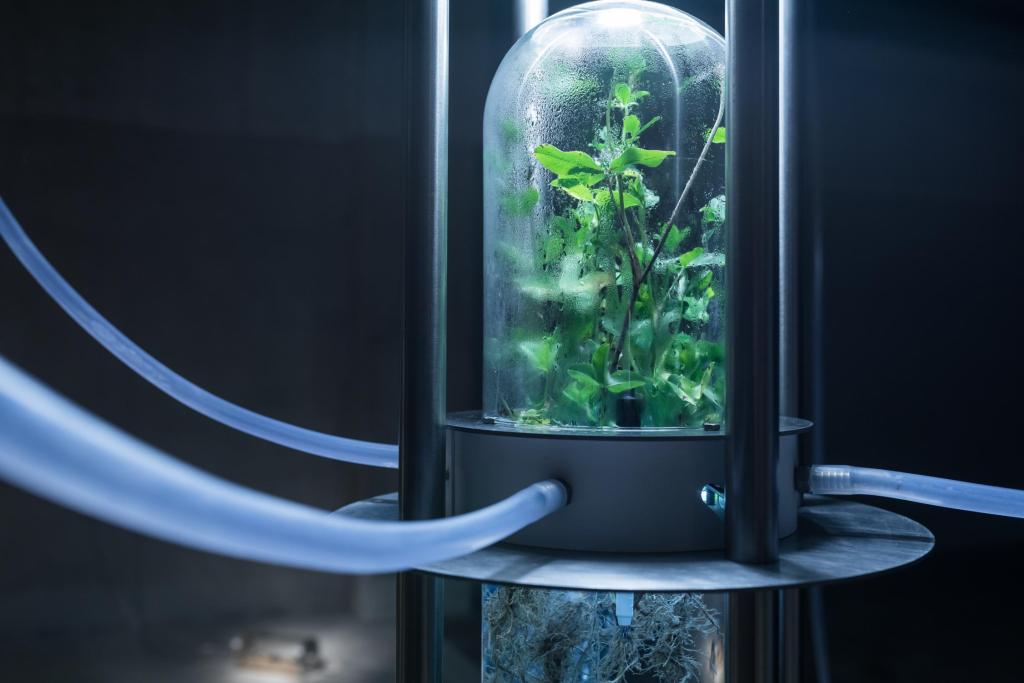
Symbiome by Saša Spačal and Mirjan Švagelj. Photo credit: Miha Godec.
IAB: From Installation to Theatre: A Stage for the More-than-Human – Your work already contains bodies, environments, temporality, sensory dramaturgy, interaction and living processes. Could your biotechnological installations become theatrical situations or could theatre itself become an ecological system? What might contemporary theatre gain by sharing the stage with microorganisms, ecosystems, machines and other non-human agents?
SS: My installations already have theatrical dimensions: spatial composition, duration, atmosphere, encounters and transformations. But they rarely follow a fixed script or preserve a stable division between performer and audience. Their dramaturgy is processual, shaped by interactions that continue to unfold. Of course, processuality, uncertainty, and improvisation are not new to theatre. Many contemporary performance practices already work with the unfinished and the unpredictable. What living systems bring is a particular kind of material and ethical uncertainty. A microorganism cannot be asked to repeat a gesture on cue. A plant grows or responds according to conditions that extend beyond the rehearsal room. A biological process may unfold too slowly to become a theatrical event in any conventional sense. In MycoMythologies: Patterning, for example, the growing mycelium of Hericium erinaceus is exposed to microorganisms from my own microbiome, introduced through my blood, sweat, and tears. A microscope and computer vision system observe the changing fungal landscapes, translating variations in their color and texture into evolving visual maps and sound compositions. The installation has a technological framework, but its dramaturgy emerges from biological processes that cannot be rehearsed or precisely repeated. The fungal colony grows, responds and transforms according to its own conditions, while the technological system follows these changes. Each moment of the installation is therefore a temporary configuration of relationships between organisms, technologies and environments. What unfolds is not a predetermined performance, but an ongoing negotiation between the conditions I have established and the living processes that exceed my control. The interesting question, then, is not how to make life obey theatrical conventions, but how theatrical practices might accommodate different temporalities, dependencies and forms of agency. Such a stage would be less a representation of an ecosystem than a provisional ecology in its own right without pretending that a constructed performance space can reproduce the complexity of the world outside it.
IAB: The Future Stage: Learning to Work with Life – What should a new generation of artists, scenographers and theatre-makers learn before entering into creative relationships with biological systems? And what ethical or methodological shift is required when the artist is no longer simply creating a work, but creating the conditions for a living process to unfold?
SS: I would begin with the capacity to observe before intervening. Working with living systems requires scientific literacy and technical knowledge, but also patience, humility, and practical care. It means learning the conditions in which an organism lives and acknowledging that its needs may interrupt our intentions. I would also encourage young practitioners to question the seductive language of control and collaboration. What do we actually know about the organism with which we are working? What can we responsibly claim about its agency? What happens to it before and after the exhibition? Who maintains the work, and who bears the consequences if the system fails? Creating conditions rather than imposing a predetermined form does not mean abandoning authorship. It means accepting authorship as a responsibility for decisions, relations and consequences, while remaining open to outcomes we did not anticipate. Perhaps the most important skill is learning to be changed by what we encounter.
IAB: The Unanswered Question – Looking ahead, what unanswered scientific, ecological, philosophical or aesthetic question continues to pull you forward? What new forms of life, interaction, performance or media would you like to encounter and what kind of stage might they require?
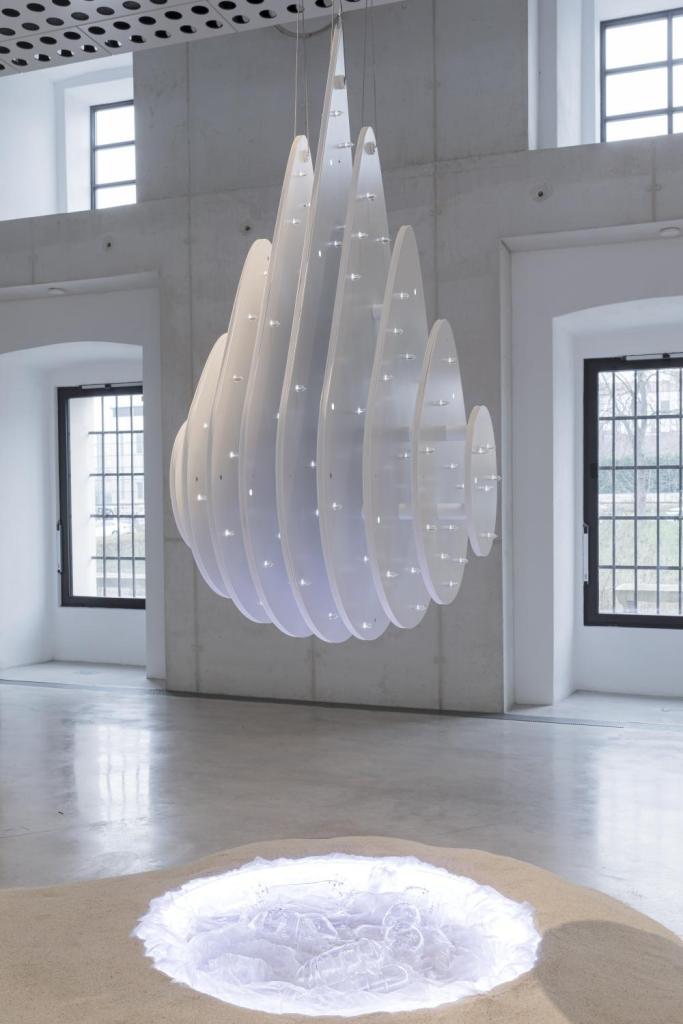
The Library of Fallen Tears by Saša Spačal. Photo credit: Miha Godec.
SS: The question that follows me now is deceptively simple: What might become perceptible if we learned to sense differently? For many years, my work involved constructing technological interfaces that translated processes beyond ordinary human perception. I remain fascinated by those possibilities, and by the knowledge and relationships they generate. But more recently, through forest therapy and practices of deep listening, I have been exploring another direction: what happens when we do not immediately measure, name, represent or interpret what we encounter? Our attention is increasingly organized by screens and systems that direct us towards particular images, sounds and responses. The forest offers a different kind of encounter. It does not demand that we look at one thing, follow a narrative or produce an interpretation. A rustle may draw our attention to a leaf, a bird, a movement in the canopy, or something we cannot identify. Our senses can wander, and our bodies can respond before our minds arrive at an explanation. I do not want to romanticize this experience. A forest is not automatically restorative for everyone, nor is it a neutral space outside politics, labor or ecological disturbance. And forest therapy is not an artwork in disguise. It is a relational practice in which I facilitate human attention while trying to remain attentive to the needs and presence of the more-than-human community. The forest is not there to perform for us, and its value does not depend on what we gain from it. Perhaps this is the continuity I now recognize in my work: I have long been interested in relations that exceed human perception and in the conditions through which we might become sensitive to them. Earlier, I often built interfaces to approach those relations. Now I am also learning to trust slowness, silence and the senses themselves. The question is no longer only what technology might allow us to perceive, but what forms of attention might allow us to relate differently. If there is a stage here, it is not one I have built. It is a living habitat with its own histories, rhythms and inhabitants, in which we have always been participants. Perhaps what needs to change is not the performance, but our way of listening.
IAB: Thank you very much, dear Saša Spačal.
(Ljubljana / Skopje, 2026)
This post was written by the author in their personal capacity.The opinions expressed in this article are the author’s own and do not reflect the view of The Theatre Times, their staff or collaborators.
This post was written by Ivanka Apostolova Baskar.
The views expressed here belong to the author and do not necessarily reflect our views and opinions.