





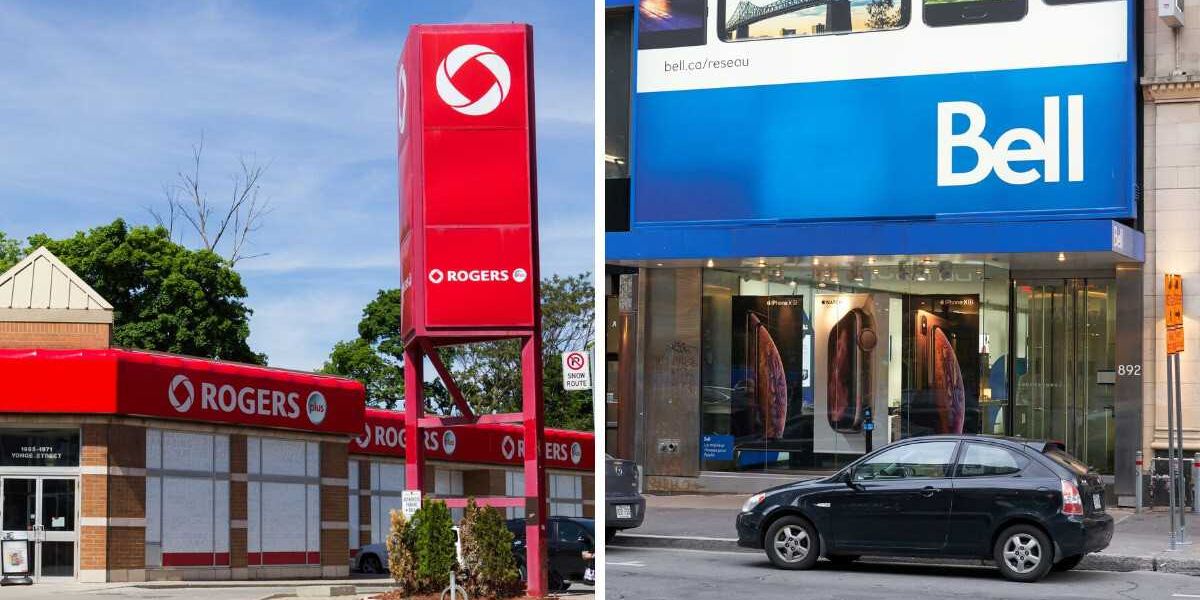
When you’re comparing Canadian cell phone plans from providers like Rogers, Bell and Telus, figuring out which company actually offers the best experience can feel like a guessing game with too many variables.
With so many Canadian cell phone plans and promotions claiming to have “Canada’s largest 5G network” or “the fastest mobile speeds in Canada,” it can be tough to know which phone company is giving you the most value for your money.
To help consumers decide, a new report from global telecoms testing company Umlaut takes a closer look at Canada’s biggest wireless carriers and ranks them based on extensive tests and real-world performance.
If you’re shopping for the best Canadian mobile plans or wondering whether your current provider is keeping up with the competition, the results offer an interesting snapshot of how Canada’s largest mobile providers compare.
According to Umlaut’s 2026 Mobile Benchmark, Rogers earned the highest overall score in Canada, beating both Bell and Telus — though it didn’t win in every category, and some areas were remarkably close.
Here’s how the three Canadian mobile companies compare.
How the providers ranked
According to Umlaut’s results, the overall scores, out of a possible 1,000, were:
- Rogers: 898
- Bell: 865
- Telus: 847
The scoring combined data performance (making up 48% of the total score), voice performance (27%) and crowdsourced network quality measurements (25%).
The data performance category looked at things like web browsing, streaming, downloads and app performance, while voice performance measured call quality and reliability. Both were based on controlled testing conducted by Umlaut using identical devices in specific cities, towns and driving routes across Canada.
The crowdsourced portion, on the other hand, used real-world data collected from users’ devices over several months, helping paint a picture of how each network performs in everyday use across Canada.
Interestingly, Rogers led in both the data and voice categories, while Bell and Telus performed slightly better in some crowdsourced coverage and speed measurements.
What helped Rogers win?
The report found Rogers delivered particularly strong results across data services, including web browsing, file downloads, YouTube streaming and app-based communications in cities, towns and along major roads.
In the reliability category, Rogers also earned the highest score at 548 out of 600, compared with 521 for Bell and 511 for Telus. According to Umlaut, Rogers achieved stronger voice and data reliability results while matching its competitors on consistent user experience.
One area where Rogers really stood out from Bell and Telus was outside of Canada’s biggest cities. While the three providers posted relatively similar data and voice scores in urban areas, Rogers built a larger lead in towns and along major roads, where the gaps were more noticeable.
According to Umlaut, Rogers earned 90% of the maximum data score in towns, compared with 80% for Bell and 78% for Telus. And its voice coverage in towns was even better: Rogers achieved 98% of the maximum score, ahead of Bell at 89% and Telus at 88%.
What it all means for Bell & Telus customers
The results don’t necessarily mean Bell and Telus customers should rush to switch providers.
In fact, Bell and Telus remained relatively close to Rogers in several categories. Bell scored 236 out of 270 in voice services compared with Rogers’ 250, while Telus earned 230.
In data services, Bell scored 403 out of 480, and Telus scored 390, compared with Rogers’ 427.
But what’s really interesting is that the crowdsourced portion of the benchmark actually showed Bell and Telus ahead of Rogers in a few areas.
Bell and Telus each achieved 91% of the maximum broadband coverage score, compared with Rogers at 87%. Rogers also lagged behind slightly in crowdsourced download speeds, reaching a score of 93% compared to Bell’s 97% and Telus’ 96%.
So while Umlaut’s controlled testing suggests Rogers delivers the strongest overall network performance when all three providers are put through the same standardized tests, the crowdsourced results hint that Bell and Telus may have a slight edge when it comes to real-world coverage and what actual customers across the country experience on their own phones.
That means your own experience could still depend heavily on where you live, what kind of device you’re using and how you use your phone day to day.
While Rogers came out on top overall, Bell and Telus remained competitive enough that factors like local coverage, pricing and plan features could still be more important for many Canadians.
How the testing worked
To produce the rankings, Umlaut combined two different types of testing: controlled drive tests conducted by its own team and crowdsourced data collected from real-world network usage. The company tested all three carriers using identical Samsung Galaxy S25 Ultra devices across cities, towns and major roadways between March and May 2026.
The benchmark also incorporated 24 weeks of crowdsourced data to help capture how the networks perform in everyday use. According to Umlaut, the testing covered more than 27,000 kilometres and measured network performance across a large portion of Canada’s population and built-up areas.
It’s worth noting that Canada’s audit report was commissioned by Rogers. However, Umlaut says its benchmarking methodology and scoring system are independently developed and used to evaluate more than 200 mobile networks in over 120 countries.
The bottom line
If you’re choosing between Rogers, Bell and Telus based strictly on mobile network performance, Umlaut’s latest benchmark gives Rogers bragging rights for 2026.
That said, Bell and Telus remained competitive across most categories, and all three providers delivered strong results overall.
For Canadians comparing mobile plans, the findings suggest that while Rogers currently holds the crown, the best choice for you may still come down to coverage in your area, pricing and the features that matter most to your everyday use.
READ NEXT: Rogers vs. Bell vs. Telus: The fastest internet provider in Canada was revealed

![3rd Aug: Live PD Presents: PD Cam (2020), 4 Seasons [TV-14] (7.1/10)](https://occ-0-7324-92.1.nflxso.net/dnm/api/v6/0Qzqdxw-HG1AiOKLWWPsFOUDA2E/AAAABcgygdllige57vdAB81oJcTXagtGBX2AB9vRFb3o5Bz7bLl5HoTApLeG3jbqqN0w9f5WbLlt2D9GYMpRFvOAXbAnHPzZvsBtjkx9Bu9M9m55P_x4MrRf3pENk3MY5cQH3O8sQ2euaOiY3G--4ktWcijRT9bzlRYlZci5vSd9WxYSwg.jpg?r=bcf "3rd Aug: Live PD Presents: PD Cam (2020), 4 Seasons [TV-14] (7.1/10)")