



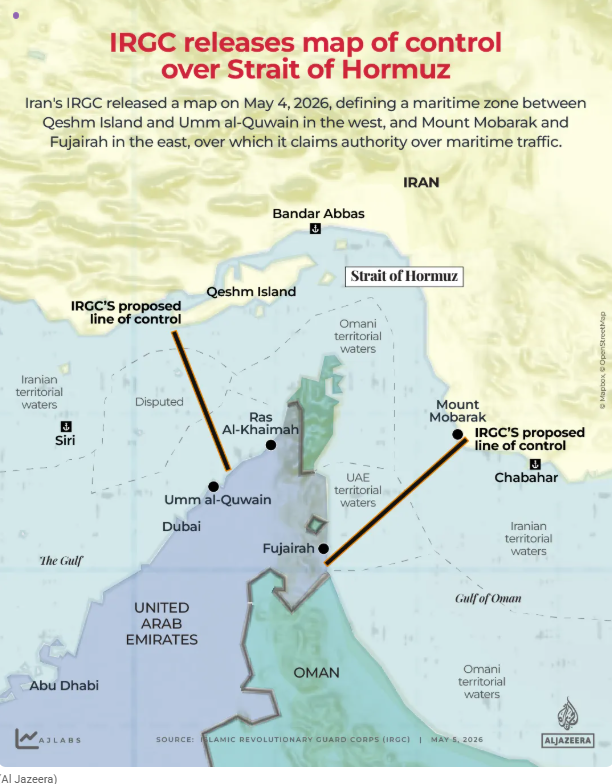
(Al Jazeera Media Network) US Secretary of State Marco Rubio has said Iran will not be permitted to charge tolls or fees for vessels transiting the Strait of Hormuz under any final agreement with Washington, exposing one of the biggest points of friction in negotiations aimed at ending months of conflict across the Middle East.
The dispute comes after Iran announced it would waive planned transit fees through the strait that crosses through its territorial waters for 60 days while talks with the United States continue in Switzerland, suggesting charges could be introduced once the negotiating period expires.
Washington and Tehran signed a preliminary agreement in Switzerland this week to halt hostilities and launched a 60-day diplomatic process focused on sanctions relief, Iran’s nuclear program and the future administration of the Strait of Hormuz.
Pakistan, which helped mediate the talks alongside Qatar, has said negotiations to end the four-month US-Israel war on Iran are expected to resume early next week, likely on Tuesday.
The future of Hormuz has already emerged as a key sticking point after Iran effectively closed the waterway during the war, severely disrupting maritime traffic through one of the world’s most important energy chokepoints and causing the price of oil to soar.
In peacetime, one-fifth of the world’s oil and natural gas supplies are shipped for export by Gulf producers through the waterway.
In April, the US imposed a corresponding naval blockade on Iranian naval ports in a bid to stem Iranian oil exports.
While a number of ships have crossed through the strait since the US-Iran agreement was signed last week, uncertainty remains over whether Tehran intends to impose permanent fees or service charges on shipping operators using the route.
On Friday, Iran’s Persian Gulf Strait Authority (PGSA) said planned fees for ships using the waterway would be suspended during the 60-day negotiation period established under the memorandum of understanding (MoU) signed with the US.
Earlier this week, Iran and Oman said in a joint statement that they would study the future administration of the trade route as well as possible charges for services provided there, while maintaining their sovereignty claims over territorial waters bordering the strait.
Speaking at the start of a regional tour in the United Arab Emirates, Rubio rejected the idea of transit fees. “It’s an international waterway. No country is allowed to charge tolls or fees on an international waterway,” he said, adding that he believed “all the countries in this region would agree”.
Iran’s chief negotiator, Mohammad Bagher Ghalibaf, has signalled that Tehran views the post-war arrangement as fundamentally different from the status quo that existed before the conflict, however. Experts also say that Iran will not give up control of the strait, which has proved to be its greatest point of leverage in the conflict with the US.
“Hormuz will never return” to its prewar status, Ghalibaf said, despite both sides agreeing on Monday to establish “communication mechanisms” aimed at keeping the waterway open.
https://www.aljazeera.com/news/2026/6/24/rubio-says-iran-cannot-charge-tolls-in-hormuz-what-we-know