


![2nd Aug: Mikael: Pemburu Dua Alam (2025), 1hr 59m [TV-MA] (6/10)](https://occ-0-858-92.1.nflxso.net/dnm/api/v6/0Qzqdxw-HG1AiOKLWWPsFOUDA2E/AAAABWem_q-0IECbhfLQlR6wQFIvsQYeZF1f4M3Jtn0kzN6WJwzmxuR1bCe-KJ9IFr5m0xt8NgNzHqzW9K9VXdwadUG5GKFQhcupMbGNo3TtLJweTg0KqCw74ORWkTTY4YExNEIVpiI0frCIP6Y0yhTdlgdubvs_s6DWI-Fs4FbBeBg0Tg.jpg?r=73e "2nd Aug: Mikael: Pemburu Dua Alam (2025), 1hr 59m [TV-MA] (6/10)")



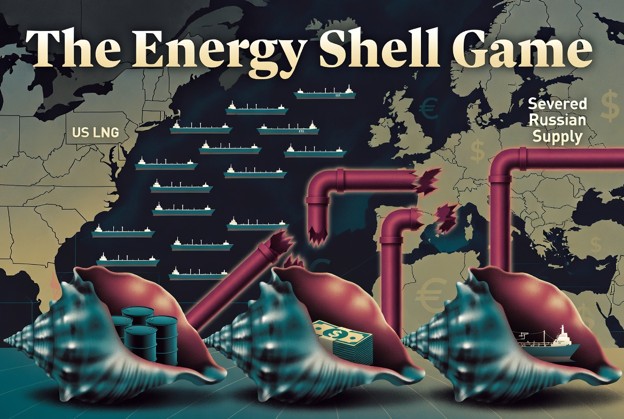
The Iranian flashpoint did more than test missiles and guidance systems. It accelerated a deeper reconfiguration of global energy flows, where liquefied natural gas (LNG) from the United States has quietly displaced Russian pipeline gas in Europe, oil sanctions have reshaped buyer alliances, and control over both hydrocarbons and critical minerals has become the scaffolding for an emerging order.
I suggest this is the largest externality shell game since carbon credits. The public narrative spun up and sold celebrates the expected checkboxes od “energy security” and, strangely, “decarbonization”. The balance sheet, however, reveals a deliberate financial and strategic redesign.
U.S. LNG exports to Europe surged after Russia’s invasion of Ukraine and have remained elevated. By 2026, American cargoes accounted for more than 50% of Europe’s LNG imports in key quarters (tripling since 2021). Filling the void left by curtailed Russian pipeline volumes with the expectation of 2/3 Europe-wide by end of 2026. The economics are straightforward: higher prices for European buyers, record revenue for U.S. producers and exporters, and a structural shift reducing Moscow’s leverage over the continent. Remember the Nord Stream pipeline sabotage? More on that shortly.
Germany and others now pay premium prices for American (not Russian) molecules while simultaneously accelerating their own renewable buildout – a dual track that looks, on paper, like prudent diversification. That German leadership now speaks of economic decline via deliberate deindustrialization largely as a product of its ill-conceived Energiewende (energy transition) coupled to a disastrous nuclear senescence to court green votes and proclaim virtue. Many admire the German post-WW2 industrial ascent, but this historic own-goal is unrivalled.
In practice, it transferred hundreds of billions of euros from European consumers and industry into transatlantic energy infrastructure. Of note in my home country Canada, producers are effectively locked out of this bonanza due to the prior federal regime’s dubious cost calculations declaring that the economics do not work.
Despite the lauded Site C hydro dam expansion, the westernmost and extremely resource-rich Canadian province of British Columbia now imports electricity from the U.S. state of Washington. The economic wisdom is dizzying.
For well over a decade, the Canadian economy has suffered due to the green fantasy of curtailing LNG to hand the market to others less ethical and more opportunistic. The Americans stand to gain more market share and greater leverage over Canadian energy, further eroding Canadian economic wealth. Canadians comfort themselves with Germany having performed even better in that negative metric.
The softening of Russian leverage, however, remains incomplete.
With pipeline flows through Nord Stream evaporated, Russia rerouted crude and refined products to India and China at discounted rates, sustaining revenue streams even under sanctions. The Iranian conflict added another layer: disruptions in the Strait of Hormuz and Red Sea shipping lanes tightened spot markets, rewarding flexible suppliers (the United States and Qatar especially) while punishing those locked into rigid contracts or vulnerable geographies.
As recent BIG Media analysis by Grant Wilde illustrated in the context of broader resource contests, these shifts reward adaptability over legacy infrastructure. This dynamic favours players with export terminals and diversified shipping over those reliant on fixed pipelines that are vulnerable to tactical airborne strikes.
Ruling the high seas was of variable domination by the Netherlands, Spain, and Britain in the ages of exploration and colonization. One star-spangled nation rules the seas now.
Venezuela offers the clearest case of strategic capture. Following political realignments and sanctions relief, Venezuelan heavy crude has re-entered global markets in volumes that help offset tighter Middle Eastern supply. The quiet U.S. influence over these flows is not primarily humanitarian; it is about loosening Chinese and Russian footholds specifically in a country holding vast proven reserves, and the Western Hemisphere more generally. Canada’s oilsands, meanwhile, remain a deliberately contained sleeping giant – vast, politically constrained, and rich in both conventional oil and trace critical minerals recoverable from tailings.
Development lags, but the strategic option value is undeniable in a world in which every additional barrel or kilogram of refined material matters. Fortress North America doctrine trumps all other doctrines. That optionality will be preserved in perpetuity.
This shell game operates on multiple ledgers.
- Europe pays more for energy security while claiming climate leadership.
- The United States exports both LNG and geopolitical influence.
- China secures discounted Russian and Iranian barrels while tightening its grip on the mineral processing that turns those hydrocarbons into military and industrial power.
- Consumers in the West absorb higher costs and efficiency losses; producers in North America capture margins.
- New alliances are tilted toward dollar-denominated trade and allied supply chains.

Critics correctly note that this is not a clean victory.
U.S. LNG carries a higher carbon intensity than Russian pipeline gas on a full life-cycle basis, and the infrastructure buildout locks in fossil dependence for decades. Mr. Wilde’s article flags the risk that short-term security gains can mask long-term transition vulnerabilities if not paired with genuine innovation in alternatives. Yet the counterpoint is equally sharp: in a world of great-power competition, energy that is reliable and under allied control beats energy that is cheap but weaponized.
The Iran conflict reveals these new rules without much effort to peel back the narrative’s wrapper. Kinetic strikes matter, but so do the tankers, terminals, and refining margins that sustain the capacity to keep striking. The energy shell game is not a conspiracy. It is the logical outcome of nations rationally and tactically pursuing advantage in a constrained, contested world. Some have no choice other than to accept the new terms.
The mineral chokehold essay earlier in this series showed who controls the inputs to the machines. This one shows who controls the fuel that moves them.
The coming Essay 6 in this series reveals how the quiet captures in Venezuelan oilsands expose the same pattern of selective belief and narrative filtering seen in the climate series – believing things that are not happening, or refusing to connect things that clearly are.
(Richard LeBlanc – BIG Media Ltd., 2026)