


![12th Jul: Rekonek (2025), 1hr 53m [TV-14] (6/10)](https://occ-0-533-1007.1.nflxso.net/dnm/api/v6/0Qzqdxw-HG1AiOKLWWPsFOUDA2E/AAAABVP-Dz6jj4tkIycMF4Dleq3JZf2B4FEfufboQS9w19C61DI4UA8-uiRfcFrD2sE6JMoCYQ1mTkVS1L9r9Vjp0nagWpAPJ8TbaJyNY4uZMuITwoMUMrvi966pbjKgpcdeHQrTIkdYYQvZYdWSkor2KQf2oZMo_Jcf6dSK-EN1loBEFA.jpg?r=099 "12th Jul: Rekonek (2025), 1hr 53m [TV-14] (6/10)")





The Iranian flashpoint was never only about oil, missiles, and nuclear sites.
It is a live demonstration of a deeper contest: control over the 17 rare-earth and critical minerals that make modern weapons possible. Without them, precision-guided munitions, drone swarms, satellite constellations, fighter-jet radars, and the next generation of autonomous systems simply do not function at the scale necessary to project, demonstrate, and sustain power.
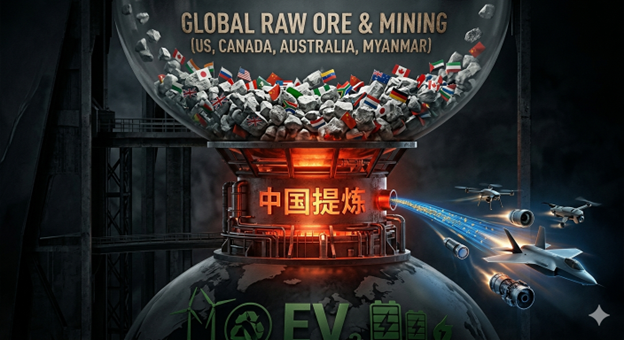
As fellow BIG Media contributor Kaase Gbakon pointed out eloquently (Clean tech’s dirty secret – why rare-earth refining still happens in China), China controls close to 70% of global rare-earth production and 90% of refining capacity. It also has the only real capacity to absorb the world’s increasing production. There is a latent supply-chain vulnerability relying on Myanmar imports. But for the foreseeable future, China holds a global strategic chokehold.
This trend is nothing new – it has been happening for decades with steadily increasing awareness in the West.
It takes a crisis (or at least the impending prospect of a crisis) under conditions of kinetic conflict to sharpen the mind.
The 17 elements – the lanthanides plus scandium and yttrium – are rare in the earth’s crust, in aggregate and in distribution. But they are difficult to extract and environmentally punishing to refine. Kaase provided excellent analysis of fundamental principles here (Rare earth elements explained – why these 17 minerals matter for energy, tech, and security).
China spent decades and billions dominating the refining stage while the rest of the world offshored the dirty work, often to project virtue in sustainability, environment, and climate projections.
To be metaphoric, they were collectively hunting muskrat while China poached wagyu.
Even when other countries mine the raw ore, the material must still pass through Chinese facilities before it can integrate into the magnets, batteries, and alloys that power everything from hypersonic missiles to the guidance systems in F-35s.
German military commander Edwin Rommel (1891-1944) was so successful in North Africa early on that he outran his fuel-supply logistics. The allies eventually figured out that precision bombing of ball-bearing factories and rail lines for them were far more effective than carpet bombing the populace.
Rare earth elements are today’s ball bearings: sophisticated machinery grinds to a halt without them. So does the deep industrial capacity to process them. China quietly calculated and leveraged.
Sun Zhu smiles; this monopoly is concrete.
Every Javelin anti-tank missile, every Tomahawk cruise missile, every Reaper drone, and every high-performance permanent magnet in a directed-energy weapon contains required components whose supply chain ultimately runs through Chinese refineries, and often factories. Neodymium and dysprosium, in particular, are indispensable for the powerful magnets that drive electric motors, wind turbines, and the precision actuators in modern munitions.
These same minerals are the nub of the green-energy transition and high-tech warfare. Two competing imperatives for the same constrained supply. Care to guess which one will be sacrificed?
The Iranian conflict renders the sacrifice visible as the risks of the chokehold increase with every missile, drone, turbine, motor, and other equipment obsolesced, expended, or destroyed.
When Israel and the United States struck Iranian facilities in 2025 and 2026, Tehran’s proxies and state media repeatedly highlighted the vulnerability of western weapons systems to supply disruption. This was not propaganda. The message was clear: strike us directly and risk a cascade of shortages in the very materials that keep your arsenals running. The threat was not idle.
Beijing’s dominance gives it leverage in any prolonged conflict involving the United States or its allies – precisely the kind of hybrid pressure that the broader arms-race dynamic made routine. Recall that Iran advanced the systematic sacrifice of schoolchildren in its war against Iraq in 1980, was repeating the same as late as 2022, and appears to be running the table again.
Goading their opponents into expending rare-earth-necessary arms and equipment is akin to not shooting until you see the whites of their eyes. And best keep your powder dry.
It is not illogical, particularly when you can enlist millions of (often young) humans as collateral.
The same minerals that enable precision warfare underpin the clean technologies that western governments are racing to deploy. That reality is becoming uncomfortable for the virtue seekers who will soon find that free-range paper bags require a robust military.
Canada has long been floated as a potential counterweight with its considerable Albertan oilsands containing trace concentrations of rare-earth-bearing minerals such as monazite, concentrated in froth-treatment tailings during bitumen processing. Some studies have identified elevated levels – up to several hundred parts per million in certain waste streams – raising hopes of co-production alongside massive volumes of oil.
It reminds me of the Shubenacadie River in Nova Scotia with its considerable, but difficult to process titanium deposits. Note: I’m an East Coaster and have ridden the tidal bore on that river. If you haven’t, do it – river surfing is a blast!
Like those titanium deposits, the oilsands potential is real on paper. In practice, it is marginal.
These are not primary deposits; they are byproducts. Extraction remains technically complex, economically marginal, and politically contested.
Speaking of oilsands, is Venezuela more than oil into rare earth elements (including that important neodymium), too? Perhaps President Trump has competent advisers after all, playing the long game.
Canada’s true rare-earth promise lies elsewhere in advanced projects such as Nechalacho in the Northwest Territories or Strange Lake in Quebec. Even those face the same 20-30 year permitting timelines that consigned North American refining capacity near zero. The oilsands, for all their scale, do not change that integral. Mining has two long tails – roughly a generation to bring a mine online and, ideally, two generations or more of productive economics. Iron law, copper law, europium, same same.
Australia offers a more interesting counter-narrative. It is the world’s fourth-largest rare-earth producer and it has moved aggressively to build downstream capacity. The October 2025 U.S.-Australia Framework Agreement committed each country to $1 billion in mining and processing investments over six months, complete with an important, minimum price floor for critical minerals. Companies such as Lynas Rare Earth (importantly the only major non-Chinese processor) have already achieved commercial production of dysprosium oxide outside China, while Iluka Resources and Arafura Rare Earths are scaling refinery projects backed by government capital and invaluable allied off-take deals. These steps constitute genuine progress and are important antidotes to the globalization off-shoring that set up today’s difficult calculus.
For all their importance and promise, they remain modest against China’s scale. Australia’s total processing capacity is measured in thousands of tonnes while China’s is measured in hundreds of thousands. Diversification is happening, but the timeline measures in many years, not a few quarters.
However, the chokehold is not absolute; alternative refining pathways exist, and investments in optionality, perhaps eventually anti-fragility, are being made.
The United States, Australia, and Canada have begun modest investments in domestic capacity. The Pentagon poured hundreds of millions into projects with MP Materials and Lynas. Still, the gap remains considerable. Scaling alternatives will take a decade and many billions of dollars. In the meantime, any major conflict that disrupts Chinese refining or shipping routes would immediately constrain the ability of all parties, including and especially the U.S. to sustain prolonged high-tech warfare.
Ball bearings.
This is the uncomfortable truth exposed by the Iranian flashpoint.
Battles will still be fought with kinetic force at points of contact, but decisive battles will be won or lost in the refining plants, the shipping lanes, and the investment decisions made (and not) decades earlier. History Rise is exceptional in documenting the strangling of the World War II German war machine via supply chains, logistics, even heavy water in the pre-nuclear age.
The 17 elements do not merely enable modern weapons; they define who can afford to keep fighting once the first wave of munitions is expended. Sun Zhu’s Principle II: Doing Battle has much to recommend – and be wary about. Ancient wisdom abounds for modern challenges.
The machines that can dominate tomorrow’s battlefields are already being designed around these minerals and substitutes. The algorithms that choose targets and the satellites that guide them all require the same constrained set of materials. My next essay will examine how those machines, algorithms, and guidance systems are changing the speed, nature and ethics of killing itself.
The mineral chokehold is not coming. It was under the surface of the water, detectable as a small wave approaching with insufficient concern, with kick-the-can irresponsibility for a far-off future.
That future is now; the wave is approaching shore.
(Richard LeBlanc – BIG Media Ltd., 2026)