




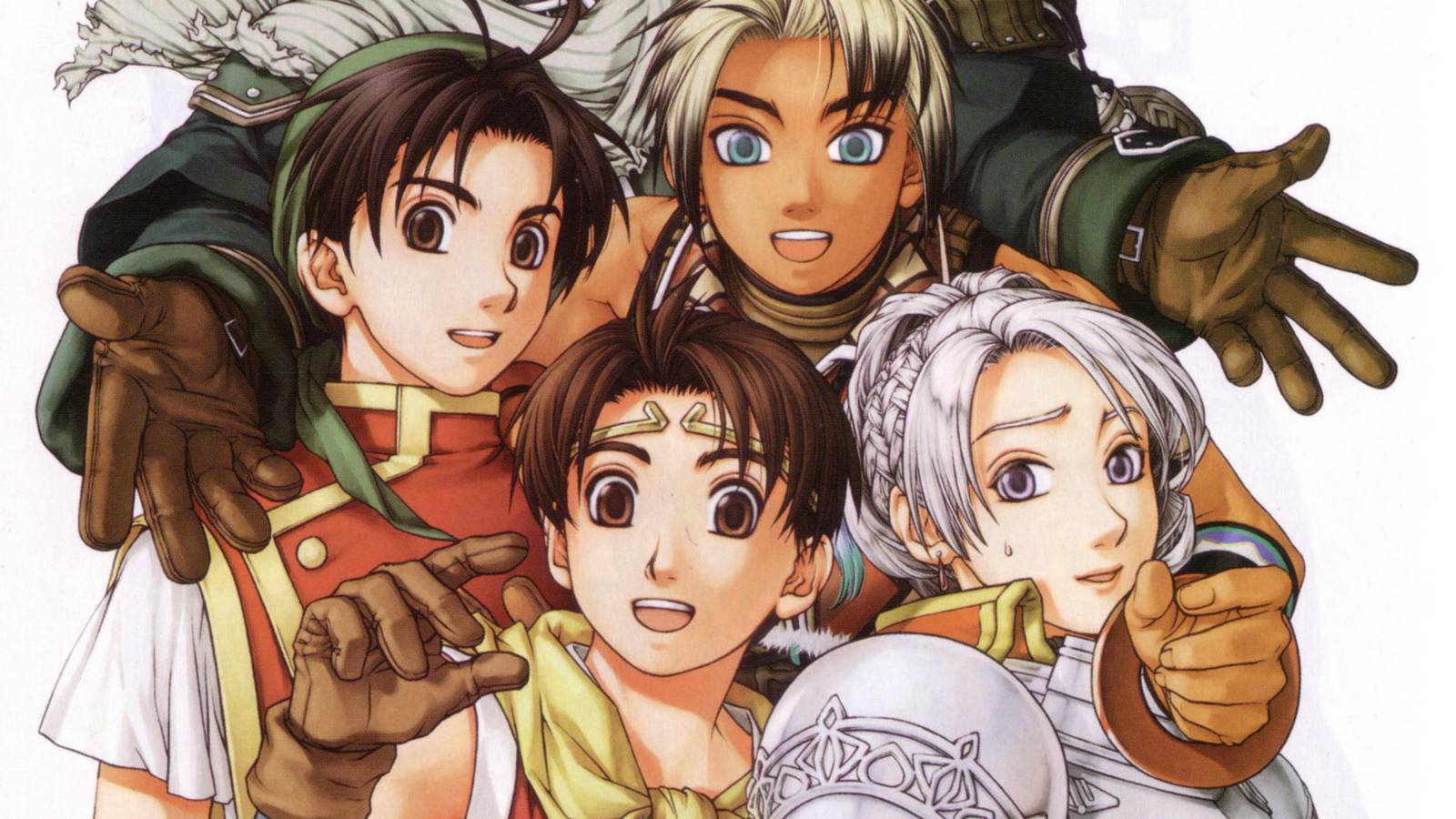
Video games are full of ancient blades with fascinating stories behind them. Usually, we learn about their histories by unearthing a dusty tome or chatting with an elderly sage. But sometimes, these formidable weapons have minds — and voices! — all their own. That’s the case in the Suikoden games, which feature a recurring non-human character in the form of the Celestial Sword. He’s a sassy old fart with a deep-seated hatred for vampires and a low tolerance for plucky young heroes. He’s also a sterling example of why the world needs more talking swords.
The Celestial Sword — also known as the Star Dragon Sword in early translations — first appears in the original Suikoden, which launched for PlayStation 1 in 1996. Midway through the story, your main objective is to defeat the vampire Neclord. (Get it? He’s undead and he also likes necks!) Problem is, he’s immune to physical and magical attacks, which means you fight your way to the end of his sprawling castle, only for him to wipe the floor with your party. Oof.
Accompanied by the mercenary Viktor, the protagonist Tir ventures to the Cave of the Past, which is said to contain the means to defeat Neclord. When the party reaches the heart of the cave, the Celestial Sword appears out of nowhere. There’s a masculine face embedded into the hilt and his eyes gleam red. Without so much as a hello, he says “he who awakens me, be cursed” and sends you 500 years into the past. You return to your own era after a brief lore dump, and everyone’s remarkably nonchalant about the whole time-travel thing.
Upon learning that Viktor’s family and hometown was wiped out by Neclord, the Celestial Sword offers to become Viktor’s “partner.” From this point on, the duo bickers like an old married couple. This character could have been a stock Ye Olde Knight type, who speaks in Shakespearean language, but he’s mostly just a garden-variety coot, perpetually annoyed by the chipper youngsters in his midst. The Celestial Sword spends much of his dialogue ragging on Viktor for being a hotheaded oaf, and you get the impression he’s encountered dozens of similar guys during his unusually long lifetime. This world-weary attitude is a memorable way to puncture some of the RPG tropes that were already verging on cliché by the late ’90s, while still lending an epic feel to the story.
With the Celestial Sword at his side, Viktor’s able to remove Neclord’s immunity, allowing your party to finally unleash the strongest attacks in their arsenal. It makes revisiting the battle — and the lengthy dungeon that precedes it — immensely satisfying. The first time, you were the one getting spanked, but now the tables have turned. Also, there’s pipe-organ music.
Until Suikoden 2, that is. In the acclaimed 1999 sequel, widely held to be the high point of the series, Neclord returns from the dead (long story) and Viktor must defeat him once more. Problem is, since the events of the first game, Viktor ditched the Celestial Sword in a cave because he got sick of its incessant yapping and complaining. New protagonist Riou and Viktor go to retrieve it, and the Celestial Sword challenges the party to a good old-fashioned boss fight. Once that’s done, you head to Neclord’s new HQ to take him down for good. Once again, it is a cool boss fight with weirdo pipe-organ music. The Celestial Sword gets the honor of last zinger before the final blow: “Crumble and die, vampire.”
To be honest, having played through last year’s remasters of Suikoden 1 and 2, the Celestial Sword’s moment-to-moment dialogue isn’t quite as funny or pithy as I like to remember it. He may not, in fact, be as cool as the other swords we honor this Cool Sword Day. But even in a pair of games where you have more than 100 party members, the Celestial Sword does manage to stand out. The sentient weapon with a sour attitude is a clever idea that felt perfectly at home in the ‘90s RPGs I adored as a kid. It’s not his fault he never really got to live up to all that storytelling potential. (How’d he get in there? Can we get him out?) All of this is to say: modern RPGs need more talking swords. And floating continents, while we’re at it.
I talked to a swordmaker about the coolest swords he makes
How Sabersmith’s cutting edge blades are born in rural Michigan

![15th Jul: Stranger Things: VHS Special Edition (2026), 8 Episodes [TV-14] (6/10)](https://occ-0-82-1001.1.nflxso.net/dnm/api/v6/0Qzqdxw-HG1AiOKLWWPsFOUDA2E/AAAABUBdOyuDJ2FKfEtwKXmADSqUCZBt8yJ6SHNXIl-M0O1s-fNYLudWhZOKb9D--5X5uHlYaCQH_ziPnXzqkdiGfFIl2C0NJ-r7-nndgk5fjzpCbzXlClEsiLklt83hfcUy5o4D_XX5-5LdF37Z5dWpbjKe9KNvqdmY_ORqGDzWv22zSg.jpg?r=e0e "15th Jul: Stranger Things: VHS Special Edition (2026), 8 Episodes [TV-14] (6/10)")