



This year’s theatre Biennale (7 to 21 June), with Willem Dafoe at the helm, has the intriguing title, Alter Native. In fact, in the program, the director and his advisory team have included practitioners from Italy and many parts of the world, including Africa, Japan, New Zealand, Indonesia, Greece, and India, who are bent on exploring native rituals and traditions while developing them in often startlingly innovative ways. Dafoe described his intent as follows: “I have sought to invite work from theatre contexts, very different from the commercial and institutional ones in the West. It’s the absence of familiarity that allows us to discover the origins of theatre and re-awaken the essential contact between theatre makers and spectators. For me, the strength and uniqueness of theatre, a total art form, lies in its immediacy, in its ritualistic nature and meeting of human beings.”
Davide Iodice presented Promemoria (Memorandum). This writer and stage director is a founder and artistic director of the Scuola Elementare del Teatro, a popular conservatoire in Naples for the performing arts, aiming at social inclusion. In 2025, his production Pinocchio. Cos’e una persona? (Pinocchio. What is a person?) was so successful that it led to an invitation to lead a year-long workshop at the San Giobbe care home in the heart of Venice. The San Giobbe houses elderly people suffering from dementia and other illnesses.
Memorandum, a site-specific piece, for around thirty audience members, came out of this research. Iodice is no newcomer to setting plays in unconventional places – he has worked in prisons and psychiatric hospitals – but a care home is a new departure.
Davide Iodice’s Promemoria (Memorandum) at Venice Theatre Biennale 2026. Photo credits: Andrea Avezzù. Courtesy La Biennale di Venezia.
The minute our group entered the residential facility, we were greeted by a welcoming young woman in uniform who talked to us about memory, memory loss and how everything in the home is labelled with its name – a door, a table, a chair, etc. Each of us was asked to write our names on a badge, which immediately made me feel that we, too, were included in the labelling process. Everyone, she reminded us, will encounter the end-of-life stage, and, with this sobering thought, what might be termed an immersive theatrical promenade through various activity rooms got underway.
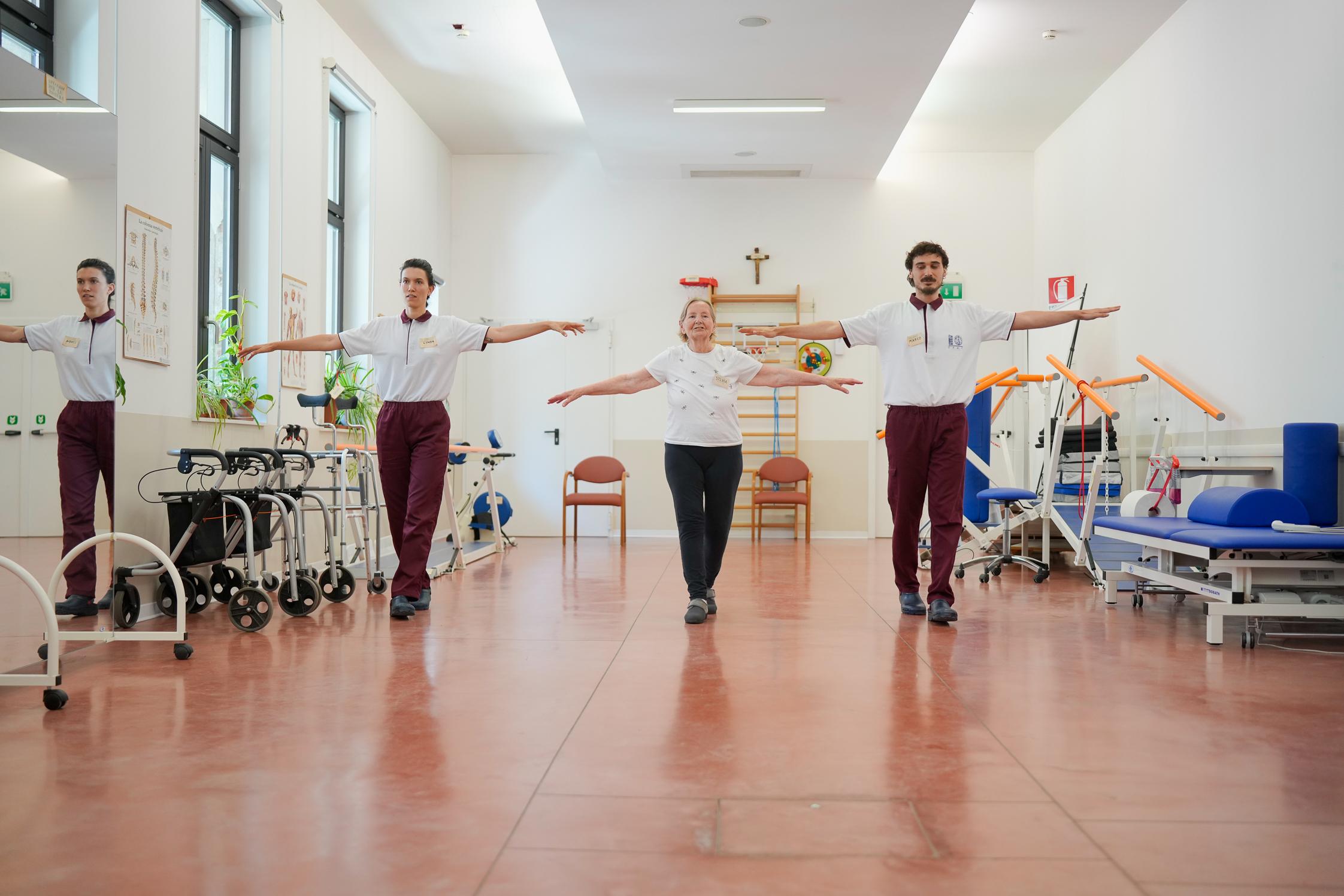
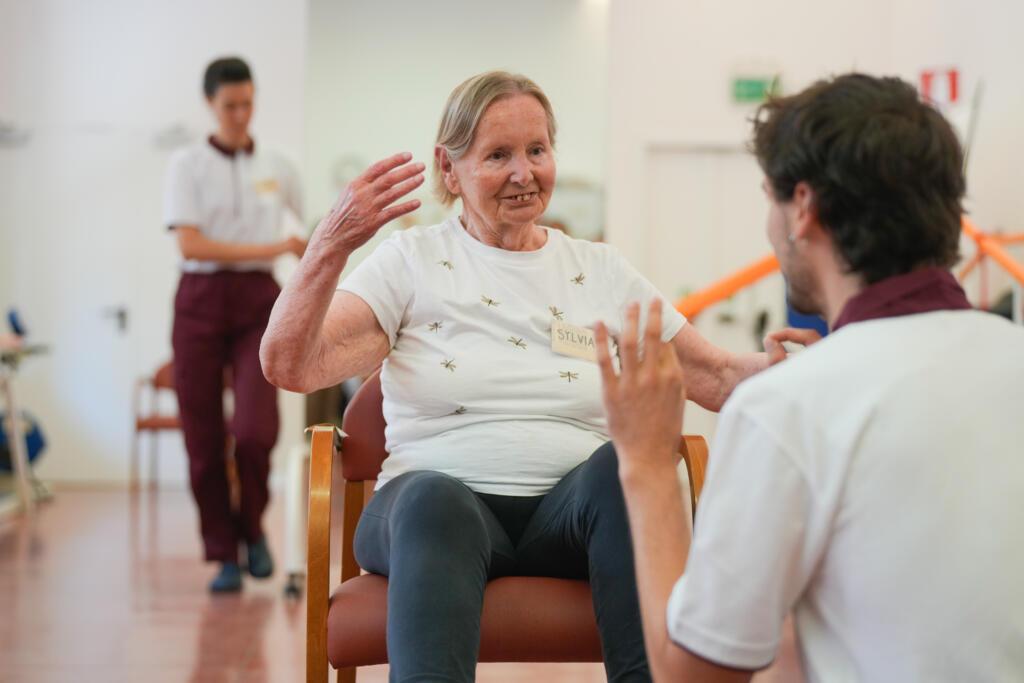
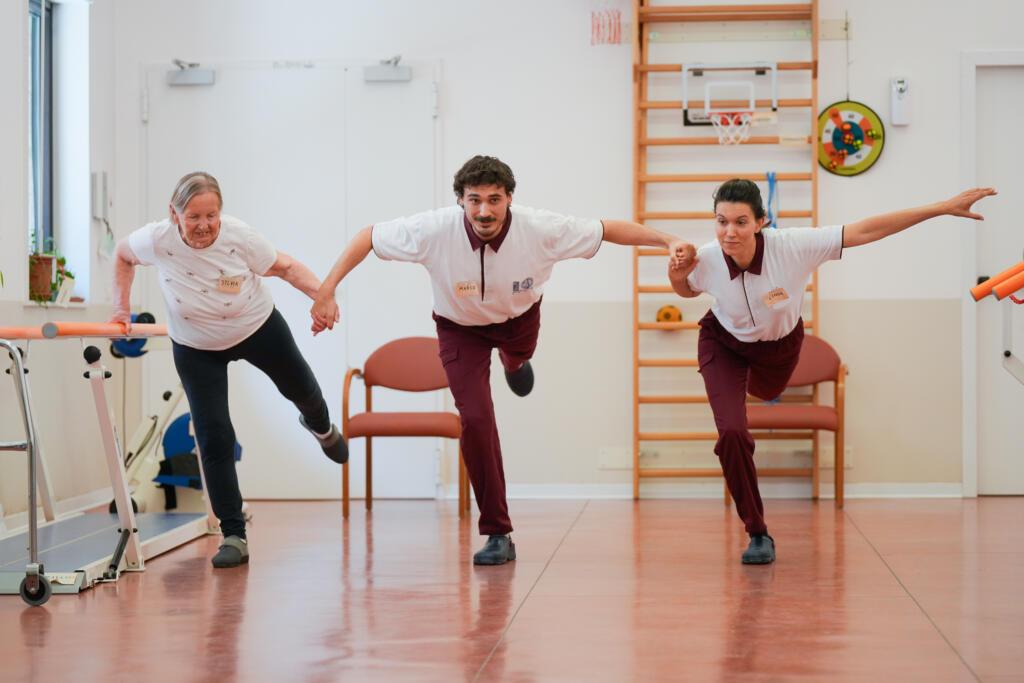
In each room a small group of residents and an actornarrator were waiting to receive us. Our first port of call was the fitness room, where the residents exercise and receive physiotherapy. Here an elderly lady was exercising, after which she danced with one of the actornarrators, prompting some audience members to take to the floor. In this case the woman’s story had been pre-recorded and we listened to details of her life in Switzerland, with her writer husband, before she migrated to Venice. Audience members were not invited to take part, but sometimes spontaneously joined in the dancing, creating a particular kind of immersive theatre.

Davide Iodice’s Promemoria (Memorandum) at Venice Theatre Biennale 2026. Photo credits: Andrea Avezzù. Courtesy La Biennale di Venezia.
Memorandum is made up of many everyday rituals. In a large sitting room, after we had settled down in comfortable chairs, one of the residents served Italian coffee from an elegant China jug. Her story, told with the help of one of the actornarrators, detailed her work as a secretary in an office whose windows looked out over Venice’s magnificent Saint Marco’s square. And she still loved perfume, and expensive ones, she whispered, a mischievous smile, covering her face. Holding out a tray full of perfume bottles, the narrator invited her to choose one, making her face light up as she sprayed herself, sharing the exquisite scent with the people around her. Later, she sat contentedly, her fingers typing rapidly on an old Olivetti typewriter. Such re-enactments of everyday tasks from the past were heightened by the context, since the narratoractors warmly encouraged the residents, and audience members sometimes exchanged a few words, in Venetian, with them, showing their appreciation.
Another resident gave a very down-to-earth account of why she was in the care home. She had made a calculated choice, by selling her house. This had turned out well, since she had made friends immediately. Her concluding remark, “I feel good here and comfortable”, revealed she had made the right choice.

Davide Iodice’s Promemoria (Memorandum) at Venice Theatre Biennale 2026. Photo credits: Andrea Avezzù. Courtesy La Biennale di Venezia.
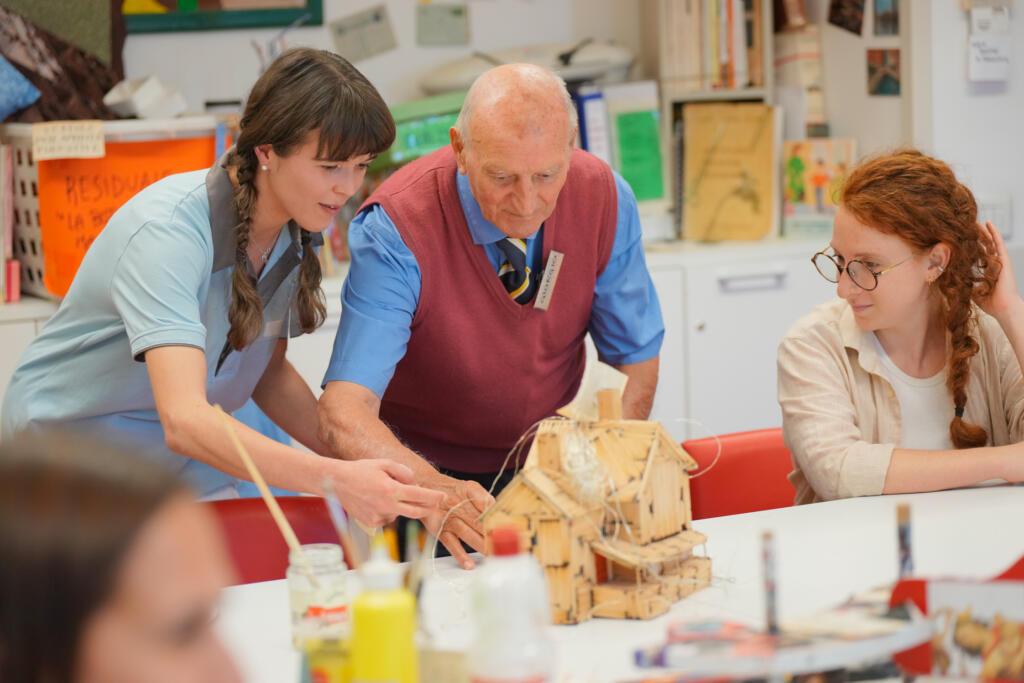
In the light, airy art room, several elderly residents were at work. An elegantly dressed man was busy drawing scenes of Venice from a large picture book. There was a card lying by its side, with the word, ‘amore’ (love) written on it, reflecting the passion for his city which he puts into these drawings every day. The residents came from all walks of life; one had been a gondolier, who related in Venetian how he had fiercely stood up to his bosses for his rights, while another had spent his working life making lamps.
For the final part of our walk, we were shown into a large room with an assortment of chairs and small tables, where some residents were already seated and others filed in slowly, some walking, some in wheelchairs. As one man was telling us about his favorite film, Vittorio De Sica’s Miracle in Milan, the soundtrack started to play. Some residents and audience members were given baby dolls to cradle, a reminder of the abandoned baby discovered in the cabbage patch at the beginning of the film. One of the actornarrators entered the room, wearing large white wings, looking as if he might take to the sky at any moment, like the lead characters in De Sica’s film, who soar high above Milan in the final sequence. Then against a backdrop of bombing and sirens, the residents’ tales of their wartime experiences stood as a reminder that many of them belong to that last generation of Italians who experienced World War Two.

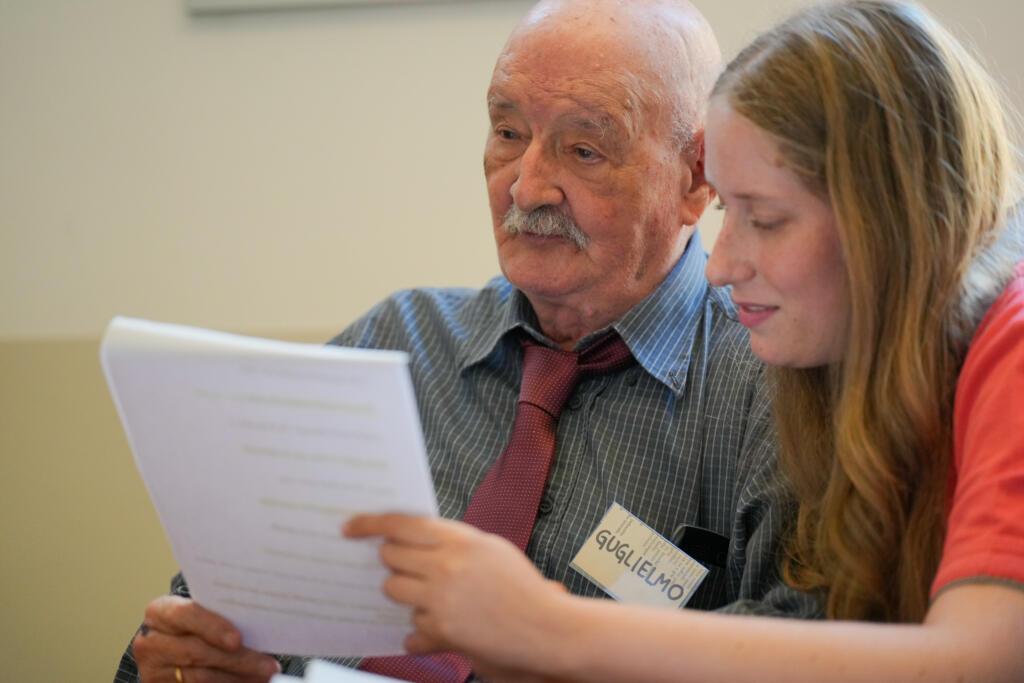
Davide Iodice’s Promemoria (Memorandum) at Venice Theatre Biennale 2026. Photo credits: Andrea Avezzù. Courtesy La Biennale di Venezia.
In the last chapter of these people’s lives, this theatre workshop and performance gave them a voice and a purpose. Davide Iodice, with the support of his talented team of actors, sensitively placed these elderly people at the center of an experience that brought different generations together, and reminded us that nobody should ever be forgotten or excluded. Memorandum is an important theatrical experiment, too, in the context of the Theatre Biennale program which rarely focuses on the city of Venice and its residents.
Look out for Davide Iodice’s next project 7 opere (Seven Works), inspired by Caravaggio’s Seven Works of Mercy. The time there will be seven workshops, with the first public presentation at Modena’s Porta Aperta (Open Door), a refuge for the poor and needy in December.
This post was written by the author in their personal capacity.The opinions expressed in this article are the author’s own and do not reflect the view of The Theatre Times, their staff or collaborators.
This post was written by Margaret Rose.
The views expressed here belong to the author and do not necessarily reflect our views and opinions.