



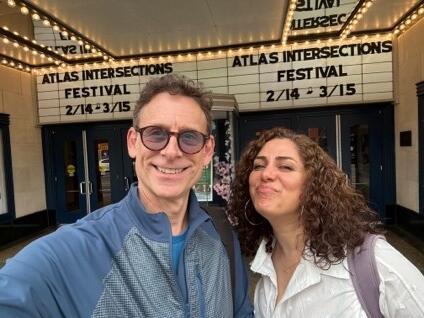
We were wrapping rehearsal for the reading of my play Seeing Maya, a Tel Aviv love story, at the Atlas Intersections Festival in DC, when our lead actor, Lisa Hodsoll, asked a question about one of the very lasts beats in the play. I don’t remember the question, just that director, Raghad Makhlouf, and I, disagreed on the answer. It was going on 5pm; we’d been rehearsing since 8am, and the reading was at 7pm.
Raghad is a Syrian expat who narrowly escaped the murderous Assad regime after protesting its brazen brutality. It was Lisa who introduced us and we clicked right away. To my mind, Israelis have more in common with Arabs—in terms of their warmth, intensity, ominous outlook and the dire hilarity that breeds—than they do with their more comfortably suppressed American Jewish cousins.
I’m not Israeli, but maybe because I was moved there at age 2, Hebrew was my first language, and I also lived there in my early 20’s, I have a line of sight on such things. The play, a comedy-drama, is in part an exploration of the cultural clash between Israelis and American Jews.
But the play is primarily centered on a fifty-something Israeli woman who is awakening to her personhood. This is triggered, but ultimately not reliant on, an affair with an American guy half her age. Hearing Raghad give notes on the maze of emotion and yes, politics, a Middle Eastern woman must walk to follow the dictates of her heart has been one of the great pleasures of this project.
Raghad and I also share a certain sense of alienation from the politics of the region. When the Assad regime abruptly fell in 2024, after 50 years of fearful oppression, Raghad couldn’t sleep with excitement and anxiety. She had never known Syria without the Assad family dominating it. The Syrian expat community was jubilant, believing the new leadership to be their deliverance, but Raghad was more skeptical.
After all, the new leader had been a jihadist with ties to Al-Qaeda. He could just as easily be another tyrant as a liberator. Where was the call for democratic safeguards? Who would check this regime’s power when they needed to be checked? The more blindly excited her people became, the more disaffected she felt.
Her sense of dread at the repetition of Syrian politics felt entirely familiar to me. While living in Tel Aviv, I learned not to follow the news and certainly not to talk about it. Admittedly, this got me in trouble when Iraq attacked Israel with scud missiles in 1991, and I had not sealed off the apartment from potential gas attacks, and a missile hit so close I heard the boom. But for the most part, the approach served. There was always a sense that in the public square, even the good would sour, and the only sweetness of living to be had was within the enclave of the personal.
When Raghad and I talked about it, I encouraged her to protect her heart. We hope for the best in places like Israel and Syria, but the survival anxiety inherent in the region tends to bring out the worst. We may think our current American political predicament is heartbreaking, but over there it’s just another news day over decades of such days. Even from a distance, living that whirlwind feels exhausting and ultimately futile. Whether it’s the Arab spring or the Israeli peace movement, once a vibrant and compelling force, the good seems to end in ashes.
With these countries trapped in cycles triggered by historical forces and driven by elemental fears, conventional political rhetoric, no matter how well intended, no matter how correct, can hardly be expected to make much of a difference. And indeed it does not.
It seems to me this is why stories like Seeing Maya matter. If the norm is tragedy played on repeat, then surely some abnormal or asymmetric perspective is the real hope. Maya at 52 has never had a good relationship with a man. This is her norm, so she’s more or less given up. When she finally connects with someone, he’s half her age, a totally abnormal situation she must open to. In the Middle East, no matter how outraged we might be, war is the norm; to connect beyond conflict, we will need to embrace the strange.
So I feel blessed to have Raghad to help me tell this story. And to have Lisa Hodsoll care so much that she will ask questions about the very last scene even after a long day of rehearsal with the reading still ahead of us. As I said, I don’t remember the questions, just that Raghad said what she felt and I took the freedom to disagree; what’s the point of collaborating if you can’t?
Lisa, a supremely accomplished actor, listened to both of us, and said she had an idea she’d like to try. I don’t know if she read it Raghad’s way, but she did not read it my way. What I do know is that her reading was so compelling, so in touch with Maya, so complimentary and clarifying to that moment in the play, that my heart literally raced with excitement.
This post was written by the author in their personal capacity.The opinions expressed in this article are the author’s own and do not reflect the view of The Theatre Times, their staff or collaborators.