



There are at least two ways for an international arts festival to be provincial. The first is obvious: isolation, lack of money, lack of access, lack of connection to the international artistic circuit. The second is more interesting. It begins when all those problems have apparently been solved. The money is there. The stars arrive. The venues fill. An institution gains access to precisely the people whose presence is supposed to certify its international importance. And yet it continues to behave as if importance were something produced elsewhere and imported for local display.
The second edition of the Baku International Arts Festival, scheduled for October 28 to November 8, 2026, offers an unusually clear example of this paradox. Its published programme comprises eleven core productions alongside a collateral programme and brings together artists and companies including William Kentridge, Romeo Castellucci, Akram Khan, Crystal Pite, William Forsythe, Lev Dodin, Dmitry Krymov, Maxim Vengerov, English National Ballet and Les Ballets de Monte-Carlo.
A necessary distinction should be made at once. This article assesses the programme as published and the festival’s own curatorial self-description. BIAF 2026 has not yet taken place. It would therefore be absurd to review performances that have not happened, or to presume their artistic success or failure. Nor is this an argument against the artists. Kentridge does not require my certification. Castellucci does not become less radical because the curatorial framework surrounding him is unconvincing. Pite, Forsythe, Khan, Dodin and Krymov carry artistic histories far larger than the event that temporarily assembles them. Indeed, the extraordinary reputations gathered here make the curatorial problem more visible, not less. BIAF has demonstrated access. What it has not yet convincingly demonstrated is why access should be confused with vision.
I should also declare something less easily footnoted. I love Baku, and I love Azerbaijan. I do not write this from the pleasurable distance of someone eager to find provincialism in a place conventionally described as peripheral. Quite the opposite. It is precisely because I know how much more complicated, contradictory, culturally dense and intellectually interesting Baku is than the clichés through which international cultural branding so often represents it that this programme feels painful. Criticism, at its best, is not hostility. Sometimes it is the opposite: a form of attention one gives to something one believes capable of being better. In that sense, what follows is intended as a gift. A rather uncomfortable one.
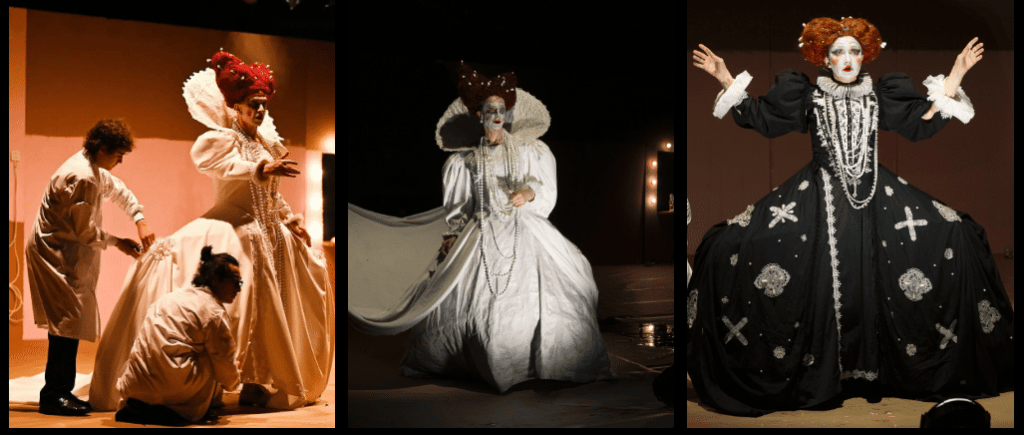
Bloody Mary written and directed by Dmitry Krymov, based on Friedrich Schiller’s “Mary Stuart.” Gesher Theatre, Israel, 2026. Photo: Daniel Kaminsky / Courtesy of Gesher Theatre.
When a second edition declares itself an institution
BIAF’s own editorial text, The Tale Continues, opens with remarkable confidence: “There is a moment in every young festival when it stops being an announcement and becomes an institution. It usually arrives with the second edition.” The first edition, we are told, is a declaration; the second, proof. The text then points to twelve days, eleven core productions and the density of internationally celebrated artists, even observing that few festivals anywhere assemble such a range within a fortnight. It is an audacious claim. But institutions do not become institutions because their press offices announce that the transition has occurred. They become institutions by producing artistic relationships, aesthetic histories, new works, arguments, discoveries, failures, audiences and memories that could not have existed without them.
A second edition may prove that an event can be repeated. That is not yet the same thing as proving that an institution has been born. This distinction matters because throughout the BIAF programme there is a recurring tendency to substitute scale for significance. Its primary unit of meaning is the famous name. Khan. Pite. Forsythe. Kentridge. Castellucci. Dodin. Krymov. Vengerov. Garrett. The names begin performing before the artists do. There is nothing wrong with stars. Salzburg has them. Avignon has them. Edinburgh has them. Holland Festival has them. The question is what a festival does with prestige once it has acquired it. Does it merely display it or does it reorganise it?
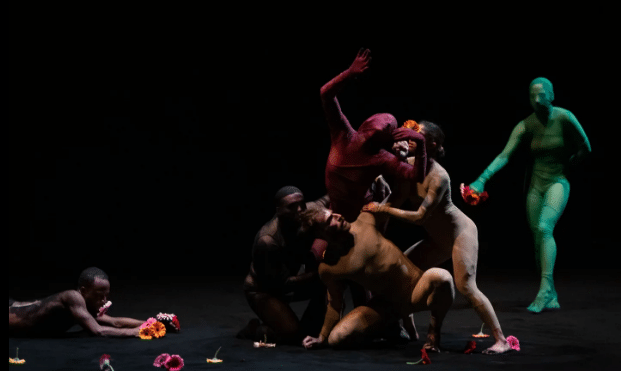
New Earth / Bolero X, choreography by Shahar Binyamini, featuring dancers from the Azerbaijan State Academic Opera and Ballet Theatre and the Baku Choreography Academy. Baku International Arts Festival, Azerbaijan, 2026.
A concept written backwards
BIAF, contrary to first impressions, has a concept. Indeed, it may offer rather too much: “The Tale Continues”; Baku as crossroads; East meets West; tradition encounters innovation; old converses with new; the Silk Roads; cultural memory; artistic dialogue; generations answering one another. The festival’s editorial performs a formidable exercise in connective tissue. Dodin, Krymov and the Rezo Gabriadze Marionette Theatre become three branches of a Russian-Soviet theatrical genealogy. Monte-Carlo is cast as a direct heir to the Diaghilev tradition; Forsythe is traced through Balanchine, and Pite through Forsythe. Ravel’s Boléro introduces Ida Rubinstein. Rimsky-Korsakov brings Diaghilev back again. Kathak evokes Persianate cultural exchange. Mugham becomes another principle of artistic fusion. Even architecture is recruited into the argument. The connections are not necessarily false. The problem is that they are infinitely accommodating.
Give a sufficiently ingenious curator ten canonical works, and it is almost always possible to connect them through memory, migration, inheritance, tradition, modernity, East, West and the inexhaustible magic word “dialogue.” A serious curatorial proposition is valuable partly because it excludes. It makes certain attractive choices impossible. It forces an artistic director to say no to excellent work because that work does not belong to the question the festival has chosen to ask. BIAF’s concept seems to perform the opposite function. Almost anything can enter it.
This is not quite curatorial dramaturgy. It is curatorial retrofitting. If a festival needs an elaborate genealogy to prove why The Seagull, Maillot’s LAC after Swan Lake, Boléro, David Garrett, Akram Khan and Scheherazade inhabit one intellectual universe, perhaps that universe is less organic than its editorial insists. The glue is showing. What emerges is a highly accomplished international touring showcase retrospectively framed as a curatorial festival. The quality of the individual works is not in question; whether their accumulation constitutes an artistic argument is.
“One school, three cities” – and a remarkably narrow map of dramatic theatre
The dramatic-theatre strand makes the problem particularly clear. BIAF itself calls this section “one school, three cities.” Its editorial explicitly links Lev Dodin’s Maly Drama Theatre, Dmitry Krymov’s work with Gesher Theatre and the Rezo Gabriadze Marionette Theatre through the Russian and Soviet theatrical inheritance. It is a plausible line. It is also remarkably narrow for a festival whose rhetoric embraces entire continents. Dodin brings Chekhov. Krymov constructs Bloody Mary from Schiller’s Mary Stuart. The Gabriadze Theatre carries forward the distinctive miniature universe of its late founder. Each may provide an exceptional evening. Together, however, they hardly constitute an adventurous map of contemporary international dramatic theatre.
Why should “world theatre” in Baku be represented so substantially through a cultural genealogy already intensely familiar to post-Soviet audiences? Within the dramatic-theatre strand, where is contemporary Iranian theatre, geographically almost next door? Where is Central Asia beyond the rhetoric of Silk Road connectivity? Where are contemporary theatre-makers from the Arab world? Where is Turkish theatre? Where are the younger artists, documentary forms, collective practices and new dramaturgies capable of disturbing rather than confirming the cultural map already familiar to an educated local audience? BIAF’s editorial describes Baku as an intersection of routes running from Istanbul toward Samarkand and from Moscow toward Tehran and the Gulf. Its rhetoric travels considerably farther than its dramatic-theatre programme. This disparity may provide the clearest definition of the festival’s current provincialism: the geographic imagination is enormous but the canon remains comfortable.
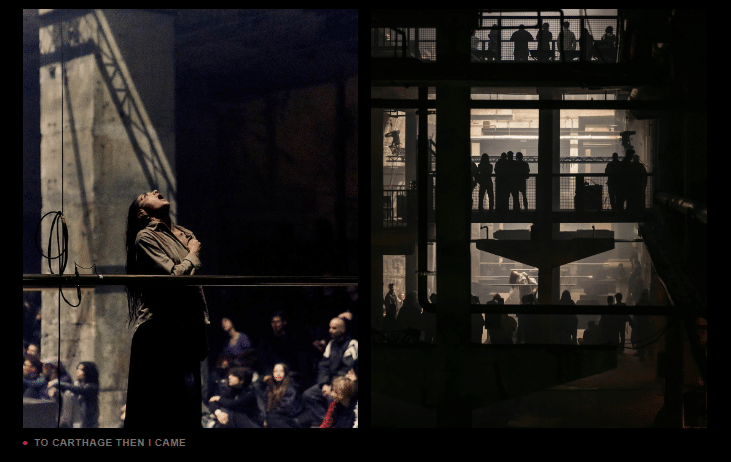
Romeo Castellucci and Scott Gibbons, To Carthage Then I Came. The Baku iteration will be presented at the Museum of Stone Chronicle as part of BIAF’s collateral programme
“East and West”: the concept that refuses to die
More troubling is BIAF’s reliance on one of the most exhausted formulas of international cultural diplomacy: East meets West. Its programme language repeatedly invokes encounters between traditions, forms, generations and artistic worlds. Its historical essay constructs Baku as the place where routes, cultures and empires have always met. But “East and West” sounds meaningful largely because nobody is required to define it. What precisely is “the East” here? Azerbaijan? India? Saudi Arabia? Persia? The Caucasus? The Soviet cultural sphere? Rimsky-Korsakov’s imaginary Orient? And where, exactly, does “the West” begin? The binary reduces extraordinarily complicated histories into two decorative halves of a conference logo.
For Baku – a city whose actual history makes this opposition particularly inadequate – that language feels not merely banal but intellectually evasive. The same problem affects the Silk Road rhetoric. BIAF’s editorial works hard to establish Baku as a historical meeting point of caravans, empires, religions, oil wealth, artistic travellers and present-day transport corridors. The history matters. Its use here often feels promotional. The city seems required to prove that it has always been cosmopolitan enough to deserve an international festival. But Baku does not need such certification. Its history is richer, stranger and more contradictory than the bland cosmopolitan adjective can contain. A culturally confident institution would reverse the equation. It would not need history to certify the city’s contemporary international relevance. It would produce work in the present that made the relevance undeniable.
When “deepest local investment” becomes revealing
The essential question for any festival with BIAF’s ambitions is not simply who arrives in Baku. It is what exists because they arrived. Here one phrase in the festival’s own editorial is especially revealing. Shahar Binyamini’s New Earth / Bolero X, involving dancers from the Azerbaijan State Academic Opera and Ballet Theatre and Baku Choreography Academy, is described as the edition’s “deepest local investment.” Binyamini brings his company, works with local dancers and integrates them into the ensemble rather than placing them alongside it. This is genuinely promising. It moves beyond the sealed touring package and places Azerbaijani performers inside an artistic process. But the superlative is almost accidentally devastating. If this is the deepest local investment, what does that say about the depth of the rest?
In the published core performing-arts programme, BIAF does not identify a major new theatre or dance work commissioned by the festival and led by an Azerbaijani artist. Where is the BIAF commission for an Azerbaijani director? Where is the new play developed for an international audience? Where is the younger Azerbaijani composer commissioned to make a major work for this edition? Where is a residency culminating in an object that belongs neither to an imported company nor to an existing repertory institution, but to BIAF itself? Where is the work that could not have existed without the festival? This should not be confused with saying that Azerbaijan is absent. It emphatically is not.
There are Azerbaijani orchestras and musicians, local dancers, Baku Art Weekend, Azerbaijani musical histories and artists in the wider programme. The Shostakovich strand is deeply connected to Gara Garayev, Elmira Nazirova and Baku’s musical institutions. But participation and authorship are not identical. Too often Azerbaijan appears as host, setting, orchestra, collaborator, historical context or source of heritage rather than as the primary author of the artistic proposition. A cultural crossroads should not merely be the place through which prestigious traffic passes.
The BIAF that might become genuinely interesting
Paradoxically, some of the programme’s strongest ideas occur precisely when BIAF begins to leave the conventional touring model behind. Binyamini’s collaboration with Baku dancers is one. Castellucci and Scott Gibbons’s To Carthage Then I Came, placed inside the Museum of Stone Chronicle and involving local participants in each city it visits, is another. BIAF itself emphasises that the Baku iteration cannot simply be identical to Brussels or Berlin. Sharon Eyal’s Work in Progress is potentially a more interesting festival gesture than another polished touring product because it exposes process rather than merely completion. Kentridge’s Oh To Believe in Another World, presented with Shostakovich’s Tenth Symphony and embedded in the specific Baku history of Elmira Nazirova, comes closer still to genuine contextualisation. These projects suggest another possible BIAF. Curiously, many of the qualities most associated with an actual festival – process, experiment, local participation, conversation, visual art, artist talks, workshops, urban interaction – emerge most strongly in or around what is called the collateral programme.
Hosting is not producing
A comparison with established festivals must be made carefully. BIAF is in its second year. It would be absurd to demand that it instantly possess the infrastructure accumulated by institutions over many decades. Yet BIAF itself invites such comparison. Its editorial invokes Salzburg, Aix-en-Provence and Ruhrtriennale as examples of the multigenre festival form and simultaneously announces that its second edition represents a transition toward institutional maturity. So what does a mature festival institution actually do?
Holland Festival’s completed 2026 edition included fourteen co-productions, two Holland Festival productions and four world premieres; twenty-seven artists made their festival debuts.
Ruhrtriennale’s 2026 edition comprised thirty productions and projects, fourteen of them in-house productions, co-productions or commissioned works. These numbers should not be turned into a crude league table. Their importance is structural. Mature festival institutions do not merely receive the international performing-arts system. They intervene in it. They commission. They co-produce. They put artists into new relationships. They give artists time. They accept the possibility of failure. They take responsibility for work before the market has certified it. They create things that subsequently travel elsewhere.

English National Ballet in Crystal Pite’s Body and Soul (Part 1), part of Masters in Motion: Forsythe / Pite at BIAF 2026. Photography by ASH
Prestige, canon and the absence of risk
The provincialism at issue is institutional, not geographical: significance is imagined as something produced elsewhere and imported to Baku already certified. BIAF can therefore resemble a luxury department store – the labels are genuine, the merchandise impeccable, but the store did not design the clothes.
The same logic governs the repertoire. Chekhov, Schiller, Maillot’s LAC after Swan Lake, Boléro, Shostakovich, Rimsky-Korsakov, Diaghilev and the Ballets Russes form an exceptionally consecrated cultural field. Modernity too often appears as the elegant redesign of an established canon rather than the discovery of something new. Even returning partners such as Gesher Theatre and Sharon Eyal will become meaningful institutional relationships only if repetition leads to commissions, residencies or genuinely new work rather than a reliable supply of prestigious content.
David Garrett exposes the marketing logic most clearly. BIAF itself presents him as a wider door into the festival, capable of attracting audiences who might later discover Dodin, Castellucci or Kentridge. Sensible audience development, certainly. But an audience-acquisition funnel is not a dramaturgy. The VIP ecosystem – premium tickets, hotels, restaurants, excursions and concierge services – further blurs the line between arts festival and luxury cultural destination. The details do not always support the grandeur. At the time of writing, BIAF’s own website places the description of the Azerbaijan State Academic Drama Theatre under the heading Muslim Magomayev State Philharmonic Hall, even retaining the reference to “Azdarma.” A small mistake, perhaps, but an eloquent one: international authority is built not only through famous guests, but through editing, research and institutional discipline.
The musical strand shows what BIAF could become. Shostakovich’s relationship with Baku, Gara Garayev, Elmira Nazirova, Fikrat Amirov and local musical institutions create something more persuasive than “East meets West”: specificity. This is what the festival needs elsewhere – not generic “dialogue,” but actual artistic tensions; not Baku as a rhetorical crossroads, but work that could exist only because these artists met in this city.
BIAF has proved that it can assemble a prestigious international programme. It has not yet proved that prestige, access and logistics amount to curatorship. The festival risks mistaking famous artists for a strong selection, multiple genres for dramaturgy, hospitality for internationalism, cultural import for cultural production, and an impressive roster for institutional identity. The harder question remains: What can happen in Baku, because BIAF exists, that cannot happen anywhere else?
A city one loves deserves more than polite applause.
This post was written by the author in their personal capacity.The opinions expressed in this article are the author’s own and do not reflect the view of The Theatre Times, their staff or collaborators.
This post was written by Emiliia Dementsova.
The views expressed here belong to the author and do not necessarily reflect our views and opinions.