



An Interview with Ms. Saša Spačal (Ljubljana, Slovenia), a beautiful, wise and deeply inspiring visual artist and healer, dramaturgically exploring the living entanglements of Eco-Bio-Micro-Nature and Art.
Saša Spačal is a Slovenian postmedia artist whose practice operates at the intersection of contemporary art, biotechnology, ecology, and posthuman thought. Through experimental installations, sound art, and living-system interfaces, she explores the entanglements of human and non-human life, planetary metabolisms, and the complex relationships between organic, mineral, mechanical, and digital worlds. Her internationally exhibited work has been presented at Ars Electronica, ZKM Karlsruhe, Transmediale, CCCB Barcelona, and other leading contemporary art institutions. Her distinctions include an Ars Electronica Honorary Mention and recognition from the Japan Media Arts Festival. More information here.
Ivanka Apostolova Baskar: Living Systems as Performers – Your practice places living systems at the center of contemporary art. When you begin a project, how do you recognize the agency of non-human actors? Can fungi, microbiomes, soil or other living systems be understood not simply as materials, but as performers with their own temporality, presence and agency and how does this transform your role as an artist, director or scenographer?
Saša Spačal: I have never been entirely comfortable thinking of fungi, microorganisms or soil as materials available for an artist to shape. Living systems have their own metabolisms, rhythms, needs and relations, which do not necessarily coincide with an exhibition schedule or an artistic intention. Their agency does not begin when they enter an artwork. It precedes us, and it continues beyond our attention. I can design an interface, arrange environmental conditions or propose an encounter, but I cannot determine everything that unfolds. In this sense, working with life has always involved negotiating the limits of authorship. I would also be cautious about calling organisms performers, if that suggests they perform for us. They are engaged in continuous processes of sensing, exchanging, adapting, growing and decomposing, regardless of whether we are there to witness them. My installations have often made selected aspects of these processes perceptible through technological mediation. Yet the interface never grants agency to an organism; at most, it helps us become aware of relations that already exist. This distinction has become increasingly important to me. In my more recent forest therapy practice, I am exploring the inverse gesture: rather than bringing living processes into an exhibition space and translating them, I enter an environment already constituted by innumerable relations. My task is not to turn the forest into a stage, but to help create the conditions for attention. Perhaps the question has shifted from how life might perform in an artwork to how we might recognize our participation in the ongoing processes of life.

Myconnect by Saša Spačal, Mirjan Švagelj, and Anil Podgornik. Photo credit: Damjan Švarc.
IAB: Beyond the Human: Who Is on Stage? – Your work is deeply informed by posthuman thinking, in which humans are only one element within a larger ecosystem. How does this shift affect the way you construct an artistic space? Could we imagine your installations as stages in which humans are no longer the central protagonists, but participants within a larger ecological performance?
SS: I am less interested in replacing the human protagonist with a fungal or microbial one than in questioning the need for a protagonist at all. Ecological relations are not organized around a single center. They arise through dependencies, exchanges, tensions and processes that exceed any individual organism. In Myconnect, the participant is connected to a fungal mycelium through a technological biofeedback system. Their heartbeat enters a circuit of signals and responses, and the encounter returns to them as a bodily and sensory experience. The point is not to demonstrate that a fungus and a human communicate in a transparent, mutually intelligible language. Rather, the interface makes the participant experience a relationship whose other participant remains fundamentally different and partly inaccessible. In Symbiome – Economy of Symbiosis, a hydroponic plant environment is connected to sensors and changing atmospheric conditions. Visitors’ exhaled carbon dioxide becomes one of the variables affecting the installation, while parameters such as pH and light are monitored and translated through its technical system. Breathing, usually experienced as an intimate and almost unconscious act, enters a larger metabolic economy. These works do not simply invite a spectator to activate an effect. They position the human body within a system it can influence but never completely command. This is also a spatial question. I think of the installation less as a scene designed for an ideal observer than as a temporary ecology, composed of bodies, technologies, organisms and processes operating on different scales. Some relations become sensible; others remain inaccessible. The artwork should not promise total transparency. It can instead make us feel the partiality of our knowledge and the fact that participation does not mean control.

MycoMythologies Patterning Saša Spačal Photo by Marta Vos
IAB: Can We Collaborate with Life? – In projects such as MycoMythologies, fungi, microbiomes and soil ecologies become active participants. How do you negotiate care, consent and ethics with living collaborators? And what happens to the conventional hierarchy between artist, performer, material and audience when the “performer” is a living organism?
SS: The language of collaboration needs careful handling. Collaboration between people may involve an agreement; I cannot meaningfully ask a fungus to consent to an exhibition. Claiming that it has agreed would obscure the asymmetry rather than resolve it. That does not make ethics irrelevant. On the contrary, it makes responsibility more demanding. Care becomes practical: attending to cultivation conditions, nutrients, humidity, transport, maintenance, contamination and the consequences of an exhibition ending. Living organisms interrupt our production schedules. Their responses may require us to change the work. We cannot call them agents while treating every deviation from our plans as a technical failure. In MycoMythologies, I approached fungi and their relationships with other organisms not as a ready-made metaphor for harmony, but as a way of questioning the stories humans tell about autonomous selves and clearly bounded species. In projects concerned with microbiomes and contamination, I have also been interested in how porous the idea of an autonomous individual becomes. Our bodies are inhabited and shaped by microbial relations; boundaries are negotiated rather than absolute. But I do not want this insight to become an easy celebration of interconnectedness. Relationships can also be exploitative, unequal or destructive. The fact that we are entangled does not absolve us of responsibility for how we act within those entanglements. I increasingly prefer to ask what reciprocity and response-ability might mean in practice: what are we asking of another living system, what are the costs of that encounter, and what are we prepared to change in response? These questions now accompany me into the forest, where care also means acknowledging that a place and its inhabitants have needs that are not reducible to human wellbeing.
IAB: Translating the Invisible: From Biological Process to Sound, Light and Performance –
In works such as Myconnect, microbial processes are translated into sound, light and sensory experience. How do you transform invisible biological activity into a perceptible event without reducing its complexity? Could this process be understood as a form of dramaturgy where biological activity itself generates the rhythm, atmosphere and unfolding of the work?
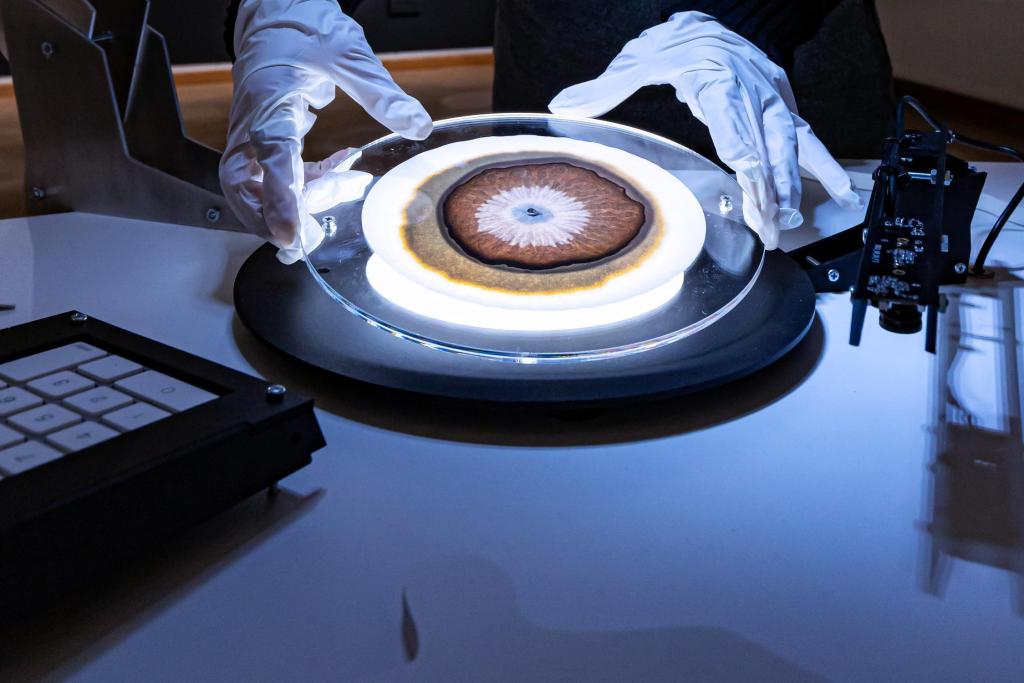
Terra Xenobiotica by Saša Spačal. Photo credit: Tim Deussen.
SS: In Myconnect, the participant’s heartbeat enters a biofeedback loop with fungal mycelium. Biological signals are mediated through a technological interface and returned to the participant as sensory feedback, creating an embodied experience of connection. Yet the mycelium’s own life, its complex networks of relations and metabolic processes, remains largely beyond human perception. I am interested in precisely this tension between what we can experience and what continues to escape us. Terra Xenobiotica approaches translation from a different perspective. For this project, I assembled an archive of 86 soil chromatograms, intricate images produced through chemical processes that reveal traces of particular soil conditions and their material histories, including contamination by persistent pollutants such as PFAS. In collaboration with sound artist Dmitry Morozov also known as ::vtol::, we employed computational methods and machine learning to interpret and sonify patterns within this visual archive. The resulting compositions are not the literal voices of soil, but constructed encounters with its complex and often invisible histories. The accompanying film Holding Patterns, developed with Alison Sperling, Assistant Professor of Literature, Media, and Culture at Florida State University, extends this inquiry into the enduring consequences of human activity, exploring how soils absorb, retain and transform the chemical legacies of industrial civilization. Both projects raise questions about what translation can make perceptible and what inevitably remains beyond its reach. I understand this process as a form of dramaturgy, although one that is never entirely predetermined. I establish the conditions and design the systems of translation, while living processes introduce their own rhythms, variations, temporalities and forms of resistance. Importantly, I would never equate a translated signal with an organism’s voice. The distance between biological activity, technological interpretation and sensory experience is not a limitation to be concealed, but an essential part of the work’s meaning. After years of extending human perception through technological systems, I have become increasingly interested in another question: when is mediation necessary, and when might it stand between us and what we are trying to encounter? Some relationships remain inaccessible to our senses without instruments, while others escape our attention simply because we have forgotten how to notice them. Through my more recent engagement with forest therapy, I am exploring what happens when attention itself becomes the means of encountering the living world. This is not a rejection of technology, but an expansion of my inquiry into perception: from developing instruments that allow us to sense differently to cultivating our own capacity to perceive what has been present all along.
IAB: When Biology Becomes Scenography – Your practice transforms biological processes into artistic environments. Where do you see the boundary between representing life and working with life as a medium? Can a living system itself become scenography not merely something placed within an environment, but an active force that continuously produces and transforms the space?
SS: For me, the distinction lies in whether life is used to represent an idea or whether its processes are allowed to materially affect what the work becomes. When working with fungi, microorganisms, plants or soil, I am not interested in using them merely as symbols of nature. Their metabolism, growth, decay, exchange and responses become part of the conditions through which the work unfolds. In MycoMythologies series: Radiotrophic Fungarium or How to Make a Coat for Marie Curie, developed with artist Kaitlin Bryson, we explored the remarkable capacities of melanized fungi that can survive in highly radioactive environments, including those found in the ruins of the Chernobyl nuclear reactor. The installation brought together living fungal cultures growing on concrete panels with histories of radioactive exposure, nuclear colonialism and human resilience. As the fungi colonized the surfaces, they gradually transformed the material environment of the exhibition according to their own biological rhythms. At the same time, we imagined speculative futures in which fungal organisms might become protective architectures, growing into garments, shelters or shields against radiation. The work thus moved between actual biological growth and speculative possibilities of interspecies care, asking whether organisms that survive environments made hostile by human technologies might help us rethink protection, vulnerability and coexistence. In this sense, a living system can become scenography, although I would understand scenography not as a designed background but as an ecology that continuously produces space. Living systems alter their surroundings: they consume and release substances, change color, grow, contaminate, decompose and form relationships. Space is therefore never finished; it is continuously negotiated and transformed by its inhabitants. My role is to establish some of the initial conditions, but not to determine the final form. This introduces a different temporality into artistic production. An exhibition may have an opening and closing date, but living processes follow other rhythms. The scenography can grow, decline or transform regardless of the institutional schedule. Perhaps this is where biology most radically changes scenography: the environment stops being a container for a performance and becomes one of its active processes. And ultimately, this is not so different from how ecological space exists outside art. A forest, too, is continually being made by everything living, dying and relating within it.
To read PART II of this interview, go to this link.
This post was written by the author in their personal capacity.The opinions expressed in this article are the author’s own and do not reflect the view of The Theatre Times, their staff or collaborators.
This post was written by Ivanka Apostolova Baskar.
The views expressed here belong to the author and do not necessarily reflect our views and opinions.