



The social, political, environmental, and economic changes of the twentieth century have generated challenging discussions across social sciences and the humanities. By focusing on earlier studies of the modern period and the new dynamics of the present, many disciplines have been reconceptualized in sociology, history, philosophy, and related cultural studies. Art and literature—and particularly drama and theatre, have also responded to these changes through new forms and practices.
The changing notion of dramatic theatre into postdramatic theatre parallels the changing notion of modernism into postmodernism. The historical dominance of drama, together with World War II, the Holocaust, and the atomic bomb in Hiroshima, contributed to a transformation in theatrical form. Experiences of meaninglessness, alienation, identity crisis, violence, suffering, and trauma shaped the atmosphere of the period and its theatre. Within this context, the prefix “post” does not simply announce the disappearance of earlier forms. It marks a complicated relation between continuity and rejection.
From Modernism to Postmodernism
Postmodernism has never had a definite or universally accepted meaning. Scholars have therefore examined the social and historical conditions in which the term emerged. Fredric Jameson (1984) describes postmodernism as the cultural logic of late capitalism and treats it as a periodizing concept that connects new cultural forms with a new social and economic order. The rapid development of technology and new lifestyles under late capitalism inevitably influenced Western culture and art. For Jameson, postmodernism is closely connected with consumer society, media, spectacle, and the erosion of the distinction between high culture and popular culture. Describing postmodern cultural forms, he calls this change “the effacement in them of the older (essentially high-modernist) frontier between high culture and so-called mass or commercial culture” (Jameson, 1984, p. 54).
Linda Hutcheon (2006) also connects postmodernism with the aesthetic sphere, while distinguishing it from the broader social and political dimensions of postmodernity. Yet she identifies continuity as well as difference between modernism and postmodernism. For Hutcheon, the relation involves “critical rethinking, leading either to a continuation and often intensification” (p. 118) or a rejection of earlier forms. The continuities can include irony, parody, and self-reflexivity; the rejected elements include ahistorical thinking and barriers against popular culture. Postmodern critique is therefore not based on a simple break from the past; its relationship with earlier forms is more complicit and ambiguous.
What Does “Postdramatic” Mean?
Hans-Thies Lehmann’s concept of postdramatic theatre raises a similar problem concerning the prefix “post.” As Karen Jürs-Munby (2006) explains in her introduction to Postdramatic Theatre, “post” is neither a purely chronological category nor a forgetting of the dramatic past; it marks a rupture that continues to maintain a relationship with drama (p. 2). Lehmann (2006) likewise states that postdramatic theatre does not mean “an abstract negation and mere looking away from the tradition of drama” (p. 27). To describe a work as postdramatic, then, it is necessary to consider its connection to traditional forms of drama and theatre as well as to the new practices that emerged in the late twentieth century.
Postdramatic theatre can vary greatly in form and content, which makes its characteristics difficult to define. Central to it, however, is the idea of rejection: a rejection of the logical, causal, and unified sense associated with the European Aristotelian tradition. The world is no longer represented on stage through a simple causal sequence that leads to a single conclusion. Instead, theatre offers multiple alternatives and layers. Playwrights challenge techniques that focus on one meaning, one reference, or one truth, while retaining and transforming some older theatrical tools. In this way, each audience member may arrive at one meaning among many possible meanings.
The term postdramatic is often preferred to ‘postmodern theatre’ because it identifies changes specific to theatrical form and performance. At the same time, the theory resonates with postmodernism and poststructuralism. It is possible to see the movement from dramatic to postdramatic theatre as parallel to wider historical and theoretical changes. Yet the relationship is not simply linear: new theatrical works may continue older practices while rejecting their claims to a single, conventional, and causal sense of reality.
Performance Beyond the Text
Another key feature of postdramatic theatre is its emphasis on performance and on the materiality of what happens on stage. The dramatic text becomes one element within performance rather than its unquestioned center. A production does not have to present the journey of a hero in the manner of traditional dramatic theatre. It may organize the dramaturgy of an idea; characters may introduce themselves as performers, even by their actual names; or feelings such as pleasure, anxiety, and distress may be presented as part of a performance situation. In such cases, fiction can be reduced or abandoned.
The audience consequently becomes part of what is happening on stage. The spectator encounters the event as an experiment rather than only as a representation of a story. Visual elements, music, sound, bodies, space, and stage action can operate alongside—or in place of—the dramatic text. This does not mean that text disappears. Rather, its position changes: it becomes one material among the other materials of performance. The theatre can therefore imitate the fragmented experience of the contemporary world through its form instead of explaining that world through a single coherent narrative. A striking example of this assertion can be found in Caryl Churchill’s Far Away (2000), particularly in its theatrical treatment of the production of elaborate hats (Figure 1) and their later use in a procession of prisoners. The visual presentation challenges the dominance of dramatic dialogue, revealing how theatrical imagery extends beyond spoken language. The extravagant hats and the bodies associated with their making and display foreground the intersection of the body, visuality, and the autonomous force of the theatrical image.
Figure 1
The Hat-Making Workshop in Far Away (Donmar Warehouse, 2020)
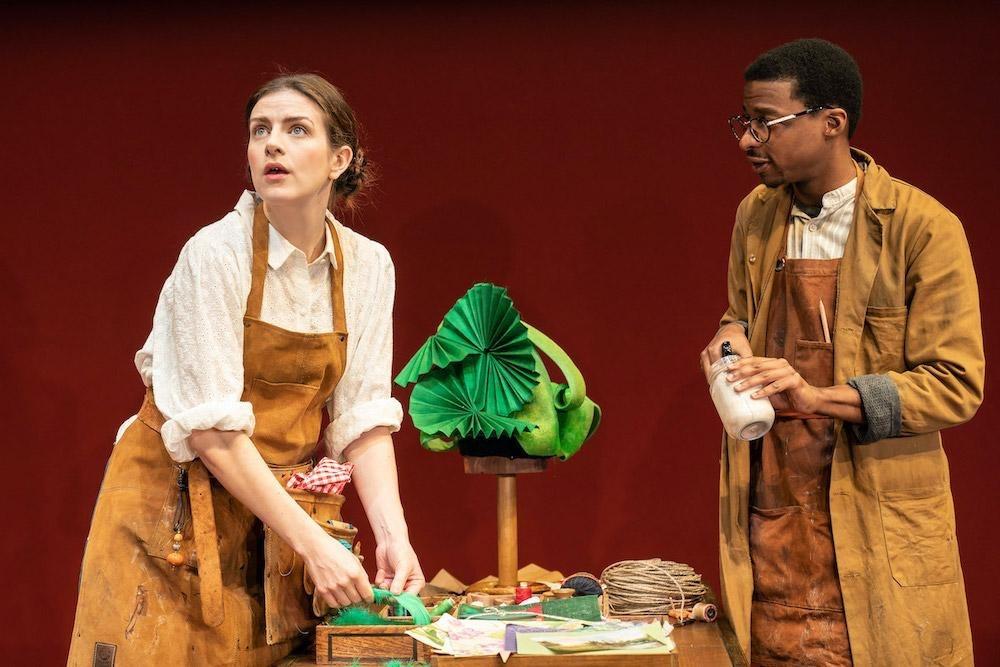
Aisling Loftus and Simon Manyonda in Caryl Churchill’s Far Away, directed by Lyndsey Turner at the Donmar Warehouse (2020). Photograph by John Persson.
Epic Theatre, The Absurd, and the Theatre of Cruelty
Several twentieth-century theatrical movements prepared the ground for this changing relationship among text, performance, and audience. Epic theatre, the theatre of the absurd, and the theatre of cruelty all challenge conventional dramatic identification, although they do so through different techniques and for different purposes.
Bertolt Brecht’s epic theatre breaks the fourth wall and aims to make the audience think about what is happening on stage without complete identification or catharsis. Direct address, commentary, visible stage devices, and a deliberate distance between the audience and the action emphasize that what is being watched is a constructed performance. Social, economic, political, and everyday realities can therefore be presented critically. The spectator is encouraged to think rather than surrender completely to fear, pity, or emotional identification. Brecht (1964) argues that “a critical attitude on the audience’s part is a thoroughly artistic one” (p. 140). In a recorded discussion of Brecht and comedy, Hans-Thies Lehmann likewise connects political theatre to a change in how spectators perceive and judge what they see, rather than to political subject matter alone (Vaciu, 2017).
The theatre of the absurd questions human existence, alienation, and meaning after World War II through a different and often provocative style. Samuel Beckett is a central figure, and playwrights such as Harold Pinter, Caryl Churchill, and Tom Stoppard employ related devices in distinct ways. Repetition, incomplete or illogical structures, long silences, strange exchanges, mysterious characters, and cyclical actions weaken the expectation of a single plot or stable meaning. Language itself may fail to establish connection between characters. The form of the play thus embodies meaninglessness, alienation, and the difficulty of communication.
The theatre of cruelty also changes the spectator’s relationship with what is presented. Traditional drama often reports violent or immoral acts rather than showing them, partly because theatre was expected to teach a lesson or create catharsis. Contemporary theatre breaks with this convention by presenting what had previously been considered unpresentable. Violence, screaming, disturbing sound, close settings, and performance among the audience can make spectators experience the event as participants rather than detached observers. Violence may still serve political, cathartic, or instructive purposes, but it can also aim to provoke a lasting effect that goes beyond conventional catharsis. Works associated with these changing practices include Waiting for Godot (1953), Endgame (1957), The Birthday Party (1958), Rosencrantz and Guildenstern Are Dead (1966), Top Girls (1982), Saved (1965), Blasted (1995), Frozen (1998), and Mercury Fur (2005).
Continuity, Rejection, and the Contemporary Stage
Their techniques and purposes differ, but they demonstrate how twentieth-century theatre questioned stable plots, unified meanings, conventional language, and the passive position of the audience. They also show that postdramatic theatre cannot be reduced to a single style. Describing postmodernism, postmodern theatre, and postdramatic theatre from an academic standpoint is therefore difficult. Their multiple meanings are also among their defining characteristics. These works continue earlier theatrical traditions while rejecting simple, conventional, and causal representations of reality. The changing stage opens new discussions of sexuality, gender, power, knowledge, violence, and other social phenomena. To understand contemporary theatre, it is necessary both to review earlier theoretical inquiries and to observe the continuing changes in literary and performance practice.
The continuing relevance of this shift can also be seen in Lyndsey Turner’s 2020 production of Caryl Churchill’s Far Away at the Donmar Warehouse. The encounter between Joan and Harper (Figure 2) places the performers’ bodies, gestures, and proximity at the center of the theatrical image. Such visual and spatial relations shape the spectator’s experience alongside Churchill’s dramatic text.

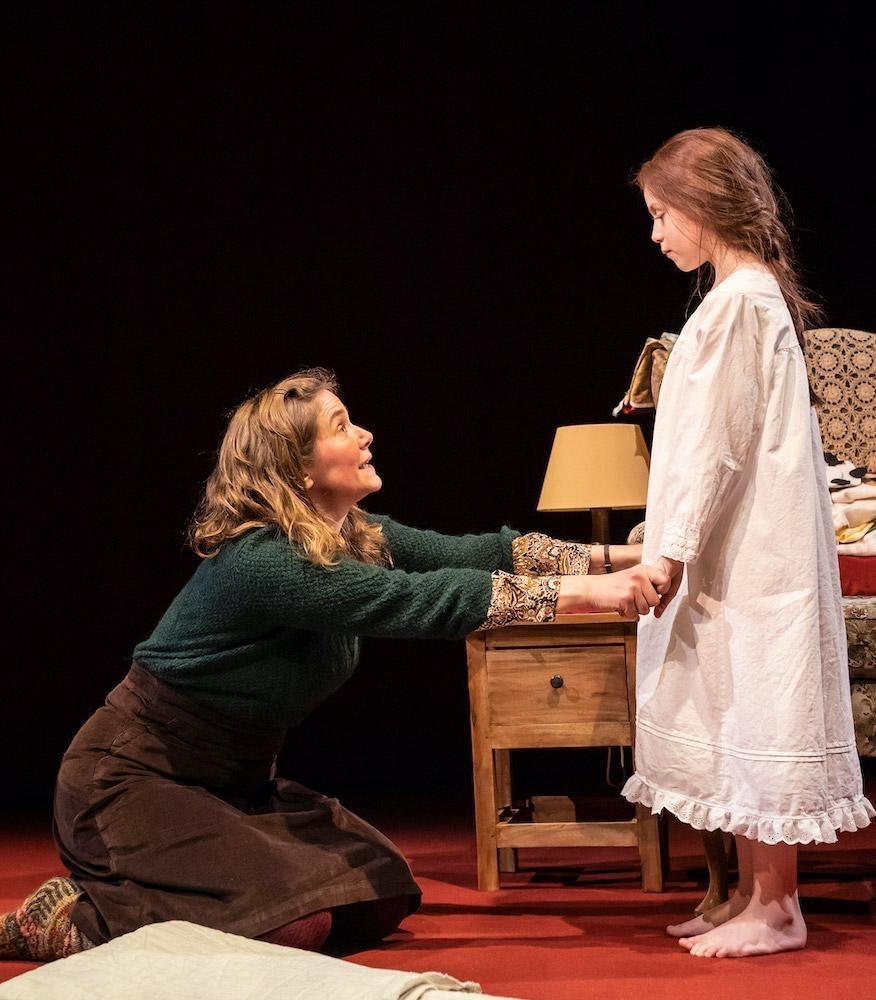
Jessica Hynes and Sophia Ally in Caryl Churchill’s Far Away, directed by Lyndsey Turner at the Donmar Warehouse (2020). Photograph by John Persson.
References
Bolton, T. (2025, August 8). Far Away at Ambika P3. Plays International. https://playsinternational.org.uk/far-away-ambika-p3/
Brecht, B. (1964). Short description of a new technique of acting which produces an alienation effect. In J. Willett (Ed. & Trans.), Brecht on theatre: The development of an aesthetic (pp. 135–147). Hill and Wang.
Hutcheon, L. (2006). Postmodernism. In S. Malpas & P. Wake (Eds.), The Routledge companion to critical theory (pp. 115–126). Routledge.
Jameson, F. (1984). Postmodernism, or the cultural logic of late capitalism. New Left Review, 146, 53–92.
Jürs-Munby, K. (2006). Introduction. In H.-T. Lehmann, Postdramatic theatre (pp. 1–15). Routledge.
Lehmann, H.-T. (2006). Postdramatic theatre (K. Jürs-Munby, Trans.). Routledge.
Lost Text/Found Space. (n.d.). Far Away. https://www.losttextfoundspace.com/far-away
Ruhl, S. (2019, April 17). On Caryl Churchill. People’s Light. https://www.peopleslight.org/blog/2019/sarah-ruhl-on-caryl-churchill/
Vaciu, I. (2017, June 12). Hans-Thies Lehmann, German theatre researcher: Comedy, Brecht and the theatre of Germany today [Video]. YouTube.
This post was written by the author in their personal capacity.The opinions expressed in this article are the author’s own and do not reflect the view of The Theatre Times, their staff or collaborators.