



On a recent trip to Scotland, I was fortunate to attend the opening night of The Prime of Miss Jean Brodie, an adaptation of Muriel Spark’s 1961 novel by well-known Scottish playwright David Harrower. I say ‘fortunate’ because the play’s short run at Edinburgh’s Royal Lyceum Theatre was immediately sold out.
Today Spark’s novel can be considered a modern-day classic, frequently adapted for film, television and the stage – in 2003, similarly at the Royal Lyceum, a production, helmed by Siobhan Redmond was highly praised. In 1969 the novel morphed into an award-winning film, in which Maggie Smith played Brodie, receiving an Academy Award as Best Actress.

The Prime of Miss Jean Brodie. Photo credits: Mihaela Bodlovic.
The present adaptation, directed by Vickie Featherstone, opens on Chloe Lamford’s stage set, resembling a university lecture theatre, or perhaps, more accurately, a miniature amphitheater, where a group of young women are reminiscing about their schooldays when they were part of what was dubbed ‘The Brodie Set.’ They voice divergent opinions about their former teacher, Miss Jean Brodie, posing an important question about the reason for her downfall: who at the school betrayed her, causing her to lose her job and retire before she was ready? Before an answer is reached, the action races back in time to the Marcia Blaine private girls’ school in 1931, where Miss Brodie (Gayle Rankin) is intent on turning six ten-year-old girls into independent, free thinkers, or, as she claims, “the crème de la crème” of Edinburgh society. The clash between Brodie and the school authorities becomes evident the moment the head, Miss Mackay (Maureen Beattie), strides onstage. The two women are like chalk and cheese; Brodie, tall, slender, and ‘in her prime,’ dressed colorfully in a tight leather skirt and flowing blouse, Mackay, slightly stooped and middle-aged, sporting shades of grey. Gayle Rankin’s Brodie is magnetic, exuding energy as she asks her girls – she never calls them pupils or students – how they feel and, in her turn, confiding in them about her own heartache; her fiancé, Hugh, was killed fighting in the First World War. Her passionate nature shines forth as she recounts her trips to Florence, where she delights in Renaissance art, Italian food and wine, expressing her admiration for the Italian fascist leader Benito Mussolini. Instead, Maureen Beattie’s Calvinist Mackay, refuses to be beaten. She firmly and repeatedly advises Brodie to stick to the curriculum. According to Mackay, the girls should be composed and obedient if they are to achieve the necessary exam results to move up the school. Two very different mindsets collide, producing moments of dramatic tension, fueled by anger and frustration on Brodie’s side and dogged determination on Miss Mackay’s. Instead, several intimate exchanges among the students reveal Spark’s ability to delve deep into the fantasy world of these ten-year-olds. Sitting alone, Sandy Stranger and her best friend, Jenny Gray, engage in a furtive conversation in which the former reveals how she is writing a romantic story, featuring Miss Brodie and her fiancé – he has survived the war and their relationship is allowed to develop.
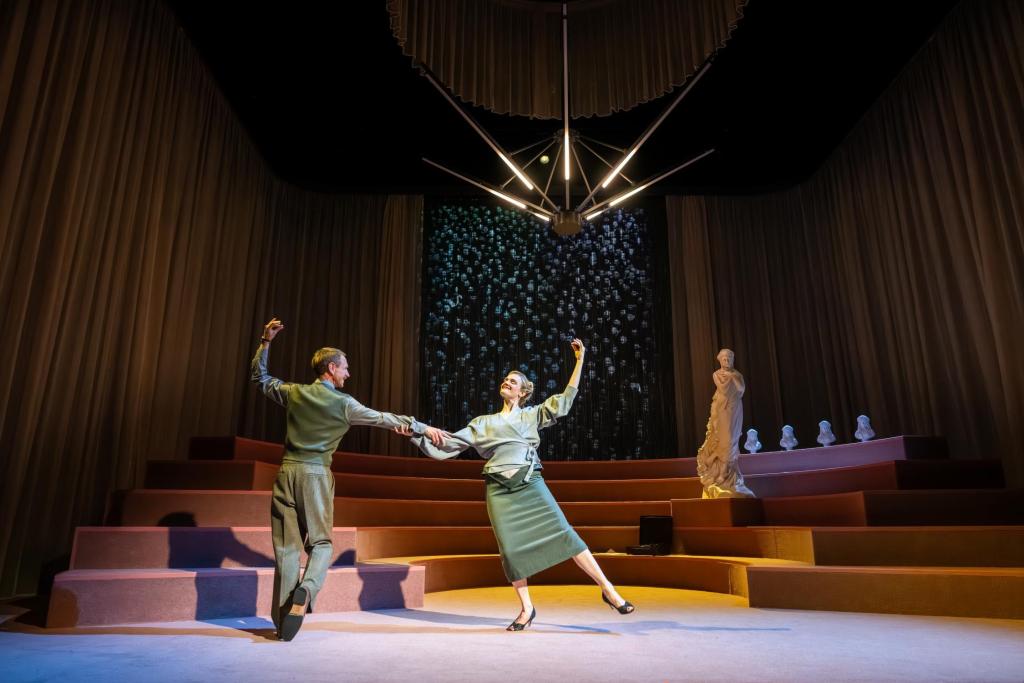
The Prime of Miss Jean Brodie. Photo credits: Mihaela Bodlovic.
An unusual love triangle involves Brodie, the music teacher, Mr. Lowther (Brian Ferguson), and the art teacher, Mr. Lloyd (Dyfan Dwyfor). Lowther is in love with Brodie, despite their diverging religious views and teaching methods, and proposes marriage. To Jean’s embarrassment, having pulled a ring out of his pocket, the man goes down on his knees asking her to marry him. More than her few words of rejection, Gayle Rankin’s anguished grimace conveys Jean’s state of mind, as she struggles to decide between marriage and giving up her job (in the 1930s women were still not allowed to teach) or to continue with her independent life.
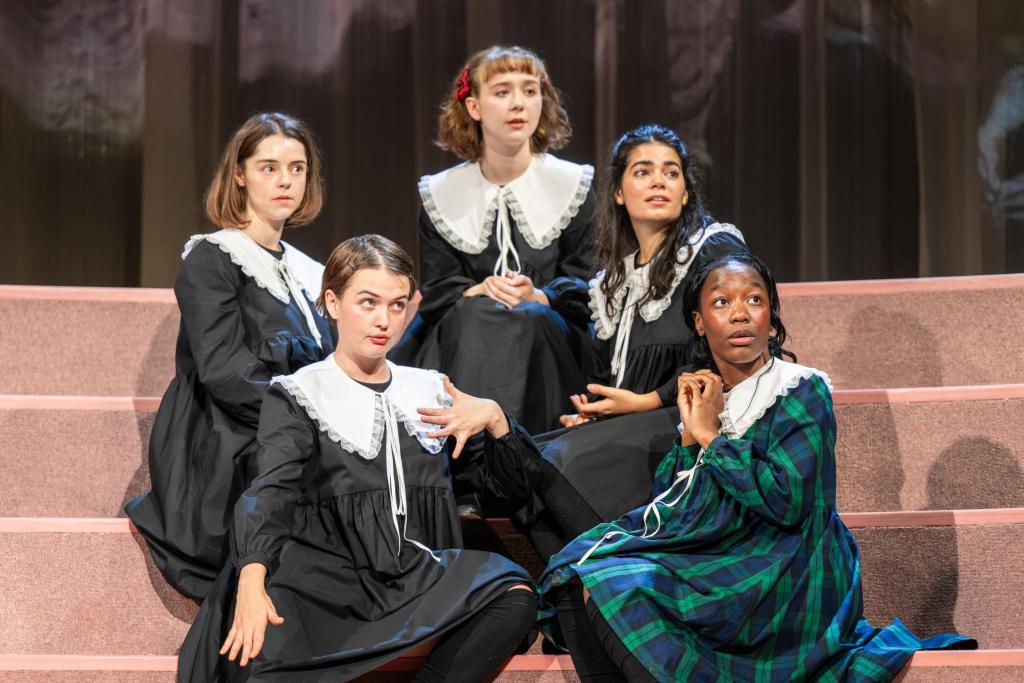
The Prime of Miss Jean Brodie. Photo credits: Mihaela Bodlovic.
Brodie, instead, is in love with Lloyd. In a scene, in which a huge projection of Sandro Botticelli’s Venus looms large, enhancing the dialogue, Lloyd discusses the sensuality of the Goddess and her power to evoke passion, causing Brodie, followed by her girls, to run quickly offstage. While a non-conformist in some respects, Brodie pulls back because Lloyd is a married man with five children. Instead, she chooses to sublimate her feelings, encouraging him to invite the girls to his house and paint the picture of one of them, but each painting looks more like Brodie herself. It is at this point that the teacher’s manic control over her students and her colleague comes to the fore. She repeatedly asks the girls about their visits to Lloyd’s house, wanting to know every detail about his home life. There is a dark side to her personality which is obsessive, and unheeding. In the end, it is Sandy Stranger, Brodie’s favorite, who sees through her teacher and has the courage to bring about her downfall by reporting her Fascist views to the Head.
The fine performances of this outstanding ensemble, together with Vickie Featherstone’s fine staging of Harrower’s adaptation, and Gayle’s Rankin’s truly mesmerizing Jean Brodie, were greeted by a long, enthusiastic applause. After Edinburgh, the production by Scotland’s National Theatre, with the support of the Royal Lyceum theatre and Pitlochry Festival Theatre, is scheduled for a Scottish tour.
This post was written by the author in their personal capacity.The opinions expressed in this article are the author’s own and do not reflect the view of The Theatre Times, their staff or collaborators.
This post was written by Margaret Rose.
The views expressed here belong to the author and do not necessarily reflect our views and opinions.