



To read PART I of this interview, go to this link.
Un procès – après l’ennemi du peuple Un Procès, [EN: A Trial – after An Enemy of the People], by Christiane Jatahy & Wagner Moura, from Brazil.

Un Procès – après l’ennemi du people, 2026. Photo credits: Christophe Raynaud de Lage, Festival d’Avignon.
In an entirely different vein, Un Procès (A Trial), a sequel to Ibsen’s An Enemy of the People, created by Christiane Jatahy and Wagner Moura, from Brazil, was more a conversation with Ibsen’s play than an adaptation. They revisit Ibsen’s play, rewrite it, in fact, and make it into a contemporary courtroom drama addressed to today’s issues – the ecological disaster, the relationship between science and politics, between power and truth in our age of fake news.
The background story is well known. When Doctor Thomas Stockmann discovered that the waters of his spa town were contaminated, he tried to warn the authorities and alert the population, only to be publicly discredited and censured as an “Enemy of the People” and exiled, accused of endangering the local economy. He has returned to defend himself again and seek justice.
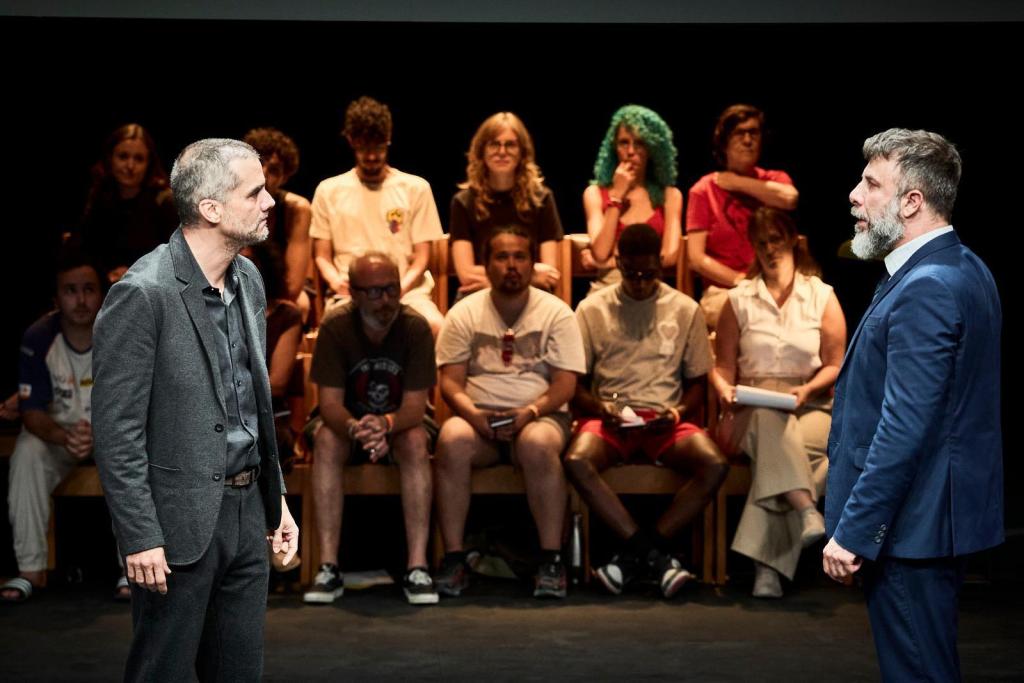
Eleven Members of the official jury are chosen from the audience at random at the start of each performance. They are seated upstage on the jury benches. There are no lawyers or judges. They question the witnesses, some of whom are actors improvising their responses while others are on Zoom. They evaluate the evidence and testimonies, film footage and documentary writing, and announce their judgment at the end of the play.
Among the many who speak out there are those in favor of Thomas Stockmann and those who had found him guilty during the first trial. Audience members are invited to decide for themselves as well.
Stage left seated at a long table, Thomas Stockmann and his daughter, Petra listen intently to the proceedings, clearly anxious, and totally involved. You can feel their urgency. Directly across from them, Thomas’ older brother Robert and his associates sit in judgment at another long table. Thomas has returned from exile, determined to exonerate himself once and for all while Robert will prove once again that Thomas is an “Enemy of the People.”
Un Proces – après l’ennemi du people, 2026. Photo credits: Christophe Raynaud de Lage, Festival d’Avignon.
No longer able to sit silently, Petra takes the stage to passionately defend her father. Her intervention is especially moving. Her desperation, palpable. She reveals the suffering her family has had to endure in exile. Her father was crucified, in her words, and her mother died of depression. Unable to continue, she bursts into tears and falls to the ground sobbing. To add to her despair, a video is shown in which we see Petra’s mother crying while her son consoles her. Surely the jury cannot help but be moved.
Central to the proceedings is the confrontation between the brothers as they present their opposing arguments, facing each in the center of the court.
Thomas argues that the trial is not about him but about an individual’s right to speak out, to defend his personal integrity. “Do I need to be absolved?” he asks. He is the voice of the people, the voice of truth. His anger and frustration get the better of him and he breaks down in tears.
Robert, on the other hand, remains stalwart as he sides with the silent majority and once more brands his brother “an enemy of the people.” His arguments have not changed since Thomas was found guilty in the first trial, during which he accused his brother of harming his community that is dependent on their paychecks. What good is the truth if those who work at the spa have no way to survive? Clearly the brothers will never agree.
In the end, it is up to the jury. They retire to deliberate. And as for us, the audience, we are left to decide for ourselves. The night I attended the play, the jury decided in favor of Thomas Stockmann. As did I and most of the audience it seemed. I wonder what the outcomes have been in other countries where the play has been performed.
*****************
Casting Lear, after King Lear by William Shakespeare, Andrea Jiménez.

Casting Lear, Andrea Jiménez, 2026. Photo credits: Christophe Raynaud de Lage, Festival d’Avignon.
The authors of this fascinating take on Shakespeare’s Lear, Andrea Jiménez, director and actress from Spain and co-director Ursula Martinez have created a play in which Jiménez plays Cordelia to a different actor playing Lear each night. When asked about her motivation for this unusual interpretation, Jiménez has explained in interviews that she is trying to solve her own family struggles using Shakespeare. Especially her relationship to her father who cut ties with her after she told him she wanted to do theater.
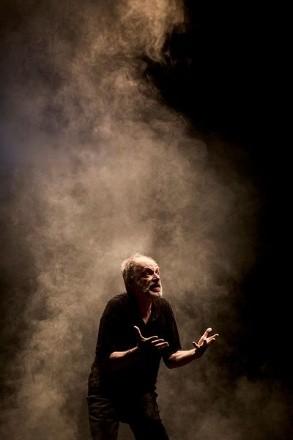
The actors she chooses to play Lear each night are unaware of what is expected of them. There are no prior rehearsals. They must have no knowledge of having seen this show before and they must be of the approximate age of her father. And they must follow her instructions. There were only two performances of Casting Lear in Avignon and I was fortunate to get tickets to one of them. July 24. The night I saw the show, Lear was played by Eric Ruf, former Administrator of the Comédie Française.
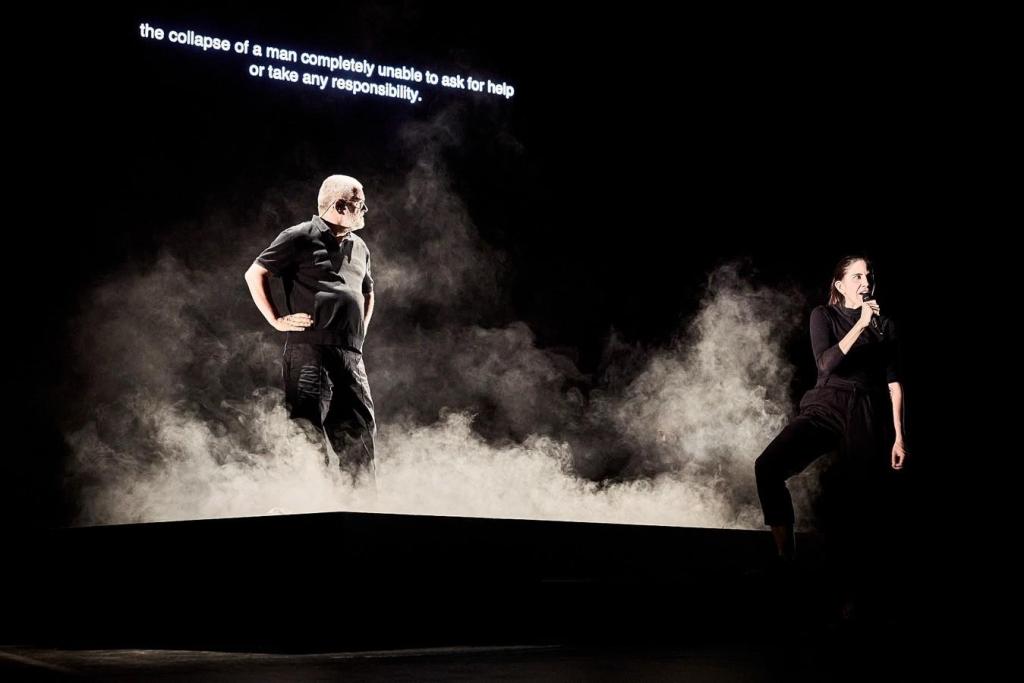
As the play began, Eric Ruf came out on the empty stage, looking somewhat bewildered, puzzled is perhaps a better word. He was clearly wondering what was expected of him. “Am I Lear?” he asked Andrea who answered with “Are you a good father?” and proceeded to let him know her plan for him. She intends “to explore his fragility,” reminding him that he repudiated his daughter Cordelia. “I am trying to solve my own family struggles using Shakespeare,” she tells him. “To free myself from them.” Ruf must follow her instructions which are fed to him through an earpiece connected to a prompter played by Matthieu Luro, while Andrea directs him. He agrees and faithfully follows her instructions throughout the ninety minutes of their on-going venture. It was fascinating to watch Eric Ruf’s reactions to Andrea’s unexpected requests. He clearly was startled at times – amused perhaps at others. There are moments of sitting and “talking” together as they seem to grow closer. At others, he simply follows her “commands,” even stripping naked to play Lear’s descent into madness performed during a violent storm. Andrea directs Ruf to leave the stage and wander through the audience, embodying “the collapse of a man completely unable to ask for help or take any responsibility.” It is not a surprise that he falls into the lap of one of the audience members, the festival director Tiago Rodrigues who greets him with humor and affection.
Casting Lear, Andrea Jiménez, 2026. Photo credits: Christophe Raynaud de Lage, Festival d’Avignon.
In the end Andrea gives Ruf a copy of an e-mail she has written to her father and asks him to read it in silence. He must not share it with the audience. We can only imagine the contents. Ruf’s fury says it all.
The final scene of Casting Lear is very touching. “How do you forgive? How is it possible? Have you ever forgiven?” Andrea asks Eric/Lear. One cannot help but feel the affection that has grown between them throughout the performance. Yet, in the end, there is no resolution. Lear does not forgive Cordelia. A father has disowned his daughter. And another actor will play Lear to Andrea’s Cordelia.
*****************
Tg STAN ‘s 1, 2, 3 Poquelin
1, 2, 3 Poquelin, tg STAN, 2026. Photo credits: Christophe Raynaud de Lage, Festival d’Avignon.
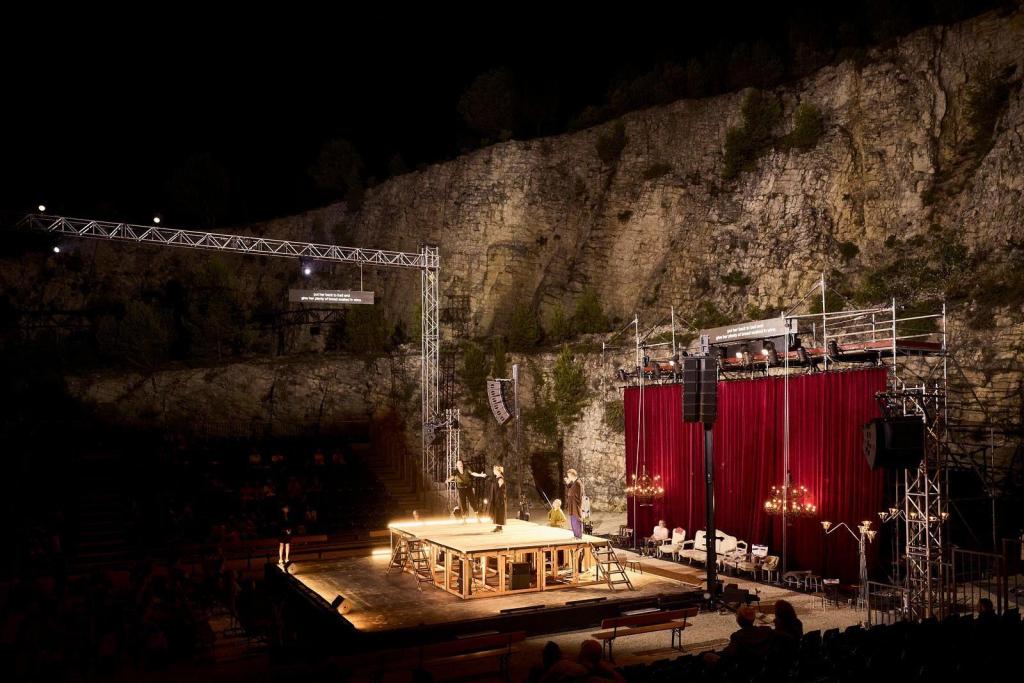
It is always a pleasure to journey out to The Boulbon Quarry (some 15 miles from Avignon) to see what the festival offers each year in this overwhelming natural setting. This year the well-known Flemish company tg STAN offered 1,2,3 Poquelin, a tribute to Molière, performed by eight actors playing some forty characters throughout an evening of five hours. It was definitely worth the trip.
I found it refreshing to discover a no-frills tréteau stage in the middle of the cliffs, a large elevated wooden platform with stairs on all sides to accommodate the multiple comings and goings of Molière’s characters. Next to the stage, an open space was reserved for prompters, company members who supplied missing lines when called for. Another stage composed of a large ruby-red velvet curtain, two impressive chandeliers hanging from the scaffolding and a few fancy chairs seemed to serve only as a reference to Versailles, a reminder, perhaps that Molière wrote his plays for Louis XIV, his patron.
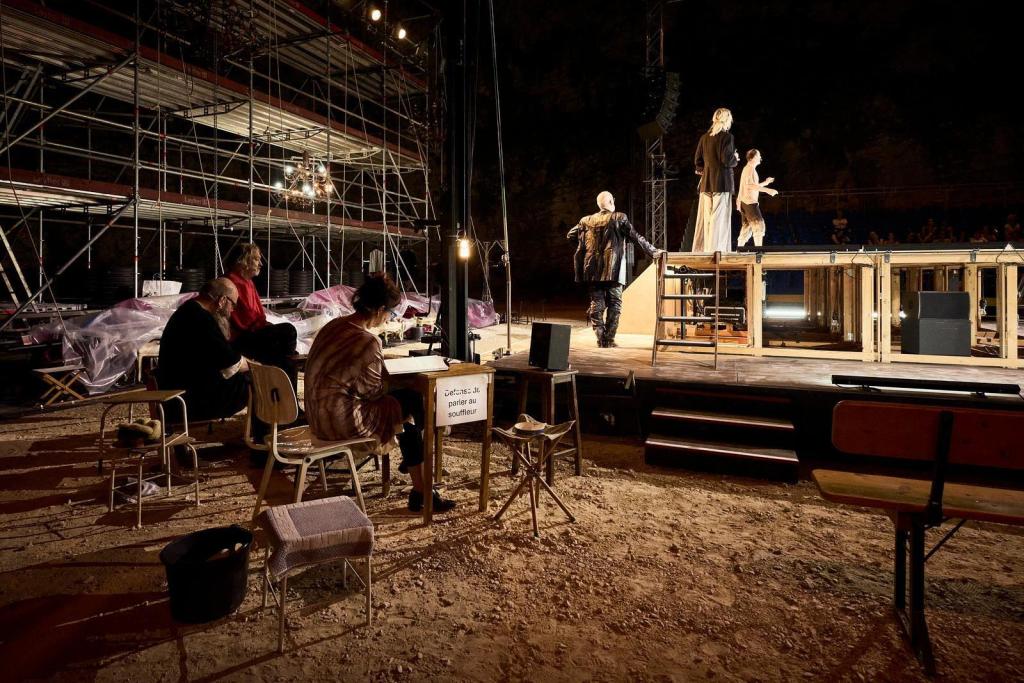
The “prompters” in 1, 2, 3 Poquelin, tg STAN, 2026. Photo credits: Christophe Raynaud de Lage, Festival d’Avignon.
When we arrived, company members were milling about, smiling and welcoming us to their fair ground. With tg STAN, one feels at home. At last, one of them shouted: “Let’s all get to it!” and the delightful evening began. We were introduced to familiar characters taken from five of Molière’s farces, The Imaginary Invalid, The Doctor in Spite of Himself, The Miser, The Forced Marriage, The Learned Ladies, and The Egotists (?). Hypocrites, pseudo intellectuals, sycophants, pedants, snobs and pretentious ladies entertained us in rapid succession. One barely had time to recognize a character before the next one appeared in a different role. Rapid fire asides, playful jostling, ringing necks, and of course multiple beatings with pool noodles, all of the tricks of farce were masterfully exploited to create a world of recognizable types, familiar figures in Molière’s plays, as well as today’s. To be a miser, to make stupid decisions, to be forced to do anything without one’s consent, or to be a learned lady without the credentials, one could easily name a number of our contemporaries. Clearly, these Flemish actors know how to capture our attention. And hold it for five delightfully entertaining hours.
*****************
My final show, Le Pas du monde, by Collectif XY from France, a company of twenty-two acrobats, circus performers, singers, and artists flying through the air in the Cour d’honneur promised to be a most welcome closing event. Spectacular!!


Le Pas du Monde, Collectif XY, 2026. Photo credits: Christophe Raynaud de Lage, Festival d’Avignon.
The Collectif XY, an exciting French company of contemporary circus performers and artists was scheduled to present four performances of their new show Le Pas du Monde as the Cour d’honneur‘s final offering on July 25. It would be refreshing to marvel at these young artists rather than have to depend on supertitles for Portuguese, Spanish, Korean, and Italian, as exciting as these shows have been.

Le Pas du Monde, Collectif XY, 2026. Photo credits: Christophe Raynaud de Lage, Festival d’Avignon.
My ticket was for the 25th. It was pouring rain and a large crowd had gathered outside of the Palais des papes in hopes that Tiago would announce that the “show would go on.” To the disappointment of all, he had to cancel the evening. As ticket holders began to disperse, Tiago suddenly announced that the company had agreed to come out onto the square to share a few numbers from Le Pas du Monde with the disappointed spectators – in the pouring rain! This was great news but I worried that performing their “aerial poetry” on the slippery cobblestones was extremely risky. I held my breath.

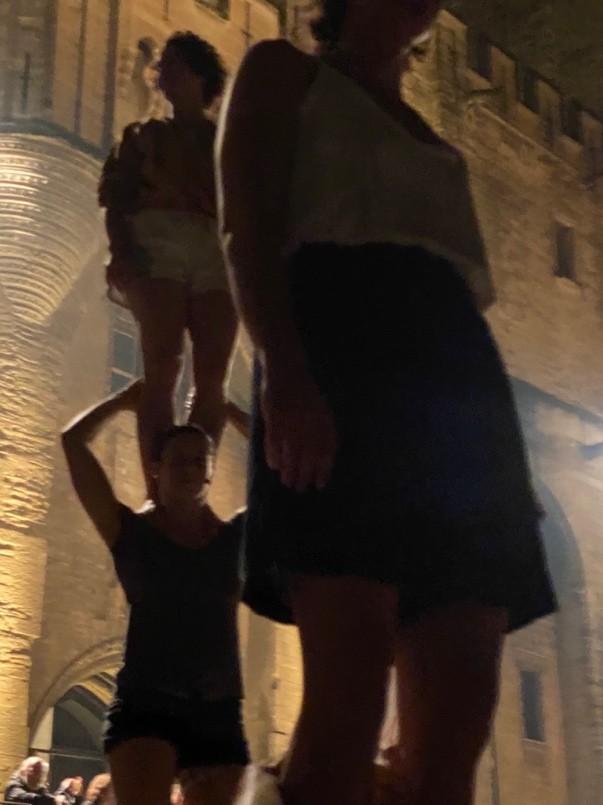
Le Pas du Monde, Collectif XY, outside of the Cour d’honneur, in the rain. Photo credits: Philippa Wehle, Festival d’Avignon 2026.
Squeezed in among the standing crowd of 2000, next to three of the XY company members, I wasn’t even aware that I had clicked my camera, and this photo is one of my lasting memories of the 2026 festival. I post it in tribute to their courage and generosity. Jumping, diving, and climbing on each other’s shoulders as other members of their group sang in the rain – it was breathtaking! Once more Avignon had fulfilled its promise of exciting discoveries and lasting memories.
This post was written by the author in their personal capacity.The opinions expressed in this article are the author’s own and do not reflect the view of The Theatre Times, their staff or collaborators.
This post was written by Philippa Wehle.
The views expressed here belong to the author and do not necessarily reflect our views and opinions.